This article is for informational purposes only and does not constitute financial advice. Always do your own research before making investment decisions.
26 May 2026 · 3 min read · 0
Standard bank today. Still must-have tool or overrated asset?
Let's review idea to invest in Standard bank. You will see latest metrics, possible entry point, perspectives.
South Africa's largest bank, with strong financial performance and high shareholder returns, could be a solid foundation for long-term growth in your portfolio. In this review, we'll look closely at why Standard Bank has become a standard must-have asset for many long-term investors.
Key components of Standard Bank's success
A pan-African footprint. The bank operates in more than 20 African countries, expanding well beyond South Africa. That diversification spreads its risk and lets it earn in emerging markets with higher economic growth rates than its home base.
Profitability across every business line, with improving asset quality. The group's credit loss ratio — the cost of bad loans — improved over the year, falling from 83 to 73 basis points. A lower number here means fewer loans are going bad, which is exactly what you want to see in a lender.
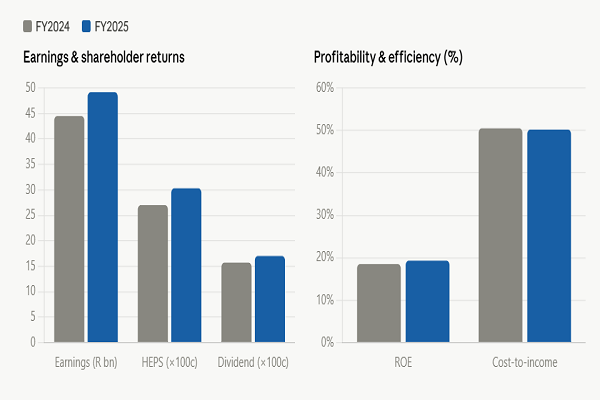
Headline numbers in the green. For FY2025, headline earnings reached R49.2 billion, and headline earnings per share rose 12% to 3,026 cents. The metric that matters most for a bank is return on equity, and ROE improved to 19.3% — at the top of the group's 17–20% target range. A sustainable ROE near 20% is a marker of a quality banking franchise, not a one-off.
A solid capital buffer. The group's CET1 ratio (its core capital cushion) stood at 13.8%, comfortably above its own >12.5% minimum — the buffer that absorbs shocks in a downturn.
Technical picture
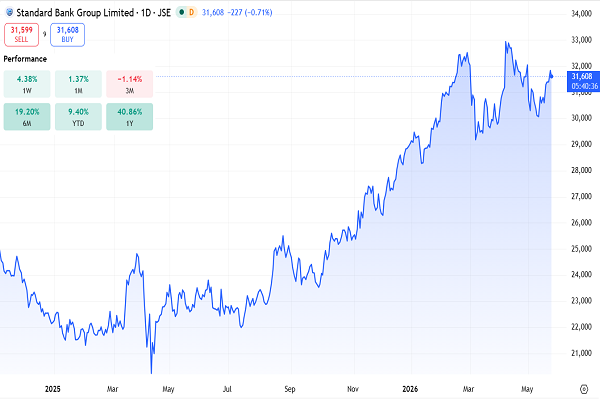
Standard Bank's chart is the kind you don't see often from a century-old bank: a confident uptrend, with the stock climbing strongly over 2026 and the past 12 months. Investors who bought at the start of 2026 were up roughly 9% by spring, while those who bought 12 months earlier were up around 40% — figures worth re-checking against a live chart before you act on them.
Oscillators are broadly neutral, but the moving averages are reading as a strong buy signal, and the recent price correction appears to have ended, with the stock turning higher again.
What moved the story in May 2026
In May 2026, Standard Bank became the most valuable bank in South Africa by market capitalization, overtaking its peers. Around the same time, Moody's revised South Africa's sovereign outlook from stable to positive (while keeping the rating itself at Ba2). It's an outlook change rather than a ratings upgrade but it's still a meaningful vote of confidence, leaving South Africa as the only G20 country currently on a positive outlook from Moody's, which is a constructive backdrop for the whole banking sector.
The fundamental speech
Analysts have stayed fairly conservative and broadly neutral, pointing to limited upside with the stock near its highs and to the risk of escalation in the Middle East, which could ripple into the global economy. For investors willing to look past those geopolitical risks, analyst estimates imply roughly 6% to 20% share-price upside over the next 12 months - conditional on the positive trend continuing in future results. Either way, the bank's financial stability is hard to dispute on the current numbers.
Conclusion
Standard Bank, founded in 1862, is not a name that invites much doubt. Despite a history spanning more than a century, its chart looks more like a fast-growing newcomer than a legacy institution but unlike a startup, it pairs that momentum with genuine financial stability and a lower (never zero) risk profile. So if you're weighing Standard Bank shares, the case is a reasonable one: it's built on real, reported numbers rather than marketing. As always, do your own research and size any position to your own risk tolerance.
This article has been published for information reasons. Do your own research upon investing. Author isn't responsible for consequences of following or not following recommendations since has no impact on the market.