
This article is for informational purposes only and does not constitute financial advice. Always do your own research before making investment decisions.
17 September 2026 · 5 min read · 0
Hyprop Investments Limited. Exciting idea for investing or another stock for watchlist?
For this time we will talk about idea to invest in property with the one of South African REIT - Hyprop Investments Limited. You will see details of their business, metrics, strategy.
Amid high interest rates, global market volatility, and general uncertainty, investors have increasingly turned back to real estate as a defensive asset class; predictable rental income, the mandatory dividend payouts associated with REIT structures, and low correlation with riskier equities make the sector attractive precisely when markets are jittery. South Africa’s listed real estate market is no exception: institutional investor interest in this segment of the JSE has grown significantly over the past year. Hyprop Investments (JSE: HYP) is a prime example - South Africa’s largest specialized retail REIT boasts a beta of just 0.22 (meaning its stock volatility is roughly five times lower than the broader market) while simultaneously seeing its share price rise by 28% over the last 52 weeks. We examine the story behind this performance and consider whether Hyprop is a worthwhile investment opportunity today.
Hyprop was incorporated in South Africa in 1987 and listed on the JSE on February 24, 1988; at that time, the company’s portfolio comprised just three properties (Hyde Park Corner, Boksburg Hypermarket, and two office buildings) with a total value of R94 million. Since then, the company has grown into South Africa’s largest specialized retail REIT, managing a portfolio valued at approximately R42 billion. Today, Hyprop’s South African portfolio includes landmark shopping centers: the super-regional Canal Walk; major regional properties such as Clearwater, The Glen, Woodlands Boulevard, Cape Gate, Somerset Mall, Rosebank Mall, and Table Bay Mall; and the smaller regional Hyde Park Corner. In addition to its South African operations, the company owns a portfolio in Eastern Europe - comprising The Mall in Sofia (Bulgaria), two City Center one locations in Zagreb (Croatia), and Skopje City Mall in North Macedonia, recently expanded to include Galleria Burgas in Bulgaria.
Under the leadership of CEO Morné Wilken, the company exited higher-risk African jurisdictions and focused on two markets: South Africa and Eastern Europe. Notably, its portfolio is dominated not merely by commercial real estate, but specifically by shopping centers and malls.
Fundamental and technical analysis for Hyprop Investments
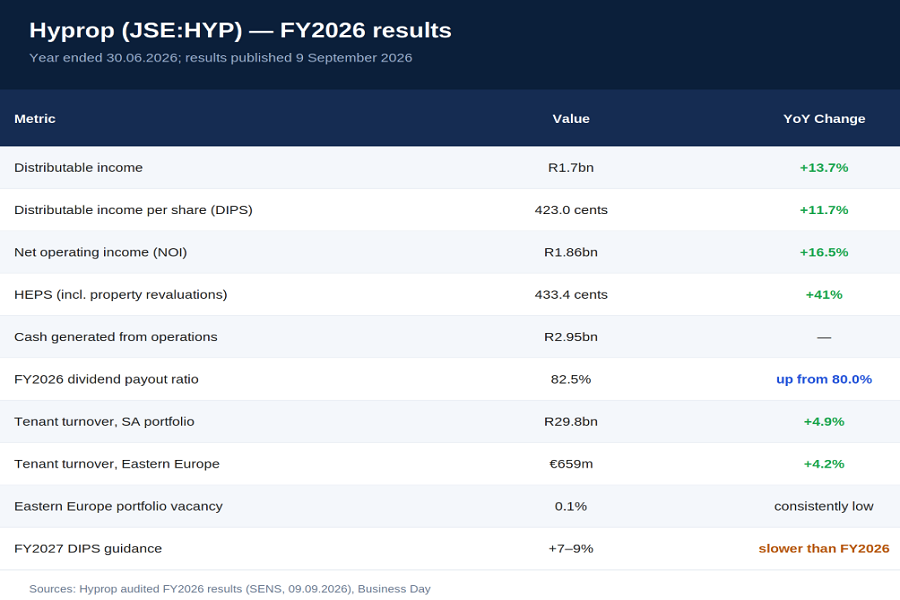
On September 9, 2026, Hyprop released its audited results for the 2026 financial year (ended June 30, 2026), and they were strong. Distributable income rose by 13.7% to R1.7 billion, while distributable income per share (DIPS) increased by 11.7% to 423 cents—hitting the upper end of the initial 10–12% forecast range. Net operating income grew by 16.5% to R1.86 billion, and operating cash flow stood at R2.95 billion.
Portfolio operating metrics are also strong: tenant turnover in South Africa rose by 4.9% to R29.8 billion, and in Eastern Europe by 4.2% to €659 million, while the vacancy rate in the Eastern European portfolio remains at an exceptionally low 0.1%. The balance sheet continues to strengthen.
On the chart you can see a weak upward trend. Such companies typically exhibit high volatility, yet this one appears to be the most stable, thanks to its focus on specific markets and property types, combined with an extensive asset portfolio, geo-diversified.
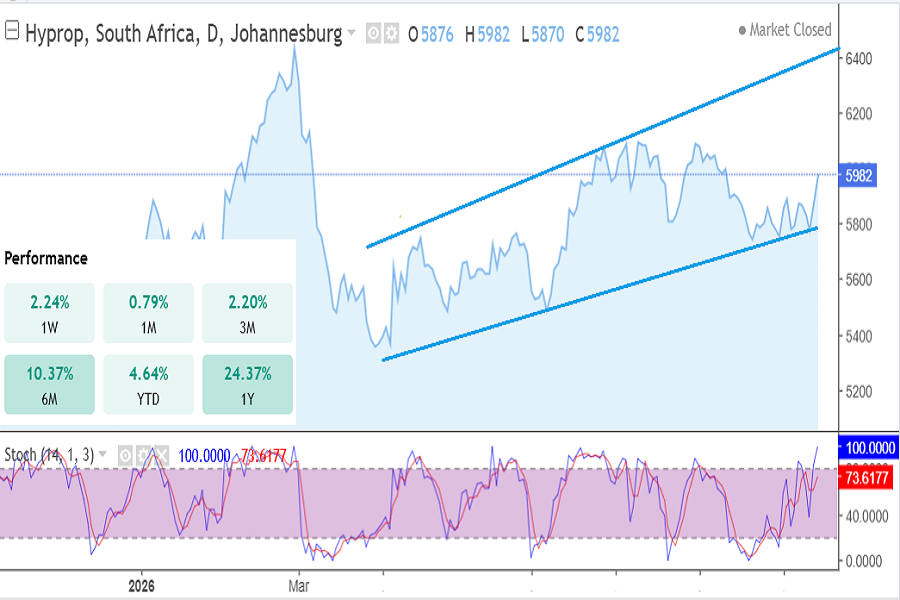
Hyprop Investments stocks on JSE, September 2026
Over the past 12 months, we have observed steady growth with significant pullbacks but ok for REIT. In reality, this is far from the limit. Peaks twice as high were reached in 2017, although analysts currently consider the present price to be justified rather than undervalued.
Technical analysis indicators suggest otherwise, pointing to an unequivocal signal - Strong BUY.
SWOT point of view on Hyprop stocks
Hyprop is no longer the story of deep undervaluation it was a couple of years ago; it has evolved into a mature, defensive, dividend-paying stock characterized by accelerating payout growth, a robust balance sheet, and some of the lowest volatility on the JSE. The company has successfully transitioned from a risky Pan-African portfolio to a focused "South Africa + Eastern Europe" model, simultaneously reducing its debt burden and increasing its payout ratio. The flip side of this maturity is that the stock is no longer "cheap" in the traditional sense: following a 24% gain over the past year, it trades close to its Net Asset Value (NAV) rather than at a significant discount, and analyst opinion is divided on how much upside remains.
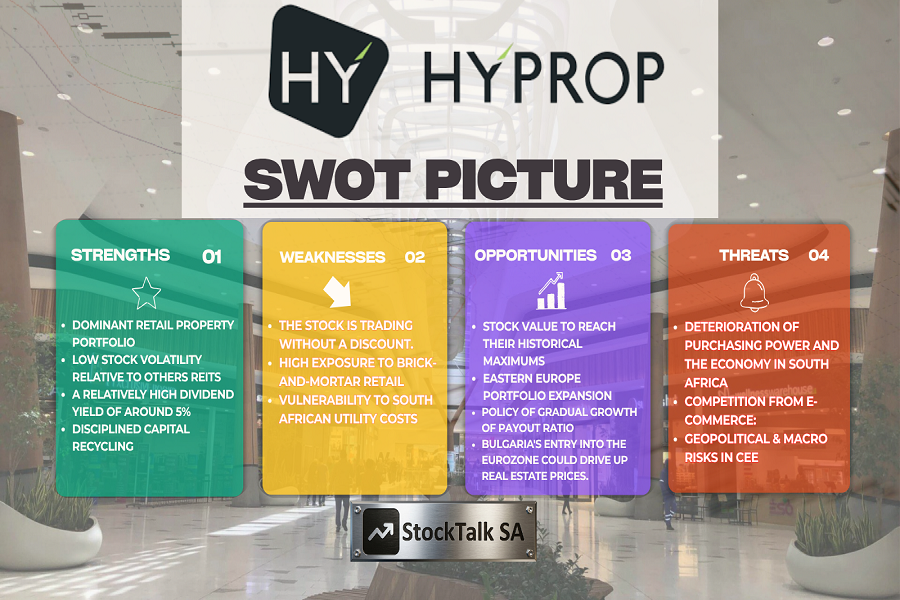
SWOT of investments in Hyprop stocks on JSE
Bull case.
If Hyprop continues to seamlessly integrate its Eastern European acquisitions (primarily Galleria Burgas) and the board maintains its policy of gradually raising the payout ratio above 82.5%, the dividend yield and its growth trajectory will remain attractive, especially given the likelihood of further interest rate easing in South Africa. Bulgaria’s adoption of the euro, alongside structural reforms in South Africa’s energy and logistics sectors, could drive a re-rating of the entire listed real estate sector (not just Hyprop), thereby boosting institutional capital inflows into defensive, dividend-focused investments. Under this scenario, the analyst consensus price target could be revised upward, following actual results that are currently outperforming the company’s own forecasts.
Bearish scenario.
Management’s FY2027 forecast (+7–9% in DIPS) signals a growth slowdown following a strong FY2026. If high interest rates and weak consumer demand in South Africa prove more persistent than anticipated and if the EUR/ZAR exchange rate works against unhedged Eastern European revenue. The stock (having already rallied 28% and trading near NAV) risks failing to attract new buyers at current levels and could pull back to the lower end of its 52-week range (around 4,380 ZAc). An additional risk stems from ongoing share issuances (a 4.1% increase in shares outstanding over the year): if capital raising to fund Eastern European expansion continues at this pace, it could dilute DIPS and NAV per share faster than the business itself grows.
Idea of investing in the Hyprop Investments: summary
Today, Hyprop represents a high-quality, defensive dividend play on the JSE with genuine operational momentum: double-digit growth in distributable income, a strengthening balance sheet, near-zero vacancy rates in its Eastern European portfolio, and an increased payout ratio. It is no longer the deep-discount-to-NAV story it was in 2023–2024. The market has largely priced in that narrative and the stock is now better suited for investors seeking a stable, growing dividend stream with low volatility rather than those hunting for significant undervaluation.
Key factors to watch going forward include whether the company can maintain DIPS (divedends per share indicator) growth near the upper end of its new guidance (7–9%), how the integration of Galleria Burgas unfolds, and whether dilution from additional share issuances begins to outpace the growth of the business itself?