This article is for informational purposes only and does not constitute financial advice. Always do your own research before making investment decisions.
1 October 2026 · 12 min read · 0
Datatec ltd: The South African AI rally you missed and underrated?
Foreign companies linked to AI and data centers are skyrocketing. What about South African Datatec? Foreign companies linked to AI and data centers are skyrocketing. What about South African Datatec? I their 34.5% annual growth is just a beginning or their maximum? Let's find out.
US companies selling the "picks and shovels" of artificial intelligence and data centres have become the stars of the stock market. Against that backdrop, Datatec's 34.6% gain over the past year looks modest, and since the start of 2026 the share has barely moved. Its US peers look very different: since the start of the year Insight Enterprises is up 89% and Arrow Electronics almost 99%. Yet Datatec has just reported one of the best years in its history. HEPS rose 56.5%, and CEO Jens Montanana links that growth directly to demand for IT infrastructure that is becoming more complex because of AI adoption.
That raises an obvious question: if the business is growing on AI demand while the share lags its US peers, is the market undervaluing it? To answer, we need to understand how Datatec actually makes money, and who it should really be compared with?
About Datatec Limited and Peers on the US Stock Market
Founded in 1986, Datatec Limited is today an international information and communication technology (ICT) group with a presence in over 50 countries worldwide.
Key operating divisions:
Westcon-Comstor (Westcon International): A global specialist distributor of networking, cybersecurity, and cloud technology solutions. It works with major vendors (Cisco, Palo Alto Networks, Fortinet, F5, Check Point, etc.).
Logicalis: An international systems integrator and managed IT services provider. Logicalis designs, builds, and maintains hybrid cloud infrastructures, private networks, and data centers for enterprise clients.
Mason Advisory: A UK-based consulting division specializing in IT strategy and digital transformation.
The key point for investors is that Datatec is neither a chipmaker nor a data centre owner. It is an intermediary between technology manufacturers and corporate customers. Its revenue grows with corporate IT budgets, but the middleman's margin is thin: gross profit is about 11.7% of gross invoiced income, and EBITDA about 3.2% (my calculation from FY26 figures).
The right US peers are therefore not Nvidia, but distributors and integrators:
Arrow Electronics (ARW): a distributor of electronic components and enterprise IT solutions. Its enterprise computing division is similar to Westcon, but its core business is tied to the semiconductor cycle.
TD SYNNEX (SNX): the largest IT distributor and Westcon's closest peer. Fittingly, in 2017 Datatec sold Westcon's US business to SYNNEX.
Insight Enterprises (NSIT) and CDW (CDW): resellers and integrators whose model is close to Logicalis.
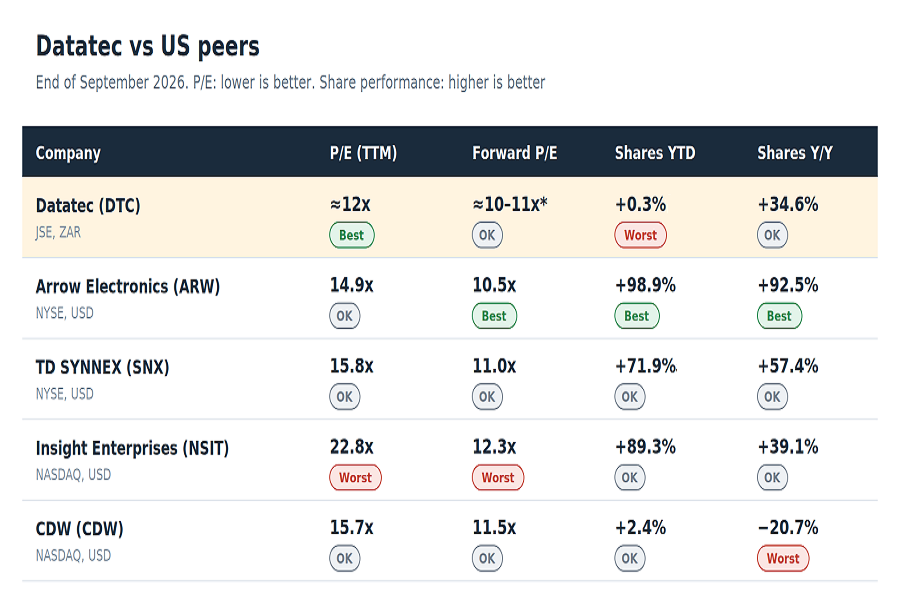
Datatec comparison with US companies
This is where the comparison gets uncomfortable for Datatec. Over 52 weeks Arrow rose 92.5%, TD SYNNEX 57.4% and Insight 39.1% (StockAnalysis, 28–29 September 2026). Datatec gained 34.6%, and since the start of 2026 it is almost flat. Only CDW looks worse, with a decline of 20.7%.
Why? There are four reasons.
First: US peers found new earnings drivers in 2026. According to Harbor fund's quarterly letter, Arrow rose almost 50% in the second quarter alone on the back of the AI infrastructure build-out. It also beat earnings expectations and launched a buyback of almost 10% of its shares. Insight grew adjusted EPS by 44% in the second quarter and raised its full-year guidance, with management directly linking margin expansion to AI-related demand. Datatec has published no new figures since its May results; interim results are due in late October or November.
Second: Datatec already had its rally and gave it back. By June 2026 the share reached an all-time high of about R99.70, roughly 24% above its level at the start of the year. After the General Atlantic deal was announced (19–22 June), it fell back to around R80. A direct causal link cannot be confirmed, but the logic is clear (hypothesis): the deal valued Westcon at $950 million before debt, about 5.5 times annual EBITDA (my calculation). The market got an external valuation anchor lower than expected, together with external debt at 9% and a minority shareholder with warrants.
Third: currency. The peers are priced in dollars, while Datatec is priced in rand even though it earns in dollars. Based on the exchange rates Datatec used to convert its own dividends, the rand strengthened from about R17.50 per dollar (December 2025) to R16.07 (July 2026), roughly 8%. The same dollar earnings turned into fewer rand.
Fourth: market structure. In the US, thematic ETFs and technology indices automatically buy companies like these when interest in AI rises, and each is covered by between 4 and 11 analysts. The JSE has no such mechanism for mid-sized technology companies and the stock is covered only by one analyst. In these conditions, earnings growth takes longer to reach the share price.
Fundamental and technical review for Datatec stocks
Latest financial report was strong. According to it profit growth is outpacing revenue growth, indicating operating leverage: fixed costs remain under control, while each new major AI infrastructure integration or cybersecurity contract yields higher margins.
The main story is further down the income statement: EBITDA grew 21.6% to $269.1 million, profit after tax rose from $69.3 million to $108.7 million, and HEPS increased 56.5% to 39.9 US cents. Underlying EPS (the measure management considers most important) was 47–49 cents according to the trading statement, up 32–37%. ROIC rose by 510bps to 21.6%.
By segment:
Westcon International: gross invoiced income of $5.74 billion (+9.6%), adjusted EBITDA of $172.4 million (+15%).
Logicalis International: gross invoiced income of $2.14 billion (+11.8%), adjusted EBITDA of $114.5 million (+21.8%). Management called the result "exceptional".
Logicalis Latin America: gross invoiced income of $524.9 million (slightly lower), but adjusted EBITDA up 20.9% to $24.3 million.
Management outlook: FY27 is expected to be stronger than FY26, although the company warns of supply chain volatility.
The General Atlantic deal (June–August 2026). The biggest event of the year came after the reporting period. Investment firm General Atlantic bought 5% of Westcon for $25 million and provided Westcon with a six-year $375 million loan at 9% a year. Together with the partial refinancing of an intercompany loan, Datatec received about $434 million (about R7.1 billion) and is returning this money to shareholders as a special dividend. Datatec keeps control of Westcon.
The deal has two sides. On the plus side, it gives an external valuation of Westcon. According to TechCentral's calculation, General Atlantic's entry price implies an equity value for Westcon of about $500 million after debt and about $950 million before debt. On the minus side, the group now has external debt with interest of about $34 million a year, and part of Westcon's profit now belongs to a minority shareholder (Financial Mail notes that with warrants, General Atlantic's stake could rise to 8.7%).
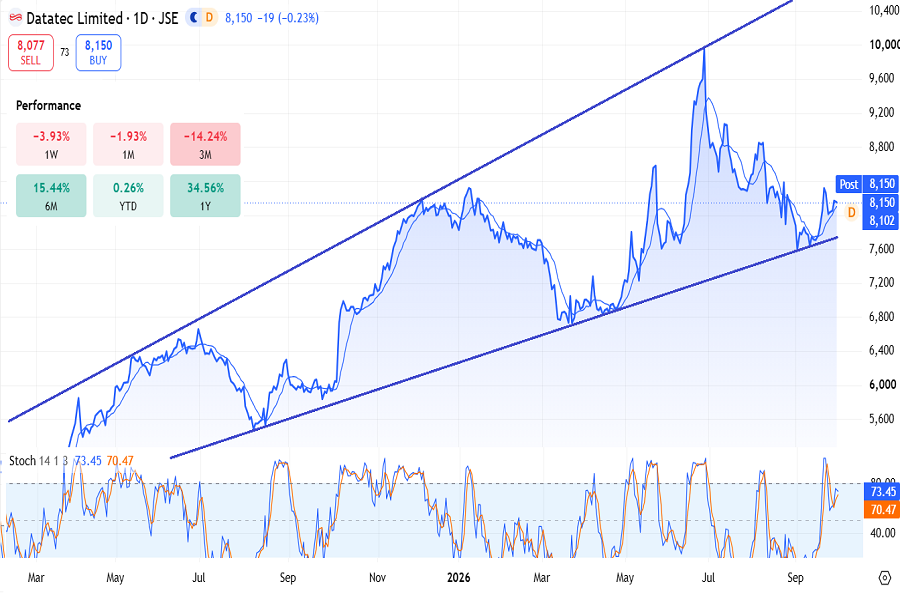
Datatec Limited stocks - September 2026
The chart shows an upward wave-like trend, suggesting the imminent start of a rally - a new wave following a price correction. While this may well happen, it could take longer than desired; the delay is not due to negative factors or the company's debt obligations. In fact, the situation presents a favorable opportunity for existing shareholders. The announced special dividend payouts will cause the share price to drop by up to 30% - a technical decline. For those planning to buy, this also offers a chance to purchase shares at a discount.
This will take place in mid-October, followed by the release of a new report - an event that could certainly trigger a rally driven by expectations of potentially strong results for the reporting period.
Datatec's Dividend policy
Datatec has a long-standing shareholder-friendly policy, combining regular dividends with occasional special payouts funded by the sale of non-core assets. Ordinary dividends are declared in dollars and paid in rand twice a year. For FY26 the company paid 24 US cents: an interim of 10 cents (R1.75) and a final of 14 cents (R2.25). A year earlier they were 4 and 11.2 cents respectively.
Payout policy: The company aims to pay dividends covered approximately 2.0x–2.5x by adjusted earnings (HEPS).
Current dividend yield: Approximately 4.5%–5.5% (in ZAR/USD terms), a highly attractive figure for the technology integrator sector (US peers such as CDW or SNX typically offer yields in the 1.0%–2.0% range).
Payout sustainability: Low debt levels and consistent free cash flow ensure highly reliable payouts, with the potential for further double-digit growth in line with HEPS.
Special dividends are Datatec's hallmark. The company regularly sells assets or raises capital and returns the money to shareholders:
2017: about $500 million after selling Westcon Americas to SYNNEX;
2021: about $70 million after Westcon repaid loans;
2022: R12.50 per share after selling 70% of Analysys Mason;
2026: R29 per share (about R7.05 billion) after the General Atlantic deal, payable on 16 October 2026. Shareholders can elect to receive new shares instead of cash.
For scale: according to Financial Mail, total shareholder return over five years was about 570%, of which share price growth contributed about 234% and the rest came from dividends. That is why share price performance alone understates how much Datatec holders have actually earned.
SWOT analysis of an investment in Datatec
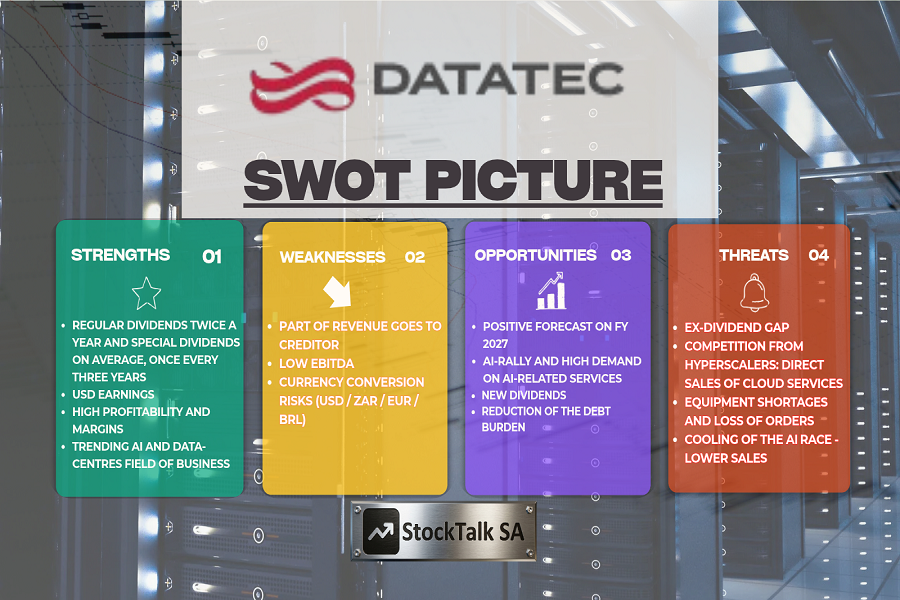
SWOT-analysis of investments in Datatec
Datatec's strengths as an investment are fast-growing earnings, management's habit of returning capital to shareholders through special dividends, and strong alignment of interests: the founder-CEO owns about 18% of the company. There is an extra advantage for a South African investor: the business earns in dollars, so the share offers partial protection against a weaker rand.
The weaknesses stem from the business model. Datatec is an intermediary with EBITDA of about 3% of gross invoiced income. After the General Atlantic deal, the group has external debt at 9% a year, and part of Westcon's profit now goes to a minority shareholder. As a result, AI demand flows through to Datatec's earnings far more weakly than to the earnings of chip and hardware manufacturers.
The opportunities lie in the group's structure itself. Based on General Atlantic's valuation, the market values Logicalis at almost nothing (my calculation and a hypothesis), and the company's history shows that every sale or partial monetisation of an asset ends in a special dividend.
The threats are mostly external: pressure from manufacturers on distributor commissions, slowing corporate IT budgets and supply disruptions. For a rand-based holder there is also a flip side to dollar earnings: when the rand strengthens, rand earnings fall. The nearest risk is purely psychological: the ex-dividend gap of about R29 may scare those who don't know about the special dividend.
Bottom line: Datatec is not an AI rocket story, but a story of hidden value and capital returns. The valuation already reflects some of the risks, but a noticeable re-rating needs a catalyst.
Forecast for Datatec Limited
Moving beyond dry tabular data and rigid point targets, let us examine three fundamental scenarios for Datatec’s development, based on the company’s business model, global trends, and revenue structure.
1. Bull Case: "Unlocking Full AI Potential".
Scenario Overview: The global boom in enterprise AI shifts from the chip-procurement phase (Nvidia) to a phase of mass modernization involving network infrastructure, corporate data centers, and cybersecurity systems. Growth Drivers: The Westcon-Comstor subsidiary records double-digit sales growth for high-margin networking equipment and cybersecurity solutions in Europe and the US. Logicalis expands its margins through long-term managed service contracts, transforming from a one-off vendor into a key IT partner for major corporations. The market re-rates the stock, narrowing the historical "South African discount," as over 80% of the Group's revenue is generated in hard currencies (USD/EUR/GBP). Expected Outcome: The stock enters a phase of strong structural rally, hitting multi-year highs. Investors realize a double return: capital appreciation combined with regular special payouts and dividends.
2. Base Case: "Steady Value & Dividend"
Scenario Overview: The company continues to grow at its current pace, gradually improving operational efficiency without experiencing sudden revenue spikes. Growth Drivers: Moderate global organic growth in IT budgets of 3–5% annually. Management maintains strict cost control and continues the practice of returning free cash flow to shareholders through dividends and share buybacks. Share prices track earnings per share (EPS) growth and regular payout cycles. Expected Outcome: The stock maintains a steady upward trend with moderate growth that outpaces local inflation, while the primary source of investor return is a high dividend yield.
3. Bear Case: "Slowing IT Spending and Macroeconomic Headwinds".
Scenario Overview: A global economic slowdown leads to reduced corporate capital expenditure (CapEx) on IT infrastructure in key markets (Europe and the US). Risks and Factors: Project delays and extended contract approval timelines among major clients. Currency volatility (fluctuations in the ZAR exchange rate against the USD and EUR) temporarily adversely affects the Group's reported figures. The distribution business's low net margin puts pressure on the bottom line, even with a slight decline in sales volumes. Expected Outcome: The stock enters a prolonged sideways trading range (consolidation) or undergoes a moderate correction. However, high reserve levels and low debt protect the company from a sharp decline, while dividend payments act as a natural "safety cushion" for the share price.
Final conclusion: Datatec’s untapped potential
Datatec shares are a great find for those seeking an asset for passive dividend income. If the company continues to deliver strong results, it will reward its investors with generous dividends.
Does Datatec have untapped potential? Partly, yes. The business is on the rise: earnings are growing faster than revenue, the sales mix is shifting towards services and cybersecurity, management expects a stronger FY27, and a sum-of-the-parts valuation leaves Logicalis almost free. But Datatec's main return mechanism is not a rising multiple; it is capital returns. The company repeatedly monetises assets and pays the money to shareholders. The potential is unlocked through dividends, not through a "rocket" on the chart.
Is a rally possible? Possibly, but the mechanism has to be the same as for the US peers: earnings growth, not a change in market mood. Arrow and Insight rose 40–90% while staying in a forward P/E range of 10–12x. For Datatec, the next test is the interim results in late October or November. If they show that earnings are still growing at double-digit rates despite the new interest burden, the share has grounds to catch up with its peers. An additional accelerator would be a deal involving Logicalis or Westcon that locks in a higher valuation than the General Atlantic agreement. Without these catalysts, the gap with the US peers is likely to persist.