
This article is for informational purposes only and does not constitute financial advice. Always do your own research before making investment decisions.
15 June 2026 · 5 min read · 0 · Edited 8 September 2026
Spar group. Why Black Friday turned into red financial year?
Latest financial report for Spar group show R212 mln losses due to Black Friday promotions. Debts increased by +35.2%. So how "high season" for retailers turned into red financial period? Let's see.
Spar group: an impressive start and expansion to Europe
Spar Group is the story of a South African company that attempted to enter the international market under an international brand originating in the Netherlands. It became Spar International's first partner outside of Europe and one of the largest franchise operators.
The company achieved such scale that it was able to go public, issuing shares to attract investment. It has been listed on the Johannesburg Stock Exchange (JSE: SPP) in October 2004, entering the market as a disciplined, cash-generative business with a reputation for reliable dividends and steady growth. By 2018, shares traded at approximately R227 - a level that now feels like a distant memory. The group had operations across Southern Africa, Ireland, Switzerland, and Poland, with 32.1% of turnover generated in foreign currency. At its peak, SPAR looked like exactly the kind of defensive, geographically diversified retailer that long-term JSE investors could trust.
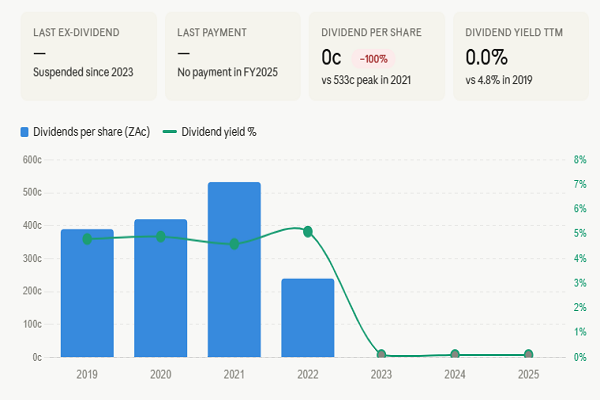
That trust has since been tested repeatedly. The company seemed like a surefire bet for investors: active expansion abroad in countries with the highest standards of living guaranteed sustainability, and the demand for food products at any time was confirmed during the most challenging times for business: during the Covid pandemic, the company was already under pressure, but profitability remained high and dividends were paid.
Spar group in 2025-2026
A few years later, we find a completely different company:
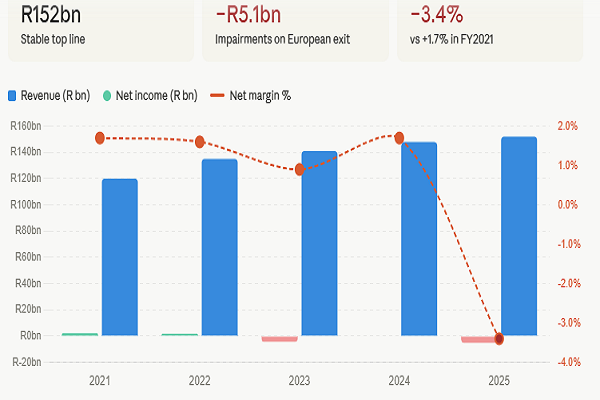
European expansion failed, resulting in billions in losses as the company struggled to compete with local retail chains.
Dividend payments stopped.
Financial reports shocked investors one after another.
The company's shares fell from 227R to 52 today. In particular the company loses 53% for the last 12 months.
The latest financial report is shocking: the company spent R212 million on Black Friday advertising. The campaign is failing, becoming one of its three expense items. The question remains: how could the company sustain losses in a place where all other retailers are making money and increasing turnover? Anyway latest Black Friday turned into long red 2025-2026 period. With successful promotion they could have +212 mlns revenue instead of losses but it's not.
The numbers behind the failure are telling: retail transactions actually fell 2.3% despite the increased spend, while gross margins were eroded by below-cost pricing and subsidies. The group tried to buy volume and loyalty. It got neither. Instead, it bought a R212 million hole in its income statement and an object lesson in the difference between promotional spend and strategic investment.
The KwaZulu-Natal Distribution Centre: R123 million drag
The KZN DC has been SPAR's most persistent problem since 2023, when a failed SAP ERP system rollout caused R1.6 billion in lost turnover and an estimated R720 million in lost profits. Years later, the wound has not fully healed. In H1 FY2026, the centre contributed another R123 million to the operating profit decline, driven by margin erosion from aggressive volume-chasing, out-of-stock peaks, and a logistics structure that simply wasn't equipped to handle the volumes being pushed through it. A R168.7 million lawsuit filed by the Giannacopoulos family — one of SPAR's largest franchisee groups — over the original SAP failure still hangs over the group.
Technical Analysis: A Long Downtrend Looking for a Floor
An 18-month downtrend looks like a dream come true for bears and traders, but not for investors who bought the stock. However, for new investors, the situation could be the opposite:
A price correction could occur at any moment
A trend reversal is likely
The entry price is minimal, and the recovery potential is enormous.
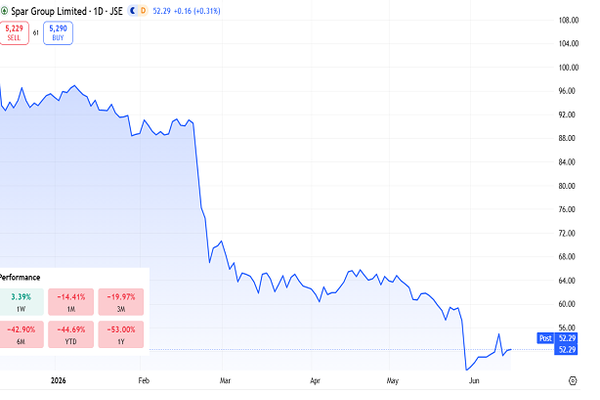
However, technical analysis indicators are pointing downwards. The company still can't find any growth drivers. Perhaps the next report will be better, and then the stock will start moving upward, but there's no guarantee that will happen. The company is showing rising debt in its reports.
Analyst Sentiment: Cautious, Not Panicked
To your surprise market experts are neutral or at least optimistic regarding Spar group. Asset still looks attractivable in terms of potential growth being extremely far from their maximums.
The average price target stands at approximately 13,483 ZAC, with a maximum estimate of 17,100 ZAC and a minimum of 11,100 ZAC. This consensus implies that sell-side analysts broadly believe the stock is undervalued at current levels but "undervalued" and "ready to recover" are not the same thing.
The Hold majority reflects a market that acknowledges the turnaround potential (new CEO, exit from loss-making European businesses, KZN stabilisation programme) but lacks conviction about the timing and reliability of that recovery.
Given SPAR's track record of disappointing on execution over the past three years, that hesitation is rational.
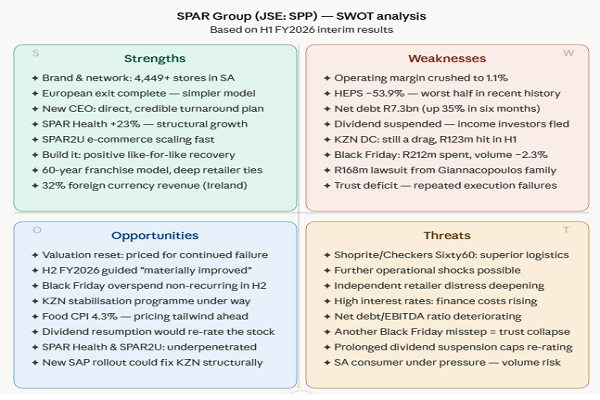
SWOT Analysis of investing in SPAR group Today
SPAR represents a turnaround-driven investment case:
Bull case: Execution stabilizes, KZN recovers, margins normalize → significant upside from depressed valuation.
Bear case: Continued operational failures + weak franchisee dynamics → prolonged value trap.
Verdict: SPAR is a high-risk, high-reward recovery story, where the outcome depends primarily on management’s ability to restore execution discipline and rebuild trust across its retailer network.
A Business That Can Be Fixed but not today
SPAR Group is not a dying business. It is a large, established franchised distribution network with genuine brand equity, a simplified post-European structure, and a new CEO who appears to understand what went wrong. The problems are real but they are, as Isaacs himself said, execution problems — not structural market failures.
The Black Friday disaster is a particularly useful lens through which to view the company's difficulties. Spending R212 million on promotional subsidies and watching retail transactions fall 2.3% is not a marketing failure: It is a systems failure, a symptom of a company that has lost alignment between its commercial strategy, its logistics capability, and its retailer relationships. Fixing that alignment is the job ahead.
For investors, the question is not whether SPAR can recover. It probably can. The question is when, and at what cost to shareholders along the way. The share price at R54–55 prices in a great deal of bad news. But a company that has disappointed repeatedly over three years has earned the market's scepticism. In this conditions we can't recommend this company for both investors and traders right now but can be added to watchlist to catch the future upward moment and a trend reversal.
Disclaimer: This article is for informational and educational purposes only and does not constitute financial advice. Author isn't responsible for following or not following recommendations, found in the article.