Grindrod special review. in search of new growth drivers after a rapid rally

Today we'll talk about a logistics company whose shares have risen 60% over the past 12 months, even after a decline in August. Grindrod (JSE: GND) shares were among the top three best stocks for the first half of the year. At the end of August, the company published its latest financial report. While it wasn't surprising, the figures confirm Grindrod's potential to remain profitable despite its dire dependence on Transnet.
Grindrod (JSE: GND): A Big Report, and Silence in the Dial
The stock, which has gained almost 60% over 12 months, publishes a report showing EBITDA growth of 52% and record volumes, and the market shrugs. We'll explore what's real in the report and why the silence in the stock isn't indifference, but a consequence of the events of two weeks ago.
Detailed Analysis of the Interim Report (H1 2026)
The company's financial report clearly divides Grindrod's business into two key areas: the rapid development of port infrastructure and moderate results in the continental logistics segment.
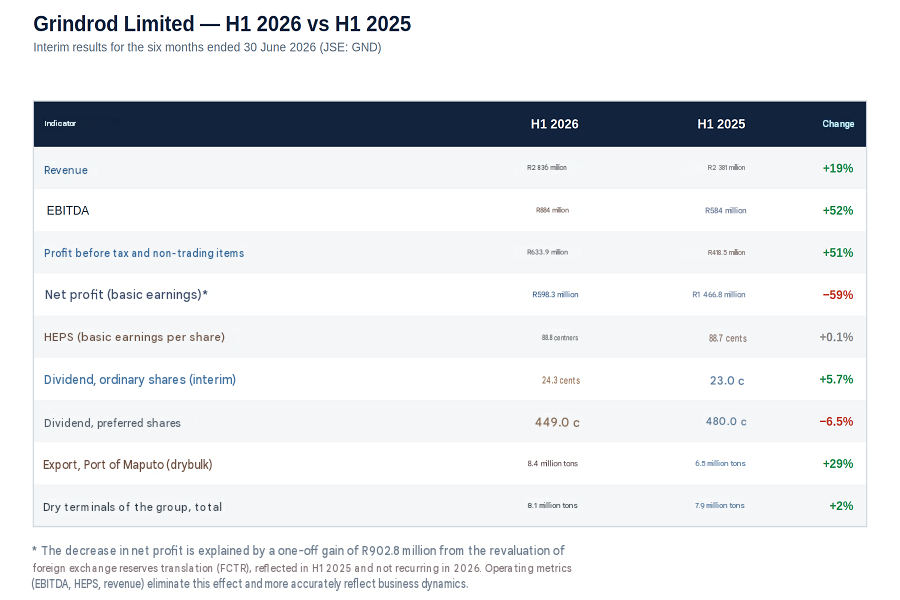
Grindrod Limited latest report for H1 2026
Port Segment and Maputo Record: The Port of Maputo remains the company's primary growth driver. In the first six months of 2026, dry bulk cargo transshipment through the company's own terminal reached a record 8.4 million tonnes, up from 6.5 million tonnes a year earlier (a 29% increase). This was supported by strong demand for coal, chrome, and ferrochrome exports, as well as the expansion of shipping channels from South Africa to Mozambique despite problems with the lines of South African national operator Transnet. The full consolidation of the Matola TCM terminal also supported Grindrod's EBITDA, increasing its operating margin from 25% to 31%.
Earnings and EPS A cursory glance at the financial statements may alarm investors by the fall in Basic Earnings from R1,466.8 million to R598.3 million (a drop of almost 59%). However, this decline is illusory and is caused solely by the effect of a high base from previous periods: In H1 2025, the company recorded a one-off non-cash gain of R902.8 million related to the release of foreign currency translation reserves (FCTR) on the buyout of the Matola stake and the exit from the marine fuel joint venture. Headline adjusted earnings per share (HEPS), which is the main benchmark for institutional investors in South Africa, remained stable: 88.8 cents compared to 88.7 cents in H1 2025. Cash generated from operations increased by 28% to R561 million, which allowed the board of directors to increase the interim dividend by 6% to 24.3 cents per share.
Why did the market react with flattened momentum?
Immediately after the report's release, Grindrod shares traded without any clear momentum. Over the past 12 months, the company's shares have already demonstrated a massive 60% rally, rising from R15.00 to a peak of R28.35. The lack of a dramatic price reaction is explained by several factors: The "buy the rumor, sell the news" factor. The market had already priced in the strong operating performance of the Port of Maputo. High chrome and coal export volumes were evident to analysts from the region's monthly trading reports. A muted HEPS figure. Despite a 52% increase in EBITDA, the final adjusted earnings per share showed virtually no growth (88.8 cents vs. 88.7 cents). Investors focused on rising capital expenditures, financial costs, and subdued performance in the logistics segment. Dependence on Transnet. The state of South Africa's rail infrastructure remains a constraint for Grindrod. A shortage of locomotives and supply chain disruptions from state-owned Transnet prevent Grindrod from fully exploiting the capacity of its land corridors.
Price chart analysis and technical picture
The daily chart of Grindrod (JSE: GND) shows a classic consolidation phase after a strong multi-month uptrend. You can see no signs of trend reversal - just a price correction which is likely to finish soon, given that downward momentum seems lost.
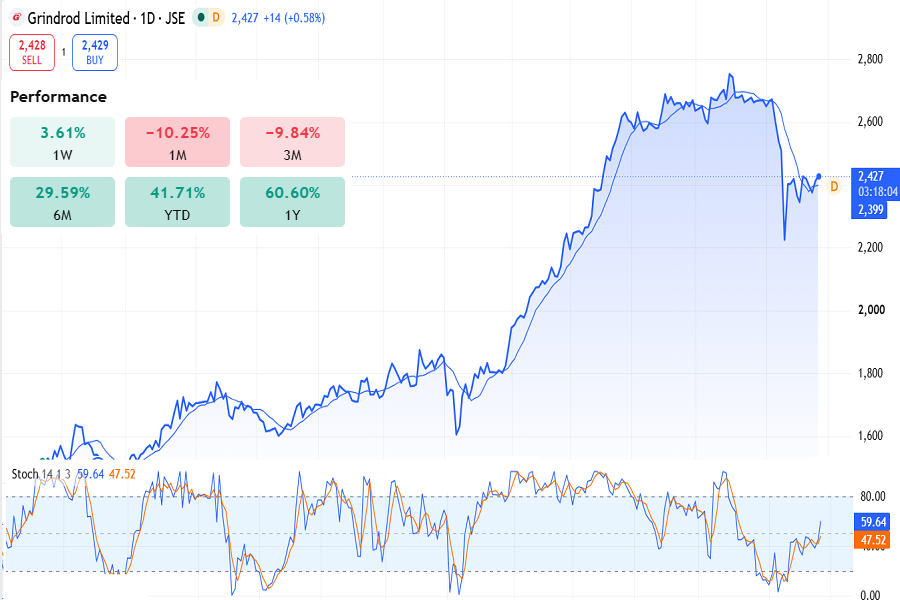
Grindrod stocks on JSE, August 2026
Stochastics (56.24/46.38) are in neutral territory, with no overbought or oversold signals, strived upward and %K slightly above %D - a weak, unconvincing hint of a momentum recovery. The MACD looks upward also.
At the same time most of moving averages still show a Sell and it seems a bit outdated. We would rate the chart as a chart with a buy signal.
SWOT: Grindrod as an investment vehicle
Grindrod is a rare asset on the JSE with a true infrastructure moat: its competitors couldn't build ports and terminals in a quarter, and record volumes through Maputo show that this moat is currently operating at full capacity.
At the same time, investors need to be able to distinguish between two different narratives in the financial statements: a stable operating business (EBITDA, HEPS, volumes) and volatile statutory profit, which fluctuates due to one-off foreign exchange items and says almost nothing about the quality of the business.
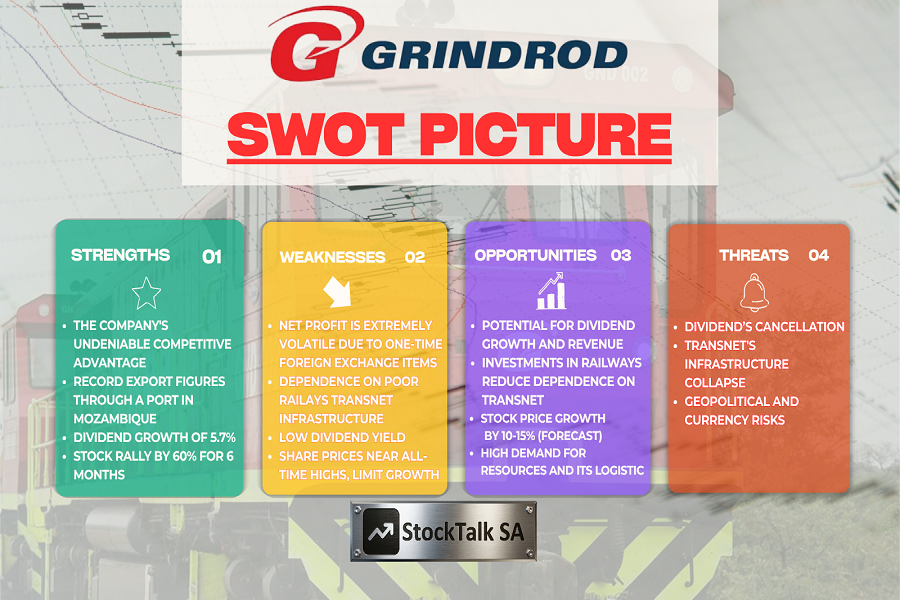
SWOT of investments in Grindrod, August 2026
Weaknesses are not fatal, but real: a localized drawdown in Mozambique, a fatal incident, a decline in the pre-dividend. Opportunities lie in continued infrastructure expansion and a potential revaluation by analysts; threats lie in the fact that after +60% year-on-year, the stock is no longer cheap, and its dependence on a single regional corridor and the rand remains.
If the Maputo dredging and Richards Bay expansion continue to convert into volumes as they have in the past half of the year, EBITDA momentum will be maintained, and the market will gradually begin to price in sustainable cash flow growth rather than peak quarterly profits—as evidenced by the move in Simply Wall Street's fair value estimate from R22.30 to R27.00, above the current price of around R24. The growing common dividend (+5.7%) and the presence of large institutional holders (PIC, Coronation, 36One) signal that smart money views the stock as a long-term story, not a speculative bounce.
After a 60% rally, the market no longer forgives the company any weaknesses—and there are some: Matola is in the red, labor safety is questionable, and the preferred dividend has been cut. If Maputo's volume growth slows even slightly in the second half of the year, rather than accelerating, the stock, already trading on elevated expectations, could face a downward revaluation—especially since the entire structure is heavily tied to a single regional corridor and the rand, whose volatility historically hits logistics business margins faster than revenue.
Summary for investors
Grindrod's H1 2026 earnings report confirmed the company's status as one of the key infrastructure beneficiaries in Southern Africa. The market's flat reaction is a natural pause after the 60% rally and the digestion of last year's one-time accounting effects. Investors should view Grindrod as a high-quality long-term growth story, anchored by its unique port asset in Maputo, where the key trigger for the next wave of growth will be the expansion of rail freight.
- If dividend income is your priority, Grindrod with 2.5% yield is a poor choice. There are much more profitable stocks in the South African market (retailers, banks, and telecoms like MTN/Vodacom).
- If growth stocks are your priority, Grindrod looks like a strong asset. The small dividend is more of a pleasant bonus here, as the company invests its capital in transforming Maputo into South Africa's main logistics hub.
The stock's retreat from its highs can be viewed as an opportunity to enter the market, as well as a discount, as consolidation suggests a high probability of a trend continuation. Therefore, Grindrod's success story in 2026 is far from over.

Stan Lytynsky
Stan Lytynsky is a well known financial expert with more than 1000 of market reviews. For the last 10 years he wrote reviews for different blogs and websites. In particular he worked for SuperForex and Zetradex forex brokers as a market analyst. Currently he is living in Canada and focused on the African market as the most promising and growing.
Comments
Loading comments…
Log in or sign up free to join the discussion.