StockTalk special review. Optasia Limited: first steps on the JSE and first report

John Nkosi
Yesterday, Optasia Limited (JSE: OPA) released a strong financial report. Did this newcomer to the JSE manage to impress investors with its phenomenal achievements and prove it is as trustworthy as companies with a 25-year trading history? We explore this in our review.
Optasia Limited is a Nigeria-based IT-fintech company, a startup boasting substantial market capitalization and investors that include FirstRand. It provides mobile operators and financial institutions with AI-based credit scoring and credit decisioning technologies, rather than issuing loans directly under its own name. It operates on a B2B business model. Today, the platform serves over 120 million active users across 38 countries, operating through 49 distribution networks and 13 financial institutions.
On November 4, 2025, the company made its debut on the JSE Main Board. The final offer price was R19.00 per share, resulting in a market capitalization of R23.5 billion, marking the largest South African IPO of the year and the biggest fintech listing since 2018. The Board of Directors was chaired by Michael Jordaan, the former CEO of FNB - a figure clearly intended to instill confidence in the listing among South African investors.
Ten months of trading: the first official results.
This marked the first time the company published a report as a publicly traded entity. The initial figures are impressive.
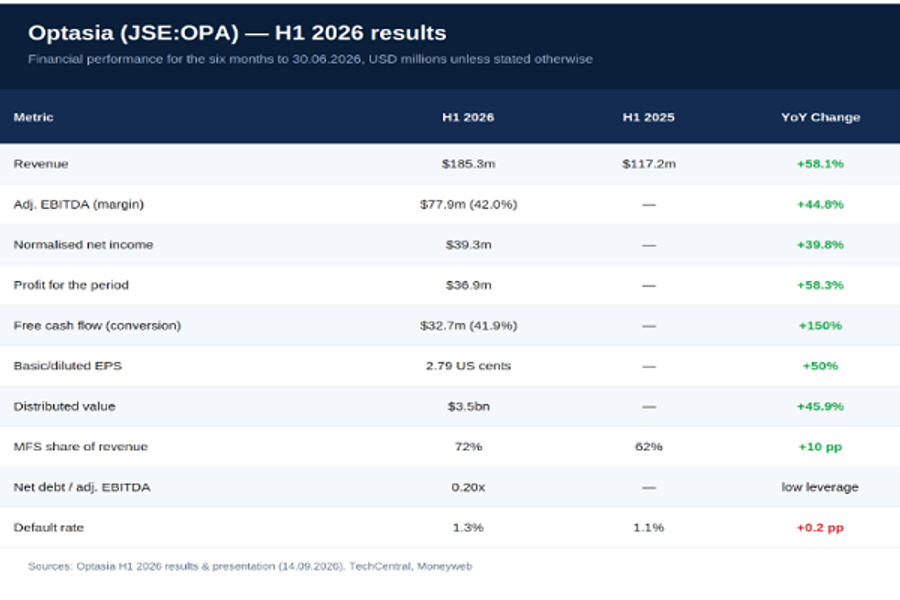
- Growth is outpacing profit, though not critically. Revenue for the six months ending June 30 rose to $185.3 million from $117.2 million a year earlier - a 58.1% increase. Adjusted EBITDA grew by 44.8% to $77.9 million, normalized net profit by 39.8% to $39.3 million, and profit for the period by 58.3% to $36.9 million.
- There is a structural shift toward mobile financial services (MFS). The share of MFS in total revenue rose to 72% from 62% a year earlier, reflecting a strategic pivot away from the less resilient airtime credit (ACS) segment. This is significant, as the ACS segment in Nigeria faced regulatory headwinds (details in the SWOT and risks sections).
- The quality of growth is strong. Free cash flow surged 150% year-on-year to $32.7 million, representing an EBITDA conversion rate of 41.9%. The take rate increased from 4.9% to 5.3%, while the delinquency rate rose only slightly—from 1.1% to 1.3%, supported by a robust coverage ratio of 4.0x.
- A virtually debt-free balance sheet. The net debt to adjusted EBITDA ratio stands at just 0.20x - a very conservative level for a growing fintech company.
Guidance raised. The company has raised its growth forecast for revenue, EBITDA, and normalized net income for the full year 2026 to 30–40%, up from the previous 25–35%.
What might investors dislike?
The stated annual target implies a sharp slowdown in growth during the second half of the year; at the lower end of the range, revenue could even contract. There are three reasons for this: the suspension of ACS accruals in Nigeria, the migration of a partner’s overdraft product onto the company’s own balance sheet across three countries (which reduces revenue more significantly than profit due to the product's low margins), and the normalization of currency effects.
A Non-Existent Dividend Policy of Optasia Limited in 2026
As a stock market newcomer and a young fintech company, the absence of dividends comes as no surprise. The company stated from the outset that any dividend payments would be made only on a residual basis. However, there is no share buyback program either; profits are being reinvested into organic growth. This is a pure growth story, where potential dividends or buybacks represent future upside rather than a current driver of returns.
Fundamental Analysis
In terms of valuation multiples, the stock is currently trading at a P/E (TTM) of approximately 24.9x and a forward P/E of around 17.4x. This notable spread reflects market expectations that earnings will outpace revenue growth as one-off expansion costs, such as scaling operations and listing expenses - fall away. While not cheap for a "classic" lending business, the valuation is not excessively high for a company growing at rates exceeding 30–40%; a comparison with high-growth fintech platforms is more appropriate than one with traditional lenders.
Analysts (though there are only two so far) forecast average annual revenue growth of 27% over the next three years compared to 16% for the global consumer lending industry, which justifies a premium valuation. However, the consensus rating is "Hold" rather than "Buy": the market acknowledges the quality of the growth but is clearly awaiting confirmation from the second-half results before pricing in further revaluation.
Positive fundamental factors include a deepened partnership with FirstRand (with the stake rising to 26.1%), the launch of merchant lending in Ghana and Uganda, and the acquisition of Finergi to enter the utility lending market; all these moves expand growth sources beyond the original ACS business, which is currently under pressure. When evaluating Optasia Limited, it is worth noting its insulation from geopolitical and macroeconomic factors. While this sounds attractive, it still entails risk.
Technical view on Optasia Limited stocks
The chart shows a downward trend that has persisted for the ten months since the company’s listing. This is a typical scenario for a newly listed company: shares are initially bought on the back of hype and interest in the newcomer, after which the valuation is adjusted based on actual performance metrics.
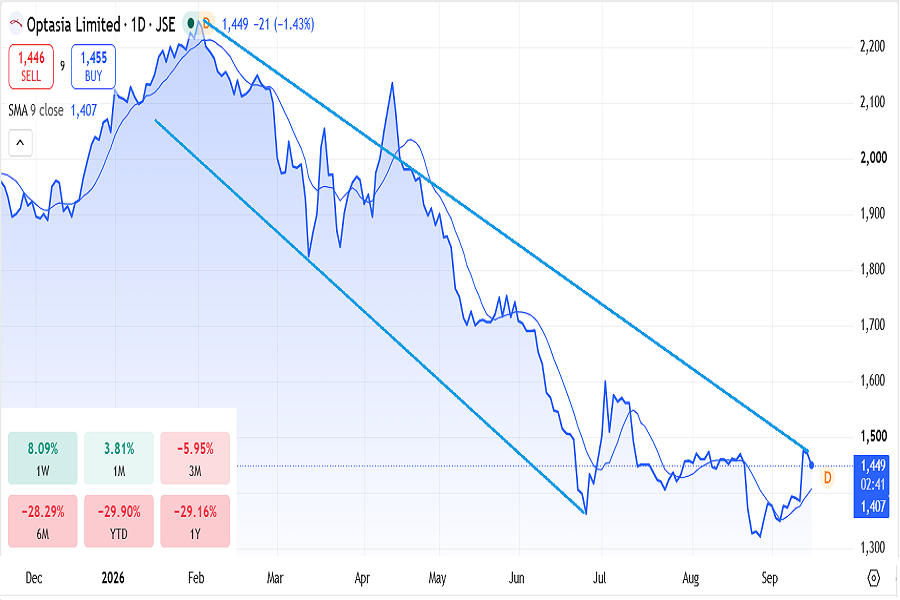
Optasia Limited stocks on JSE in September 2026
This week, the stock price consolidated following a strong report, though this did not trigger a rally or a significant price correction. Nevertheless, a solid foundation for a reversal has been established. Investors are awaiting confirmation of the company's reliability, as it has not yet built a track record on the exchange. New catalysts—such as the upcoming report for the second half of the year—are needed to drive upward momentum.
Technical analysis indicators are signaling a "Buy," a stance that may well prove correct in the long term. A local low has been established, a trend reversal is highly probable, and the price is at its lowest possible level. However, risks remain: while lower than those associated with micro-cap investments, they are higher than for long-listed assets—though the stock also offers greater potential upside.
SWOT analysis of investments in Optasia Limited stocks
Optasia presents a compelling operational growth story backed by an exceptionally strong balance sheet (with virtually no debt) and improving cash conversion; however, it also carries risks typical of recent IPOs: concentrated regulatory exposure in a single key jurisdiction (Nigeria), limited analyst coverage, heightened volatility, and most notably, the founder’s near-total exit just months after listing. For investors, this means that while the company’s operational track record is impressive, its public market history is still in the making: institutional investor confidence and valuation stability are only just beginning to take shape.
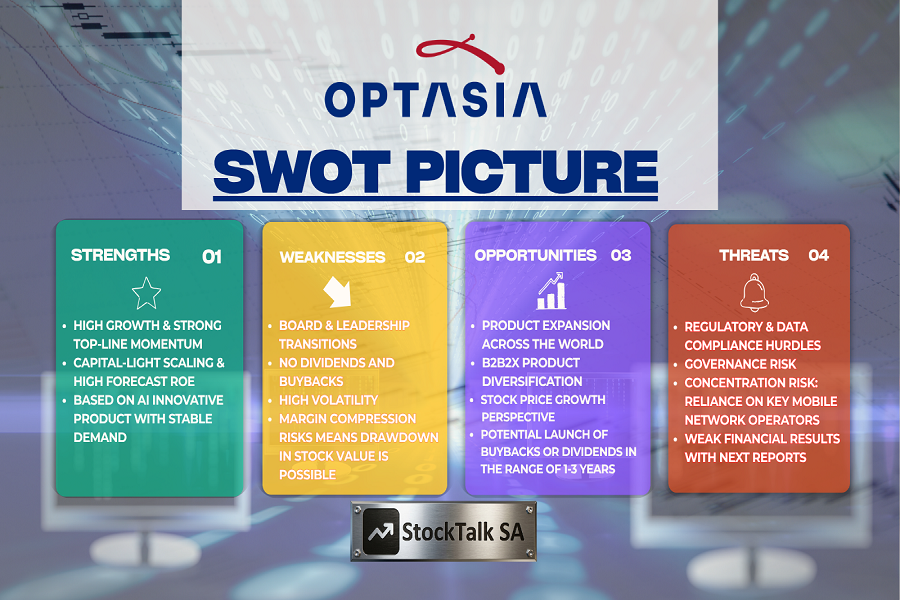
Optasia Limited SWOT
The bull case (for shareholders):
If Optasia continues to deliver growth at the upper end of its forecast range (30–40%) and demonstrates that the second-half slump was merely a one-off technical issue - stemming from factors like Nigeria, FX fluctuations, and the overdraft transition rather than a sign of a fundamental business slowdown, the market may begin to price in a premium for its high-quality growth and low debt. Expansion via Finergi and new partner rollouts offer additional growth potential, while strong free cash flow (FCF) theoretically paves the way for an initial share buyback or dividend - a move that could catalyze a re-rating toward the consensus target price (and potentially higher, approaching pre-pandemic or rather, pre-correction - levels seen in February).
Bear case (for shareholders):
If regulatory uncertainty in Nigeria drags on or turns against the company and if the easing currency tailwind coincides with the anticipated growth slowdown in H2 results for the second half could land at the low end of an already lowered baseline. This would be received particularly poorly given the market's already jittery state. A persistent supply overhang from insiders (following the founder's near-total exit) and limited analyst coverage leave the stock vulnerable to further institutional sell-offs, similar to those seen in Q1 2026. In this scenario, a retest of the June lows in the 1,300–1,340 ZAc range becomes a distinct possibility.
Summary
The H1 2026 report confirmed that Optasia’s operating model is working: double-digit growth, near-zero debt, and accelerating conversion of profit into free cash flow. However, the stock’s muted reaction (+0.34% despite strong figures) is not a market error but a sober assessment that the company’s real test lies ahead. It has only just begun to establish its track record, and that process is far from complete.
For a potential investor, Optasia currently represents a story of growth and balance sheet quality rather than a source of dividend income; no payouts have been made, nor are any planned for the coming year. Key factors to watch include the resolution of the regulatory situation in Nigeria, actual growth rates in the second half of the year relative to the raised forecast, and separately future insider activity, given that the founder has already nearly fully exited his equity position.

John Nkosi
John is from South Africa and know local financial market as it's own. He works directly for Stocktalk and responsible for making regular JSE market news.
Comments
Loading comments…
Log in or sign up free to join the discussion.