Lecture 10 (Chapter 1). Comparing the Brokers - Who Fits Whom
In this review we will compare brokers once again

Thandiwe Mbeki
Published · Updated

We've covered what each broker offers and how to open an account with each. Let's tie it all together.
If you want the absolute lowest-friction starting point, with no minimum and no existing bank relationship required: EasyEquities is built exactly for this. Sign up in minutes, deposit whatever you have, and start buying real shares or ETFs. This is the natural first stop for most people reading this course.
If you already bank with FNB or Standard Bank: their zero/low-minimum products (FNB Shares Zero, Standard Bank AutoShare Invest) let you start investing from inside an app you already use daily, with money already sitting in a familiar account. There's genuine value in that convenience and habit-forming simplicity, especially the recurring, automated nature of AutoShare Invest, which can help you build a disciplined monthly investing habit without thinking about it.
If you want a more traditional stockbroker relationship, research tools, direct human support, and a broader product range as your portfolio grows: Sharenet Securities is worth considering once you're past the very first stage. Its FICA-based, slightly more manual account opening reflects an older, more established brokerage model rather than an app-first one.
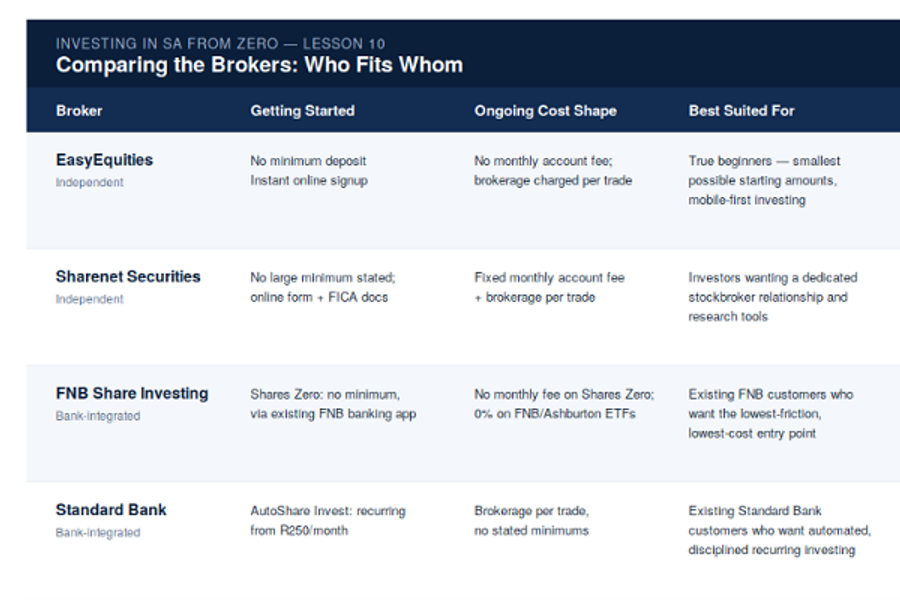
Comparing the brokers
A few closing principles from this whole course, worth carrying forward:
- A share is real ownership - not a bet, not a coupon. Its value follows the business behind it.
- The JSE is deep and liquid - for major companies, there's almost always someone on the other side of your trade.
- Splits and buybacks change how ownership is sliced, not what the company is actually worth.
- Dividends are a real, tangible reward for patience — and in South Africa, they're taxed automatically at source.
- "Real investing" and "trading" are different products, sometimes even from the same broker - always know which one you're using.
- Every broker in this course is properly licensed to place real JSE orders — the differences between them are about convenience, cost structure, and account type, not legitimacy.
Explore StockTalk tools
Charts, screeners, and analyst estimates — put what you just learned to work.
Explore tools