Lecture 12 (Module 3). News Trading
News trading means get benefit on the market's panic, fears, wave of optimism, ussually happen right at the time of news published. Is it cost to change own schedule according to the market events?

Thandiwe Mbeki
Published · Updated
What Is News Trading?
News trading targets the sharp price movement that occurs when a scheduled economic release or company earnings report differs from what the market expected. The key insight: markets move on surprise relative to expectation, not on the absolute number itself - a “good” number that still misses a widely-expected “great” number can send a price down, not up.
Common high-impact events include central bank interest rate decisions, major employment and inflation data, GDP releases, and for individual stocks - quarterly earnings reports. An economic calendar typically flags these events in advance along with a “consensus” (expected) figure to compare the actual release against, and an impact rating (often low/medium/high), worth treating as a planning tool, not a certainty, since consensus estimates themselves can shift right up until release.
Two Approaches
- Pre-positioning: taking a directional position before the release based on a view of what the data will show. Simple to execute, but it’s fundamentally a bet on the surprise direction. If the view is wrong, the position is fighting both the adverse move and the widened spread at the worst possible moment.
- Straddle / breakout orders: placing pending orders both above and below the current price just ahead of the release, so that whichever direction the market breaks, one order triggers - removing the need to predict direction at all.
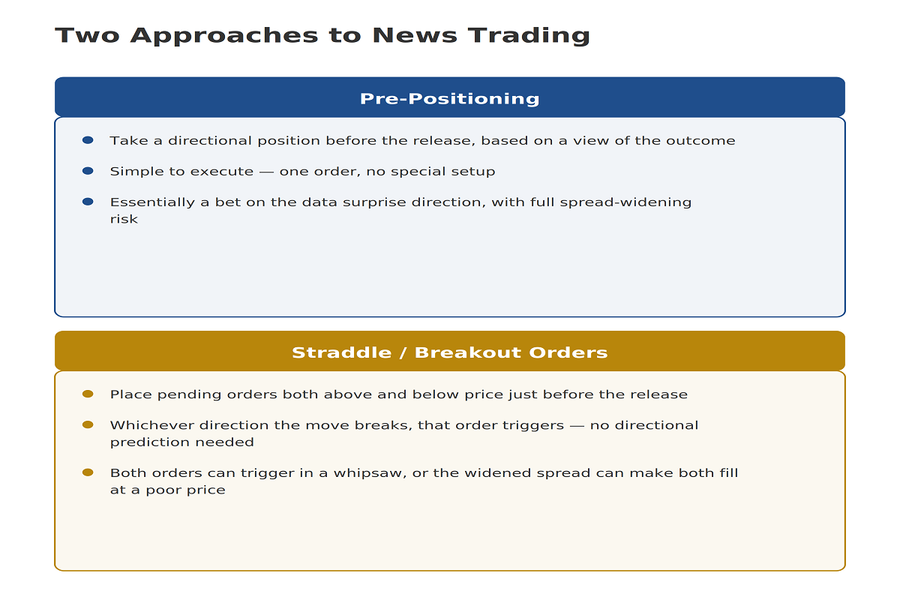
Figure 1 shows the trade-off directly: the straddle approach solves the directional-prediction problem, but introduces its own. A sharp whipsaw (price spiking one way, then reversing hard) can trigger both orders in sequence, turning a “no-prediction-needed” setup into a double loss.
Why Execution Is the Real Challenge
This is the part most new traders underestimate: the exact moment you want to trade a news release is the exact moment execution conditions are at their worst.
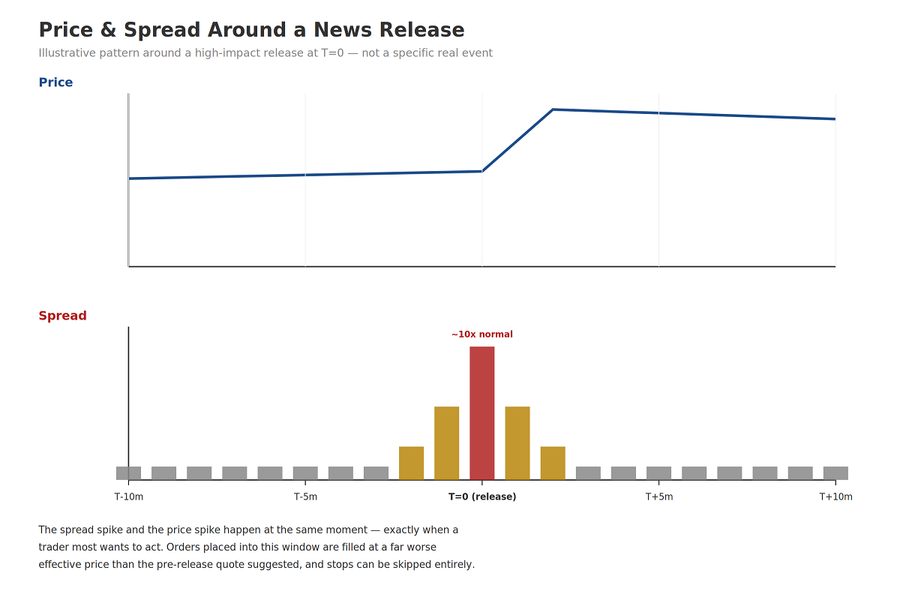
Figure 2 shows why: in this illustrative pattern, the spread widens roughly 10x its normal width in the seconds around the release, precisely when price is also moving fastest. This means:
- Orders fill at a materially worse effective price than the quote shown just before the release.
- Stop-losses (Lecture 1) can be skipped entirely in a gap, filling well beyond the intended level rather than at it.
- Some brokers apply special rules during high-impact news: wider margin requirements, order restrictions, or execution delays - specifically because of this volatility spike. It’s worth checking a broker’s specific policy on trading through news windows before relying on it as a strategy.
Practical Guidance
- If you’re not deliberately trading the news, consider reducing size or closing positions ahead of a known high-impact release, otherwise you’re carrying event risk you didn’t choose to take.
- Widen stop-loss expectations around news windows is a stop placed at a “normal” distance can be immediately and legitimately triggered by the spread spike alone, independent of the actual price move.
- Treat consensus figures and calendar entries as a planning aid, not a fixed target - actual released data, and the market’s reaction to it, is what matters, not the forecast.
Common Mistakes to Avoid
- Sizing a news trade the same as a normal trade, without accounting for the sharply elevated slippage and spread risk.
- Assuming a straddle order removes risk entirely because it doesn’t require a directional view: whipsaw risk remains very real.
- Trading illiquid instruments through major news without checking whether the broker restricts execution during that window.
Summary
News trading offers a clear, well-defined catalyst, which is exactly what makes it appealing but the same event that creates the opportunity also degrades execution quality at the precise moment a trader needs it most. Respecting that trade-off, through sizing, wider stops, and broker awareness, matters more here than in almost any other strategy covered in this course.