Lecture 2 (Chapter 1). How the JSE works?
In this lecture you will see how the stock exchange usually works and what is index?

Thandiwe Mbeki
Published · Updated

How the JSE Works
The JSE (Johannesburg Stock Exchange) is where shares like the one we just talked about - a piece of Shoprite actually change hands. It's the largest stock exchange in Africa, based in Sandton, and it's been running in some form since 1887. Today it lists several hundred companies, from banks and retailers to mining houses and tech firms.
Think of the JSE less like a shop and more like a marketplace with strict rules. It doesn't own the shares, set their prices, or decide who buys what. It just provides the trading infrastructure and enforces the rules that keep the market fair and transparent.
How does a company end up "on the JSE"?
A company applies to list, meeting requirements around its size, financial history, and disclosure standards. Once listed, it must regularly publish financial results and any information that could affect its share price. This is called SENS (Stock Exchange News Service), and it's how all investors get the same information at the same time, rather than some having an unfair edge.
How does buying and selling actually happen?
You don't shout across a trading floor anymore. That image is outdated. Today it's fully electronic: your broker sends your buy or sell order into the JSE's system, which matches it against someone else's opposite order (a seller if you're buying, a buyer if you're selling) at an agreed price. This happens in fractions of a second.
How much actually trades on the JSE every day?
More than you might expect. According to the JSE's own 2025 annual results, the average daily value of shares traded on the exchange was around R29 billion - spread across roughly 389,000 individual deals per day.
To put a single day into perspective: on Friday, 31 July 2026, JSE trading summaries recorded just under 386 million individual shares changing hands across about 404,500 deals, worth roughly R37 billion in total.
Of course, this activity isn't spread evenly - a handful of large, liquid companies (think Naspers, Standard Bank, Sasol) account for a big share of daily volume, while smaller listed companies might see only a few thousand shares trade on a quiet day. But the overall scale tells you something important: the JSE is a genuinely deep, liquid market when you place an order for shares in a major company, there's almost always someone on the other side ready to trade with you.
What are "indices" on the stock market?
You'll hear these terms constantly, so it's worth getting straight now:
- FTSE/JSE All Share Index: tracks almost all the listed companies on the JSE, giving a broad snapshot of "the market" as a whole.
- FTSE/JSE Top 40 Index: tracks only the 40 largest companies by size (market capitalisation). These are the heavyweights - think Naspers, Standard Bank, Anglo American and they make up the bulk of the JSE's total value.
When the news says "the JSE was up today," it's usually referring to one of these indices moving, not every single share.
Here is full range of indices on JSE and its comparison:
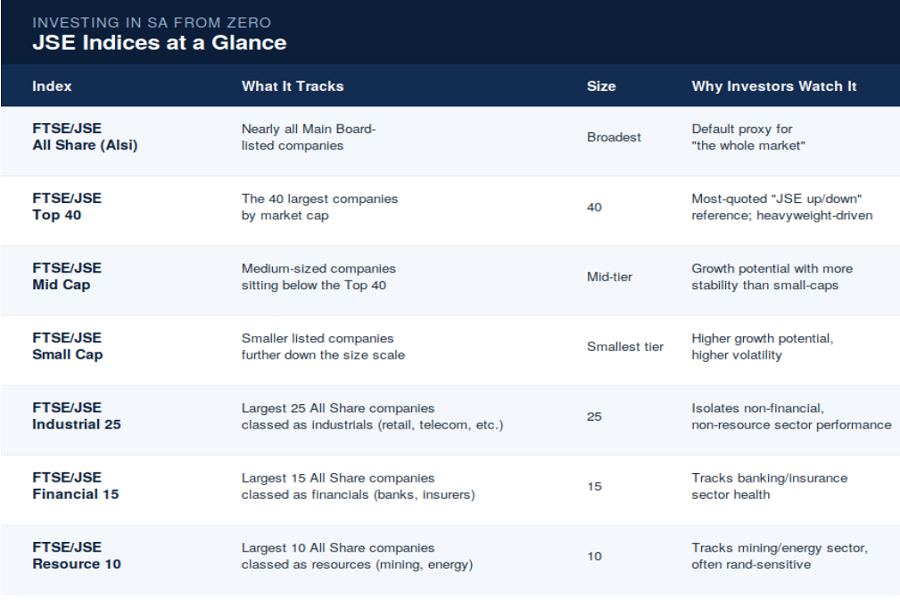
JSE indices - comparison table
One more piece: settlement.
When you buy a share, you don't get a paper certificate. Ownership is recorded electronically, and the trade officially settles a short time after the deal (in South Africa, this happens on a T+3 basis - three business days after the trade date). Your broker and a central depository handle this in the background; as an investor, you don't need to do anything for it to happen.
Takeaway: the JSE is the plumbing that lets you turn "I want to own part of Shoprite" into an actual, legally recognised holding: safely, transparently, and (these days) almost instantly.
Build your watchlist
Track the stocks you just learned about — get price alerts and daily updates.
Go to your watchlist