
This article is for informational purposes only and does not constitute financial advice. Always do your own research before making investment decisions.
12 August 2026 · 6 min read · 0
Capitec - the path from microloans to a systemic bank
Capitec, the most expensive bank in South Africa, aged 27 years. In this review we will show how they started and scaled from a local microloans company - to South African bank with 840 subsidiaries.
When discussing the banking sector, the first thing that comes to mind is a bank's history and reputation. This is precisely the bank we'll be discussing today. While it can't boast the same level of experience as many of its competitors, its 27 years of operation and growth from a microcredit organization to a systemic bank with over 800 branches across South Africa leave no doubt that we're dealing with a reputable and fairly reliable bank.
Capitec Bank Holdings Ltd. is a key phenomenon in the African banking sector and one of the most effective value creation stories in the international financial market over the past 25 years. Beginning as a microfinance lender for vulnerable groups, the bank has transformed into South Africa's largest banking franchise, with a client base exceeding 22 million and a market capitalization surpassing century-old traditional banking giants.
History of the Capitec Bank and IPO on JSE
In the late 1990s, South Africa's financial sector was dominated by the "Big Four" (Standard Bank, Absa, Nedbank, and FirstRand). These institutions focused on wealthy individuals and large businesses. The vast lower- and middle-income segment (the so-called unbanked and underbanked segment) was either ignored or served by usurious microfinance institutions with exorbitant rates. The founders of Capitec - Michiel le Roux, Riaan Stassen, and strategic investor PSG Group (led by Jani Mouton) saw a vacant niche. Capitec was incorporated on 23 November 1999 and incorporated as a controlling banking company on 29 June 2001, under the South African Banks Act. Just the following year, the stock exchange listing took place. Shares began trading at 154 cents. The listing took place under difficult circumstances. Nine days before Capitec's listing, Saambou Bank, one of the country's largest mid-sized banks, collapsed. This triggered panic, a run on depositors, and a banking crisis among regional financial institutions.
In its first year of trading, Capitec's profits fell by 38%, and the interbank lending market was closed to smaller players, so the start wasn't entirely successful. Capitec decided to abandon wholesale interbank financing and focus on retail deposits, and it worked. Seventeen years later, we see a bank that's completely different in scale and perception—one that's time-tested and has a huge client base.
Major Crisis: Viceroy Research Attack (2018)
The most severe test in the bank's history was a planned attack by short sellers from the American-European group Viceroy Research. They had just recently correctly predicted the collapse of the European-African retailer Steinhoff.
Viceroy Research published a report titled "Capitec: A Wolf in Sheep's Clothing." The stock immediately plummeted by more than 20%, and the bank's market capitalization was reduced by more than R25 billion. The report accused the bank of covert loan sharking practices, claiming that Capitec was lending to insolvent clients to pay off old debts, with potential write-offs reaching R11 billion.
Capitec management responded swiftly: that same day, the bank published a targeted technical response refuting Viceroy's methodological errors (specifically, the confusion between net fees and principal repayments). The South African Central Bank (SARB) and the Ministry of Finance publicly defended Capitec, stating that the bank was fully capitalized, liquid, and complied with all prudential regulations, and that Viceroy's report contained speculative conclusions. By the end of the day, the shares had recovered most of their losses, and subsequent independent audits confirmed the bank's stability.
Capitec Today – Performance and Dividends
In 2026, Capitec will no longer be just a retail bank for microloans, but a universal digital ecosystem (including insurance, business banking, and the Capitec Pay payment system).
Its assets also include international acquisitions. Capitec holds a 97% stake in AvaFin, a company that provides microloans in the Czech Republic, Poland, Latvia, and Mexico. They are often criticized for being overly leveraged, with a high proportion of non-performing loans, but since the average loan amount is only €355, this doesn't pose significant problems for the owners, although AvaFin's international asset is not yet Capitec's strongest suit.
The bank has delivered outstanding financial results for five consecutive years, with growth in virtually all metrics, and has also increased dividend payments. The share price has steadily risen, for good reason. Over the past 12 months, the stock has gained another 36%, but the rally has lasted for over three years. This even led to a decline in dividend yields, as payouts failed to keep pace with share price growth. However, they always remained within 50-55% of net profit.
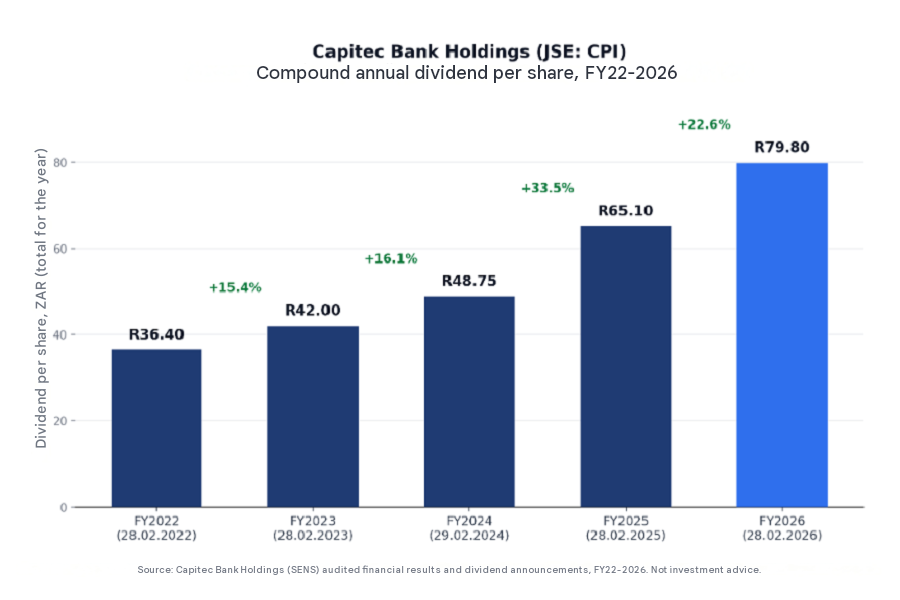
Capitec dividends 2022 - 2026
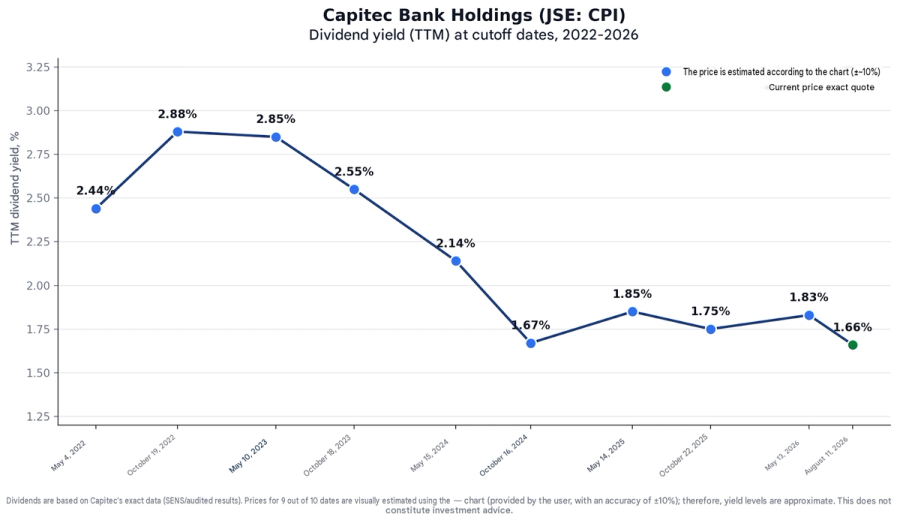
Capitec Dividend yield, 2022-2026
For investors focused on capital growth rather than dividend income, this isn't a deal-breaker: the low current yield is offset by the stock's appreciation. However, for pure dividend strategies, this dynamic is a real downside.
Capitec' Uptrend and All-Time Highs.
On the price chart, we see an upward supertrend lasting three years. On August 5, 2026, the stock reached an all-time high. This high was renewed just a month after the previous high, so the uptrend appears quite stable. The Stochastic Oscillator predictably indicates overbought conditions, but most technical analysis indicators are still pointing up.
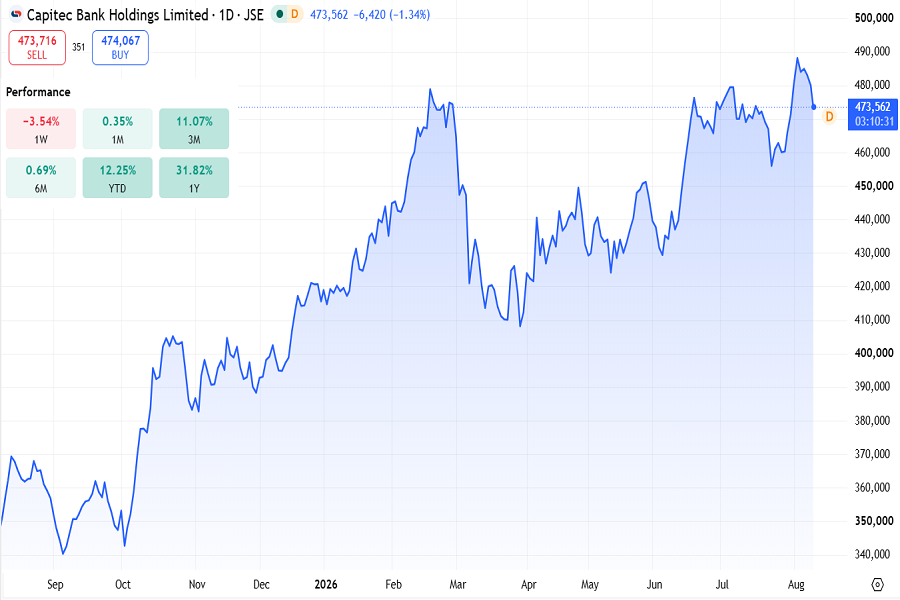
Capitec stocks chart on JSE, August 2026
If someone decides to invest in Capitec today, they will face a price correction and a high price without a discount. Perhaps the right decision would be to wait for a further decline.
Forecast and Conclusions
The fundamental picture remains strong: a fifth consecutive record year for profit, customer base growth, diversification into business banking and insurance, and dividend yield rising alongside profits. The smooth CEO transition has not disrupted operational dynamics.
Capitec appears to have no downside scenarios in the foreseeable future. With 22 million active customers, they have a good margin of safety and strong financial statements. In many ways, Capitec resembles a top-performing student who can be afforded more than other peers, as its performance and reputation are beyond doubt. They could follow their competitors and pursue large-scale expansion into other markets, not only through microloans, but also by opening branches abroad or acquiring foreign banks. In this case, this would become a new growth driver for the stock. Investors would view this expansion positively, at least until the new report on the new assets' performance.
Capitec could also focus on the domestic market, developing its payment system, offering more services, and improving dividend yields. Selling a less-than-performing foreign asset and focusing on the domestic market would also be viewed positively. Therefore, we have every reason to believe that 27 years for Capitec and its 22 million active clients is just the beginning. At the same time, investors should be mindful of all the risks. The 2018 Viceroy story also serves as a reminder: even high-quality businesses can experience sharp declines due to news that isn't always related to fundamentals. Any unfounded panic on social media or in financial circles could trigger a massive outflow of capital, a stress test that may be impossible to cope with.