This article is for informational purposes only and does not constitute financial advice. Always do your own research before making investment decisions.
22 October 2026 · 8 min read · 0
KAL Group Limited: from farming - to full diversification
KAL Group is a Company with 114 years history. For this period they grew up from farmership - to a diversified business. They had enough time for this. Isn't it the most reliable stock on the JSE?
KAL Group (JSE: KAL) is quite unlike the typical company listed on the JSE. It began in 1912 as a farmers' cooperative, formed so that members could pool their resources to purchase fertilizers. Today, it operates a network of agricultural retail outlets, filling stations, convenience stores, and fast-food restaurants across South Africa and Namibia. By the end of the 2025 fiscal year (FY2025), the group had 268 locations spread throughout all nine South African provinces and Namibia. For an investor, the company offers an intriguing combination of three key characteristics. Its business is tied to the agricultural cycle, fuel prices, and the spending habits of consumers in smaller towns. The stock is attractively priced, trading at roughly 6.6 times annual earnings and below its book value. Furthermore, the company’s history includes a sharp downturn, from which it has since recovered. In this overview, we will examine the origins of KAL, the challenges it has weathered, and what the future may hold.
History of the Company
In 1912 Farmers from the Swartland region in the Western Cape province join forces to purchase guano (bird droppings) for use on their own fields and for resale as fertilizer. This group later formalizes its structure as a cooperative, De Westelike Graanboeren Koöperatiewe Vereniging.
In 1930s–1950s: The cooperative expands into the grain sector, establishing a grain elevator complex in the Boland region and creating subsidiary agricultural associations in neighboring towns. In 1954, the main Wesgraan building is completed in Malmesbury.
Further, The cooperative merges with Western Province Fruitgrowers to form WP (Koöperatief) Beperk. The company identifies this as the first major corporate merger in its history. Subsequently, Drakenstein Vrugtekwekers and Wynland Koöperasie also join the group. In 1995, The cooperative transitions into a public company, WPK Landbou Beperk. It later acquires two additional cooperatives and establishes a subsidiary, Boland Agri. Following the merger of WPK Landbou and Boland Agri, Kaap Agri is formed.
2012 is the date when the company launch the first filling station with an attached store under the "Expressmark" brand opens in Simondium. This marks the beginning of the company’s diversification into fuel retail. New direction seems successful requires a lot of investments and attention. So in 2016, The fuel business is spun off into a separate entity, The Fuel Company (TFC).
June 26, 2017 is the date of listing on the JSE Main Board under the ticker symbol "KAL." The opening price was R58.60, valuing the company at approximately R4.1 billion. On the very first day of trading, the share price rose to R61. February 9, 2023. Shareholders approve a name change to "KAL Group Limited." The company explained that the previous name, associated specifically with agriculture and a single region no longer accurately reflected the nature of its business. The new name aligns with the company’s stock market ticker.
KAL Group Limited today: profitability, dividend history, and policy
In 2026 we meet the Company with two main lines of business. Agrimark sells farm and home supplies as well as construction materials, and it also handles grain intake and storage. PEG operates gas stations, convenience stores, and fast-food restaurants. The group employs over 6,800 people.
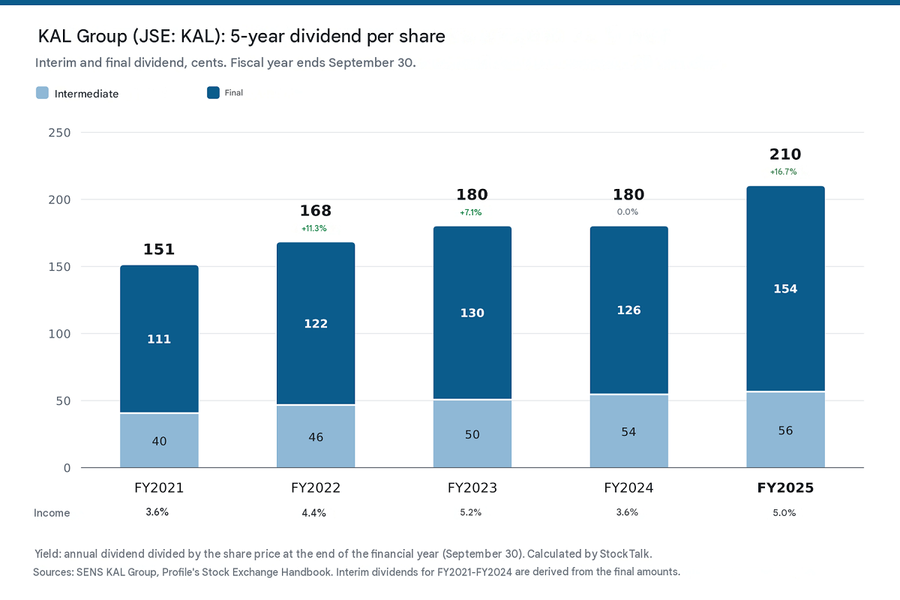
The company maintains stable revenue generation in the range of R20.3 billion – R22.4 billion and demonstrates a disciplined approach to capital allocation. The KAL Group follows a well-defined policy of making payouts twice a year:
Interim dividends: Announced in May and paid in June.
Final dividends: Announced in November and paid in February of the following year.
The current dividend yield is approximately 5%, which is an average level that is acceptable for the market.
The payout ratio is kept within a target range of 32% – 37% of headline earnings per share (HEPS). This allows the company to provide an attractive dividend yield to shareholders while simultaneously investing in the modernization of its retail store and service station network.
The Major Crisis Faced by the Company
Starting in 2020, the company entered a difficult period that lasted four years. It all began with the COVID-19 pandemic, which hit the restaurant business and the retail chain particularly hard. These business segments were effectively left without revenue, putting significant pressure on the company’s overall profitability.
Even more challenging period in the group’s recent history was the combined macroeconomic and climatic crisis of 2022–2023, which impacted all areas of its operations:
Energy Crisis and Load Shedding:
Record-breaking power outages imposed by the state-owned utility Eskom forced the KAL Group to rapidly install and operate high-capacity diesel generators around the clock. This led to a surge in operating expenses (OPEX) required to maintain the cold chain, warehouses, and Agrimark retail complexes.Spike in Fertilizer and Fuel Costs:
Geopolitical shocks in 2022 triggered a sharp rise in the cost of mineral fertilizers and diesel fuel. Farmers were compelled to reduce their purchases of agrochemicals and optimize their planted acreage, which temporarily compressed profit margins in the core agricultural segment.Avian Influenza Outbreaks and Climatic Volatility:
Outbreaks of avian influenza (H5N1) in 2023 caused significant damage to poultry farms - key clients of the group in the Western and Northern Cape, while erratic rainfall patterns hindered soil preparation in several critical regions.
How the Company Overcame the Crisis?
By diversifying its revenue streams through retail operations and benefiting from a steady cash flow from its network of filling stations (PegRetail), the group was able to mitigate the decline in profits within its agricultural segment. By 2024–2025, as power supply stabilized and fertilizer prices eased, the KAL Group’s operating margins recovered to normalized levels.
Technical review
KAL Group historical chart
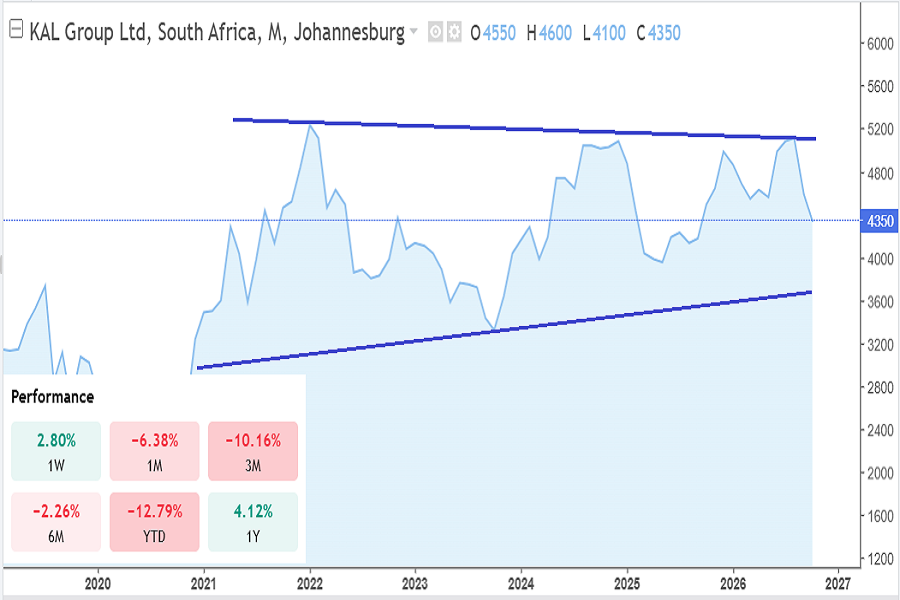
While the chart may appear to show an upward trend, the resistance line indicates a lack of upward momentum beyond a certain level. Since the company’s listing, its share price has never returned to its initial level; however, this does not necessarily point to any underlying issues within the company. The situation remains under control. At the same time, one negative factor is worth noting: the company’s development and diversification efforts are not clearly reflected in its stock performance. Over the past 12 months, the shares have tended to lose value, though only marginally. This is certainly not a stock for which one should wait for a significant discount; the price is effectively in a constant state of being "discounted," with fluctuations remaining within a range of less than 10%.
Technical analysis indicators point to the effectiveness of short positions. In this case, even from a technical analysis perspective, we cannot classify this stock as a "growth stock." Such shares are typically purchased to generate passive income through dividends. A rally in the stock’s price seems questionable, despite the company’s stability. Though, by the same token, one should not expect any dramatic declines either.
Forecast for KAL Group stocks
Upcoming Event: FY2026 Annual Results November 25, 2026. Key questions for the report:
Did profit growth continue in the second half of the year? Management warned that a record rise in fuel prices since April (due to the conflict in the Middle East), inflation and a possible increase in rates would put pressure on fuel volumes. At the same time, the company did not expect a serious impact on the group.
What will the final dividend be, taking into account the coverage target of 2.5.
What the strategic review of Agrimark will bring: This segment has a lower return on capital than PEG.
Bullish scenario.
FY2026 results confirm double-digit earnings growth; the company announces a final dividend of approximately 180 cents and resumes share buybacks. A low P/E ratio (around 6.6x) and a yield exceeding 5% attract buyers, pushing the price back into the R48–52 range to test the triple-top resistance at R53.5. A breakout above this level would pave the way toward R58.60—the stock’s 2017 listing price.
Bearish scenario.
High fuel costs and weak consumer demand erode second-half profits, while agricultural clients cut back spending due to poor harvests and high interest rates. The final dividend proves modest; the price breaks below R41, heading toward 2025 lows near R37. Given the low liquidity, the decline could be sharp. Nevertheless, a strong balance sheet (debt-to-equity ratio of 32.9%) mitigates the risk of a repeat of 2020, when dividends were cancelled.
Summary
Over the course of 114 years, KAL has evolved from a farmers' cooperative that purchased fertilizers into a retail chain operating gas stations and stores throughout South Africa and Namibia. The most challenging period in its history as a public company occurred between 2020 and 2024; however, the business proved resilient, profits remained largely stable, and a year later, dividends tripled. Today, KAL boasts its lowest debt level in 15 years, growing dividends (210 cents for FY2025, with a 25% increase in the interim payout for FY2026), a share buyback program, and a valuation below its book value. Its weaknesses include low liquidity, sensitivity to fuel prices and the agricultural cycle, and the fact that, nine years after its stock market debut, the share price has yet to return to its listing level (it currently sits approximately 24% below the R58.60 mark). A key technical level to watch is the R52–R53.5 range, and a pivotal upcoming event is the earnings report scheduled for November 25, 2026.