100 of ideas for investing. Idea #6. Aspen Pharmacare Holdings

John Nkosi
Today, we're discussing investing in a massive pharmaceutical company, which has long surpassed South Africa in scale, operating on virtually every continent except the Asia-Pacific region and the United States. For most people, medicine and the pharmaceutical industry conjure up images of losses and illnesses, but for those who own shares in these companies, holding pharmaceutical-related stocks in their portfolios is a way to hedge risks in the face of geopolitical and macroeconomic turbulence, serving as a sort of cure for the disease known as "losses."
Yes, we'll be looking at Aspen Pharmacare Holdings Limited (JSE: APN). It's the largest pharmaceutical manufacturer on the African continent and a key global player in the specialty & generic pharmaceuticals segment, established in 1850. Headquartered in Durban, South Africa, the group operates in over 50 countries, including Latin America and Europe.
Aspen is a global leader in the production of sterile anesthetics and thrombolytic/anticoagulant agents.
: The company is transforming its manufacturing capabilities into a high-margin business for the sterile filling of vaccines, biosimilars, and complex biological products for international pharmaceutical giants.
What does the company do?Holds a dominant share of the pharmaceutical market in South Africa and Africa as a whole, developing the distribution of vital medicines.
Why investors are interested in investments in Aspen Pharmacare Holdings?
Investors usuall respect this company for Shifting from simple generics to complex contract injectable technologies (including biosimilars and GLP-1 drugs) and attractive Fundamental Valuation.
Aspen's stocks trades at a price-to-book (P/B) ratio of approximately 0.82x, indicating a significant discount to the book value of net assets. The company also regularly Contracts with pharmaceutical giants such as Eli Lilly (for the promotion and bottling of popular drugs such as Mounjaro) and other global leaders. What does it mean to investors? High profitability for the Company thanks to global activity.
This is a classic "random hedge" story of a stock with a defensive demand profile (chronic diseases are not dependent on the economic cycle), but over the past year, a rare turnaround scenario has been added to this for the defensive sector: a deep crisis in 2025, a complete resolution of the conflict, dramatic balance sheet deleveraging, and a reversal in profits – that is, a combination of a defensive asset and a speculative recovery story at the same time.
Aspen's dividends policy
Aspen Pharmacare's dividend policy is focused on paying an annual dividend based on net profit from continuing operations (with a target dividend coverage ratio of approximately 3.0x - 3.5x HEPS).
: For the last financial year, the company paid a dividend of 359 ZAc (R3.59) per share (marked D on the chart near 10,000 ZAc).
Current Payouts and YieldAt the current share price of 14,778 ZAc (R147.78), the historical dividend yield is approximately 2.4% - 2.5%. Not a high numbers but contain perspective inside.
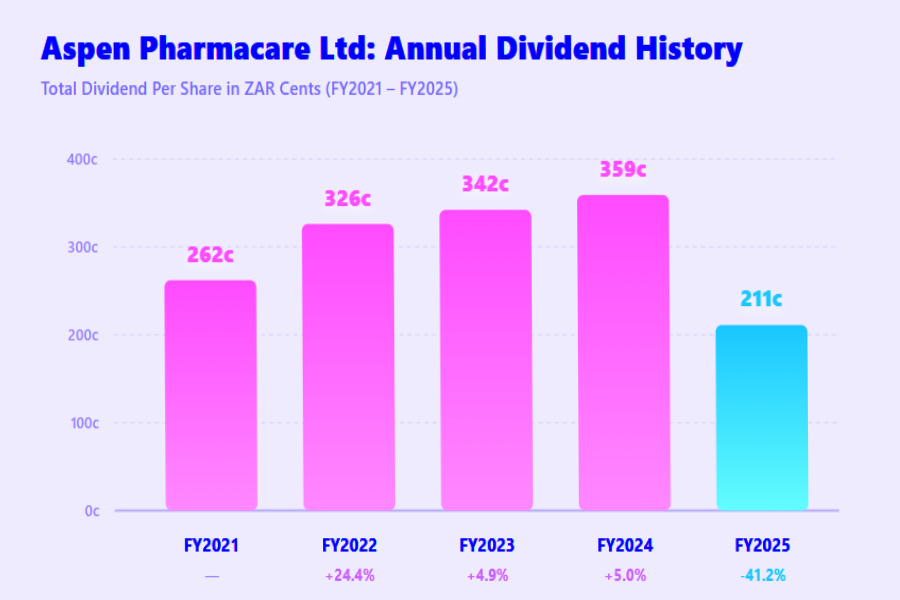
Aspen's dividends for the last 5 years
As new high-margin contract bottling lines (CDMO) come on line and free cash flow (FCF) metrics recover,
The 2025 Crisis for Aspen's investors
It would be strange if a company over 150 years old had no crisis moments. The most well-known recent incident occurred in 2025. On April 23, 2025, Aspen shares plunged 31% in a single session - their worst drop in nearly 27 years after the company warned of a contract dispute over mRNA vaccine production at its French site that could lead to a loss of up to R2.77 billion.
A difficult annual report followed: operating profit plunged 79% to R1.4 billion, revenue fell 3% to R43.4 billion, HEPS fell 42% to 792.1 cents, the company recorded a loss per share of 243.9 cents versus a profit of 991.4 cents a year earlier, recognized a R4.1 billion impairment charge on its Chinese assets, and cut its dividend to 211 cents from 359. By the beginning of September 2025, the stock had lost more than 60% for the year and was almost 78% below its 2015 peak. year (R450).
The legal disputes were resolved by early 2026. The shares have begun to recover in price, but experts believe they still remain undervalued. Therefore, most analysts consider Aspen shares a prudent buy today. The general tone of commentary on the company is "cautious optimism": even conservative sources, who called the stock nothing more than a "Hold" at the height of the crisis, acknowledge that a strategic pivot toward GLP-1 generics and insulin contracts offers a realistic path to recovery, provided quality execution is achieved.
Technical Analysis of Aspen Pharmacare rates on JSE
The daily chart of Aspen Pharmacare shows the price transitioning from a medium-term growth phase to an active technical correction, accompanied by a clear local sell/profit-taking signal.
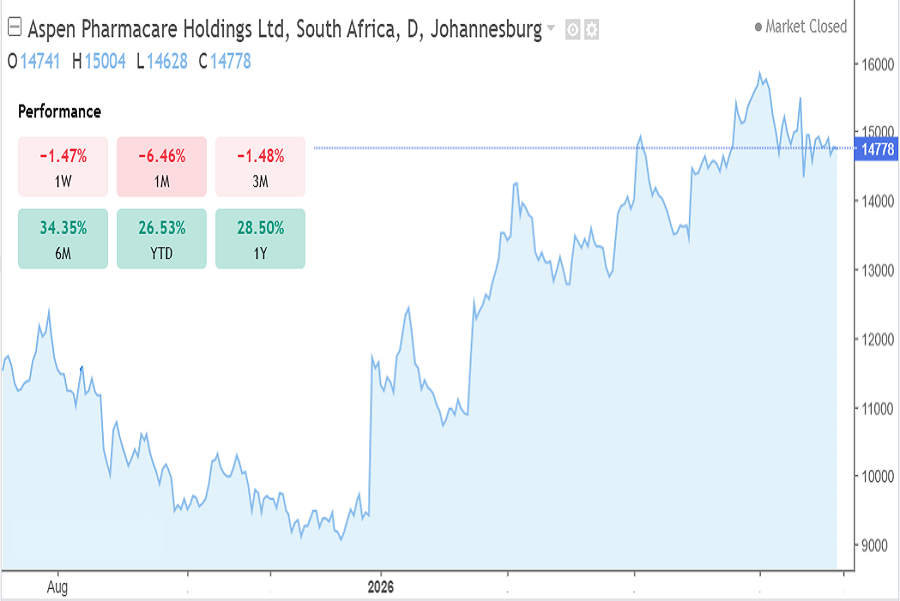
Aspen Pharmacare hldgs (JSE: APN), August 2026
The chart shows a seven-month uptrend, but a price correction is currently underway. Good news - likely it's finish or transform to downward trend soon. So now is good entry point if you accept risks. The upward momentum was lost in July, but it is too early to talk about a downward reversal. However, technical analysis indicators are already pointing to sell.
So That's a positive story, proved for investors. This stock has a potential and a speculative vibe at the same time. It's actually hard to ignore stocks like this if you're aimed to make long-term portfolio and ready to deal with locak drawdowns.
It's cost to remember here: medicine is always in demand - no matter how much oil cost and no matter if D. Trump decide to fight with someone.
Has exited the overbought zone and is trending downward, signaling continued selling pressure in the short term.
RSI (14):: A strong surge in selling volume during the formation of the corrective impulse confirms that profit-taking is organized.
SWOT analysis of investments in Aspen Pharmacare Holdings
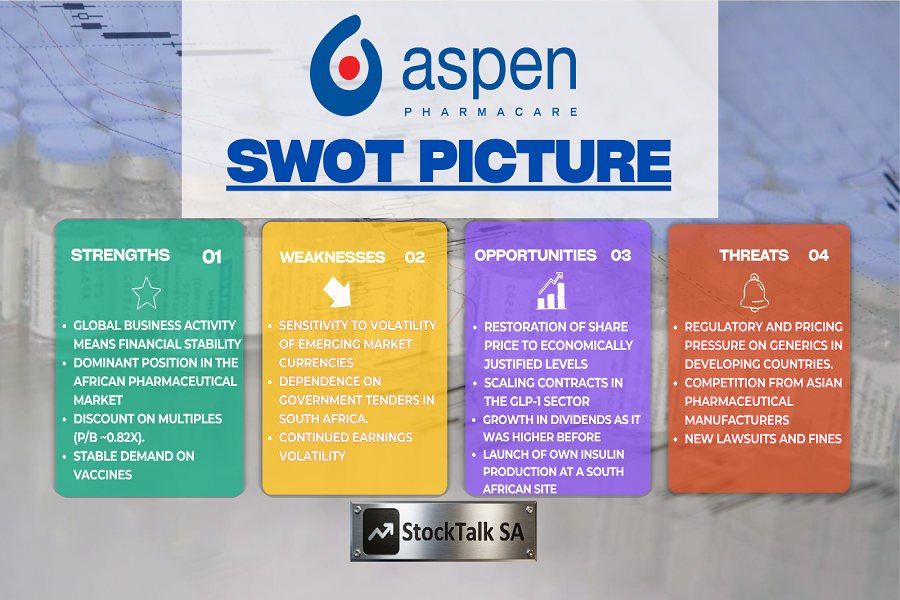
Aspen Pharmacare's SWOT of investments in 2026
Aspen's SWOT profile today is a typical picture of a "post-crisis turnaround": strengths and opportunities are almost entirely future-oriented (a closed dispute, a clean balance sheet after the APAC deal, GLP-1 potential), while weaknesses and threats are primarily a lingering legacy of problems in 2025 that haven't yet been fully resolved (a high comparative base, one-time restructuring costs, reputational risk after a series of shocks). This makes the stock a typical "historical value trap vs. turnaround" dilemma: if the company truly delivers on its double-digit HEPS growth guide in the second half of 2026, the stock is likely still undervalued relative to pre-crisis levels (recall the 2015 peak was R450); if it disappoints even once more, the reputational discount could linger for a long time, given that 2025 has already marked the third major confidence shock for this stock in a decade.
Summary: Prospects, Forecasts, Conclusions
Aspen Pharmacare is a rare example of a highly dramatic turnaround story for the defensive pharma sector: a more than 60% plunge in 2025 amid a contract dispute and impairment charges, followed by a full settlement of the conflict, the sale of a large non-core (by geography) asset for almost R27 billion with the proceeds used to reduce debt, and a bet on GLP-1/insulin as a new growth engine.
Analyst consensus is currently leaning toward "Buy," with mid-price targets in the R150-175 range, suggesting moderate rather than explosive upside from current levels—the market has already largely recovered from its September 2025 bottom. Key things to watch going forward are (1) the fulfillment of the double-digit HEPS growth guide in H2 FY26, (2) the sales momentum of the GLP-1 portfolio, and (3) the stock's ability to consolidate above the R135-165 consolidation zone as technical confirmation of trend continuation.
Historical yield of ~2.5% with high potential for double-digit payout growth makes the security an excellent candidate for a long-term portfolio
For investors, this is more of a "prove it by doing" story: the company has provided all the prerequisites for recovery (balance sheet, settled dispute, new product driver), but given the three crises of confidence that have already occurred in the past decade, it makes sense to factor in a premium for execution risk rather than take the current turnaround as guaranteed.

John Nkosi
John is from South Africa and know local financial market as it's own. He works directly for Stocktalk and responsible for making regular JSE market news.
Comments
Loading comments…
Log in or sign up free to join the discussion.