100 of ideas for investing. Idea #9. Lewis Group ltd.

John Nkosi
Lewis Group is a rare case on the JSE where a cheap valuation comes with rising earnings and generous payouts. The company sells furniture and household appliances on credit to South African families on middle and lower incomes. At first glance it is a risky niche: a weak consumer, high unemployment, expensive money. That is exactly why the market values Lewis at roughly five times annual earnings, even though the dividend has more than doubled over the past three years and the company has bought back almost half of its shares since listing.
The idea is simple: an income share with a double-digit dividend yield, priced by the market as if the credit book is about to turn sour. The question for the investor is how realistic that scenario is.
Everything about Lewis Group ltd.
Founded in Cape Town in 1934, Lewis Group Limited has transformed over the past 90-plus years into one of Africa's largest home goods retailers. The company’s network comprises more than 800 stores across South Africa, Namibia, Botswana, Lesotho, and Eswatini.
The key difference between Lewis and an ordinary retailer is that it earns not only on the merchandise margin but also on instalment interest, service contracts and customer insurance through its own Monarch Insurance. In effect it is a hybrid of a store and a small lender, and the company's main asset is not its warehouses but its debtors book. Consequently, on the stork market investors usually learn the Company's report with a focus on number of issued credits and their quality over the number of sold goods. So it looks like you're investing in retail business but in fact investing in a financial services.
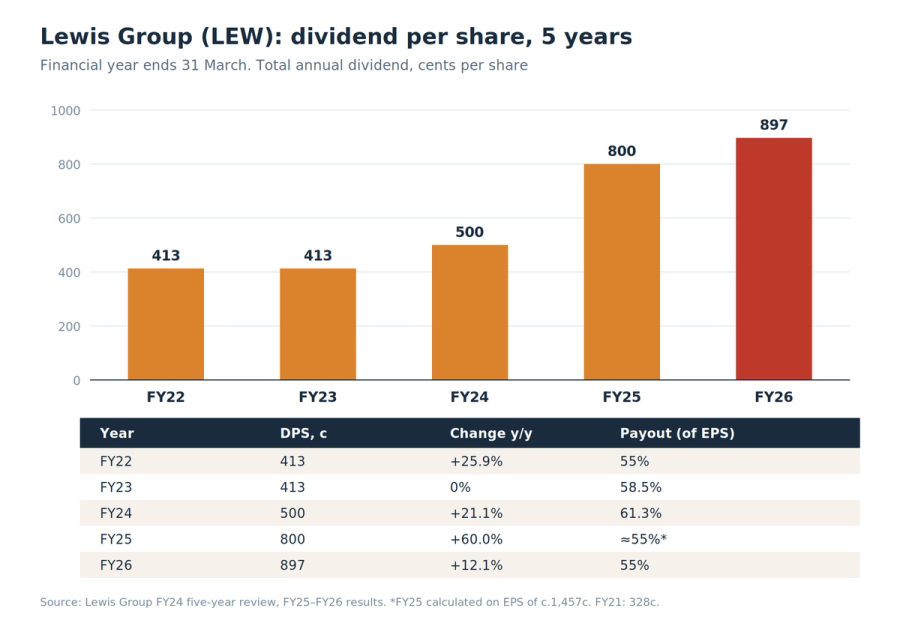
Lewis group dividends payouts
Lewis pays dividends twice a year: an interim in January and a final in July. The board keeps the payout ratio at no less than 55% of earnings and has paid dividends for 22 consecutive years, including through the pandemic.
For FY2026 the total dividend rose 12.1% to 897 cents (an interim of 337 cents and a final of 560 cents). That is more than double the level of three years ago. The company put the yield at 11.4% at the declaration date and, by its own figures, the average yield over five years was 10.7%. At the current price of about R84, the trailing yield is roughly 10.7% (my calculation).
Share buybacks are the second pillar of capital returns, and for shareholders they matter just as much. Since listing, the company has repurchased 47.8% of its shares and returned more than R1.8 billion to shareholders through buybacks. Each buyback increases the remaining shareholders' share of earnings, which is why EPS grows faster than net profit. In FY2024 Lewis returned more than 100% of earnings to shareholders through dividends and buybacks for the third year in a row.
For the holder, this means the total return (dividends plus buybacks) is higher than the dividend yield alone. There is a flip side, though: as debt rises, the room for aggressive buybacks narrows.
Fundamental and technical analysis
Financial results for the 2025–2026 fiscal year demonstrated strong operational resilience despite the challenging macroeconomic environment in South Africa (high inflation and high SARB interest rates).
- Revenue and margins: Company revenue exceeded R4.9 billion, with a gross profit margin of approximately 43.7%.
- Net profit (HEPS): Headline Earnings Per Share (HEPS) rose by 18.3% over the last fiscal year, reaching 1,753 cents.
- Return on Equity (ROE): Reached 16.2% (up from 15.4% the previous year).
- Credit portfolio quality: The provision for impairment of receivables stands at approximately 37.7% of the credit portfolio, reflecting a highly conservative approach to risk.
Debt is rising. In 2019 Lewis had a net cash position of about R205 million; by 2026 this had turned into net debt of roughly R2.2 billion. The borrowings ratio stands at 22.4%, and gearing including leases at 40%. For a credit retailer this is not critical, but the trend matters: the book is funded with borrowed money, and in a high-rate environment that weighs on earnings.
Valuation. At around R84 (mid-September 2026) the share trades at roughly 4.8 times annual HEPS and below book value (P/B of about 0.9). For a company with a 16% ROE and growing earnings, that is a low multiple. The market is effectively applying a discount for credit risk and the weakness of the South African consumer.
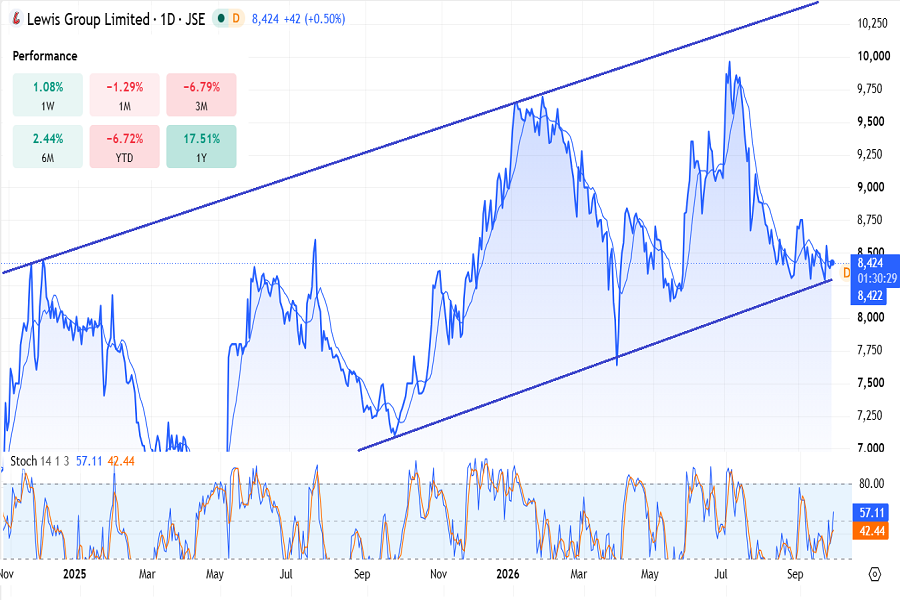
Lewis Group stocks on JSE, September 2026
Over a 12–20 month horizon, Lewis shares are in an uptrend: each low has been higher than the last (about R71 in October 2025, about R76.50 in early April 2026, about R81.50 in May), and the July high near R100 topped the January high of about R96.50.
Since July the share has been in a correction, falling roughly 16% from the high. A significant part of that move is the ex-dividend gap on 22 July, when the 560c final dividend came out of the price. That is a mechanical effect of the payout, not selling.
We are currently at the point where, based on the pattern of previous waves, a new upward wave should begin. However, as the market is currently reacting to the tightening of monetary policy, the correction is dragging on. Nevertheless, we remain optimistic and believe this offers an excellent entry point at a discount ahead of a potential rally. Meanwhile, technical analysis indicators are sending mixed signals.
SWOT analysis of the Lewis Group shares
Lewis's strengths as an investment are its high and rising dividend yield, its discipline in returning capital and a low multiple despite growing earnings. Its weaknesses stem from the nature of the business: the shareholder's outcome depends directly on how reliably customers pay, and book growth is increasingly funded with debt. The opportunities lie in the macro picture (SARB rate cuts make funding cheaper and support the consumer) and in a re-rating of the multiple if the company keeps showing stable book quality. The threats are also mostly macro: deteriorating payment behaviour, regulatory limits on consumer lending, a weak rand and more expensive imports. Bottom line: this is a share where the yield and valuation already compensate for a large part of the risk, but do not eliminate it.
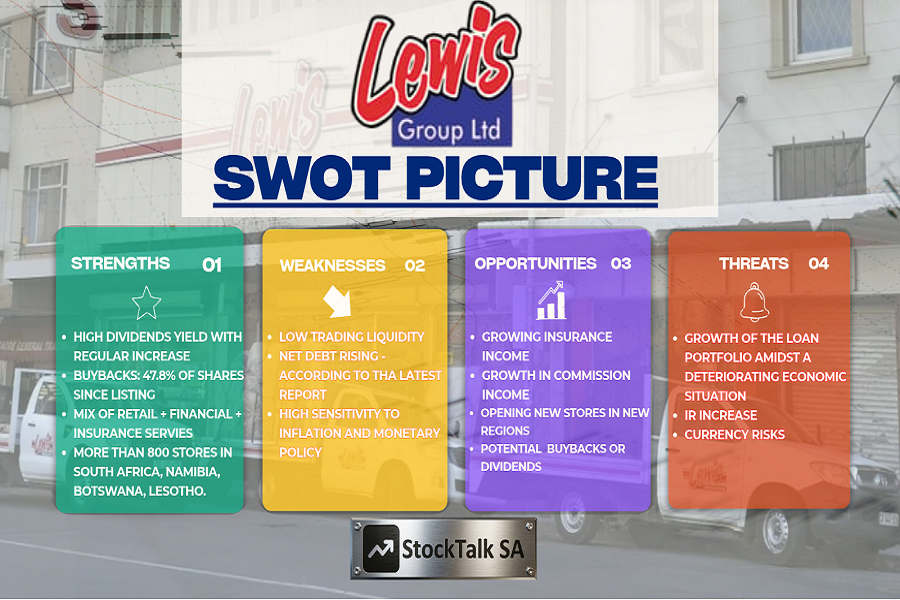
Lewis group SWOT-picture September 2026
Bull case. The credit book holds its quality at around 82–83% satisfactory payers, ROE moves towards the 17.5% target, and the SARB cutting cycle continues. In this scenario the dividend keeps growing at double-digit rates, and the market starts re-rating the share from a P/E of around 5 to higher levels. The investor gets both a 10–11% yield and price growth, with a break above R100.
Bear case. The South African consumer weakens, the share of satisfactory payers keeps falling, NPLs rise and the company has to increase provisions. At the same time debt-servicing costs climb, while higher freight costs and a weak rand squeeze margins. Earnings then stop growing, the dividend at a 55% payout stalls too, buybacks are scaled back, and the share drifts back to the bottom of its annual range around R70.
Idea of investing in Lewis Group stocks: Summary
Lewis Group is a classic "value plus dividend" idea on the JSE. A company with a 90-year history, stable management and the largest furniture chain in the region generates an ROE above 16%, grows earnings and pays a dividend yield of around 10–11%. Yet the market values it below book value.
This asset represents a "two-in-one" investment: on the one hand, you are investing in a non-food retail chain, while on the other, thanks to a distinct financial business line, you are investing in the financial sector. It is essentially an asset diversified across two sectors, though it remains sensitive to the economic climate and currency fluctuations in the countries where the company operates.
Driven by high dividend yields and share buyback practices, it is an attractive proposition, not necessarily for capital appreciation or a quick sale, but for holding a valuable asset that has proven its effectiveness over many years. Therefore, the idea of investing in Lewis Group is certainly worth considering.

John Nkosi
John is from South Africa and know local financial market as it's own. He works directly for Stocktalk and responsible for making regular JSE market news.
Comments
Loading comments…
Log in or sign up free to join the discussion.