JSE & Global Markets - Weekly review. Second week of October 2026


This week will be remembered as the moment the market began to seriously question the AI narrative for the first time. Investors started looking for alternatives. US inflation came in higher than expected, putting the possibility of a Federal Reserve rate hike as early as October back on the table, while concerns regarding how the race for AI infrastructure is being financed took a toll on the chip and software sectors. Capital didn’t leave the market; it simply shifted, moving from technology toward the "old economy." While the Nasdaq endured its worst week since June, the UK’s FTSE 100 and the JSE Top-40 both enjoyed their best week in six months. This caught many by surprise; few could have predicted that investors would suddenly turn away from AI and revisit assets previously dismissed as hopelessly outdated.
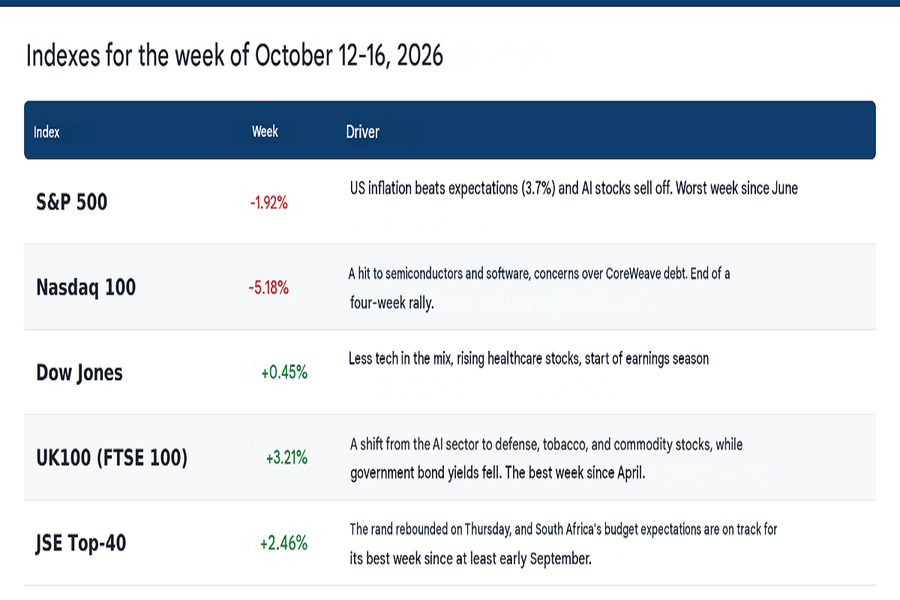
Indexes comparison table October 12-16 2026
The week split global indices into two camps. Indices heavily weighted toward technology declined: the S&P 500 lost 1.92%, while the Nasdaq 100 tumbled 5.18%. Conversely, indices with less exposure to the tech sector saw gains: the Dow Jones rose 0.45%, the UK’s UK100 climbed 3.21%, and South Africa’s Top 40 index added 2.46%. The primary reason is clear: investors scaled back their bets on AI and shifted capital into defensive sectors such as tobacco, real estate, commodities, and healthcare.
South African stock market in October, week 2
The local stock market remained fairly calm, seeing neither significant weekly rallies nor dramatic sell-offs driven by fundamental factors or corporate events that might have otherwise triggered a wave of selling or buying. Against this backdrop, the JSE Top 40 Index emerged as a key indicator of growing optimism and a renewed investor interest in traditional emerging-market assets - mainly unrelated to artificial intelligence.
Among a few corporate events of the week we meet outstanding financial report, published by iOCO (JSE: IOC). The technology group iOCO, formerly known as EOH, concluded its financial year (ending July 31) with a 39% increase in profit after tax. Earnings per share and headline earnings per share (HEPS) both rose by 42%. Revenue grew by 3% in constant currency terms, adjusted EBITDA increased by 21%, and the return on capital reached 35%. The company has secured new multi-year contracts valued at R2.1 billion and continues to execute share buybacks.
This week the JSE has announced the delisting of Tongaat Hulett, effective November 3. Once a giant in the sugar industry and a member of the Top-40 index, the company first listed in 1952; however, following an accounting scandal in 2019 and subsequent bankruptcy protection proceedings, its shares have not traded since July 2022. Shareholders will, in all likelihood, be left with nothing, as the company’s assets are being sold off to settle its debts. With the removal of Tongaat, the total number of delistings on the JSE for 2026 reaches 13, against only two new listings.
This story is reminder about high risk of losses upon investing even if you avoid speculative or low-liquid stocks. Investing in sugar industry sometime isn't sweet in fact, even if we're talking about the Company with long history.
JSE TOP-40 tech review for the second week of October
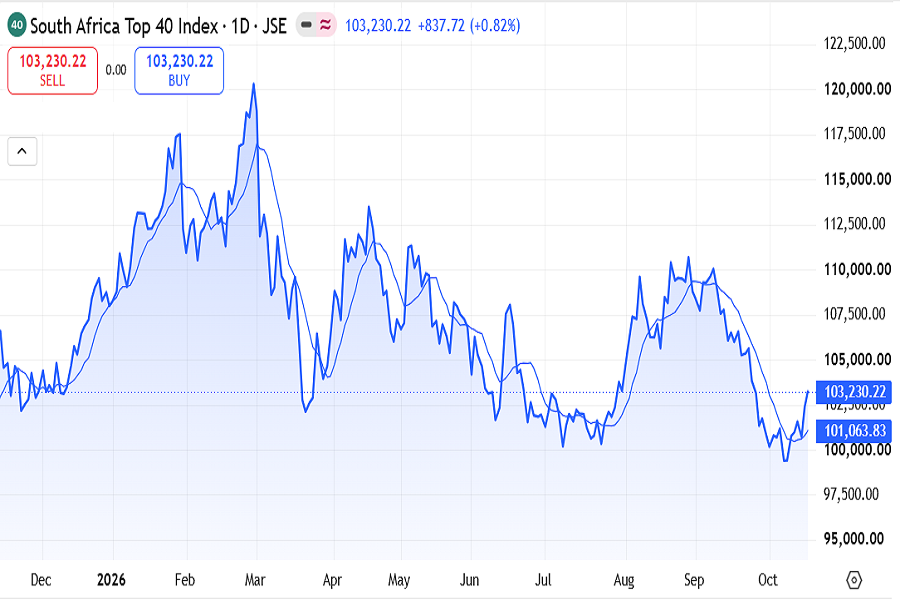
TOP-40 index October 12-16 2026
The index has experienced its best week in the last six months. Finally, some positive momentum has reached the major companies that make up the index. There is nothing extraordinary to be seen on the chart. Based on technical analysis, an upward wave was expected - a point we touched upon last time.
Technical indicators currently appear neutral, which leads us to the following outlook: the price correction could persist into next week, potentially continuing until the very end of October. The index might reach the 105,500-point level before the likelihood of a resumption of the downward trend increases.
British stock market in the middle of October 2026
London has almost no large technology companies; consequently, when investors pull back from AI, they shift their capital into the very sectors that make up the UK100: defense, tobacco, raw materials, and consumer goods. As a result, the index much like the South African, delivered its best performance in quite some time. Trading proceeded smoothly, free from any major shocks whether external or internal. The bulk of the gains occurred on Thursday (+1.08%, reaching a high not seen since late August), following the release of GDP data and a decline in the yields on British government bonds. On Friday, Bank of England Governor Andrew Bailey helped steady the market by downplaying the risks of "second-round" inflation.
Investing in British pub chains appears to be a trend this October on LSE. This week, Marston’s (LSE: MARS) stocks added in value +24.75%. So they caught our attention. One of the UK’s largest pub operators with over 1,300 establishments, announced that its pre-tax profit for the fiscal year would exceed even the most optimistic analyst forecasts.
The company’s profit is now more than triple what it was three years ago, and Marston’s has pledged to return capital to shareholders, likely through a share buyback program. Its key strategic advantage is the rebranding and reconfiguration of its pubs: after being converted into "Grandstand" sports pubs, locations see sales increase by approximately 30%. The company plans to renovate at least 100 more pubs next year, up from 60 this year. On the day the announcement was made, the stock price jumped by approximately 18%, then continued growth for the next three trading days in a row.
British crash of the week belongs to ActiveOps (LSE: AOM) stocks which lost -40.4%. Shares of the British developer of software for managing operational processes plummeted by nearly half on Monday. A major client announced that it would not be renewing its contract, which is set to expire in March 2027 and currently generates £3.8 million in recurring annual revenue for the company. The board of directors immediately excluded these funds from their plans and warned that revenue and profit for fiscal year 2028 would fall significantly short of analysts' expectations.
For a stock that the market had viewed as a growth story, the loss of a single client proved tantamount to a change in the narrative: over the course of a week, ActiveOps’ market capitalization shrank to approximately £80 million.
UK100 index tech review
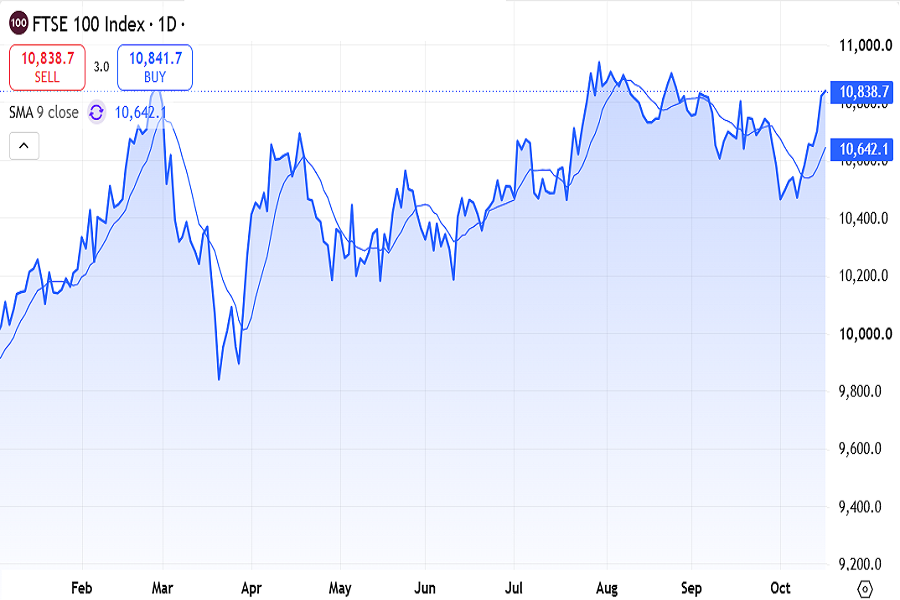
UK100 index October 12-16 2026
In fact, this index and the British stock market as a whole, can be considered the winners of this week, with the index posting the largest gain at 3.21%.
Following a significant price correction, the chart is finally in a position to recover. There is a strong possibility that the uptrend will continue. Technical analysis indicators also clearly point toward buying opportunities.
US stock market for October 2026, week 2
The U.S. stock market proved most vulnerable this week, amid a shift in investor sentiment regarding the AI sector. Software companies lost about $260 billion in market value over the course of a week. Another negative factor - inflation coming in higher than forecast, exerted additional pressure on the financial sector. The likelihood of an interest rate hike continues to rise.
Nevertheless, under these circumstances, there were companies that actually benefited from the market’s cooling toward high-tech, and some even made successful stock market debuts this week. Although listings and delistings on U.S. exchanges happen all the time, one company drew special attention.
A San Diego-based biotech firm, backed by Nvidia, ARK, and Sequoia, Iambic Therapeutics (NASDAQ: IAM) raised $150 million in an IPO, pricing its shares at $16. The company develops cancer drugs using artificial intelligence: its proprietary models propose molecules, while robotic laboratories synthesize and test hundreds of compounds each week.
For a few days Iambic Therapeutics stocks increased in price by 47% at the time when all AI-related Companies lost their positions. So they likely could perform better if IPO was a week before. Great debut anyway.
Nasdaq’s rally of the week leader is Bending Spoons stocks with +23.7% growth. Shares of the Italian company, which owns Evernote, Vimeo, WeTransfer, and AOL- surged 41% on Wednesday following news that Berkshire Hathaway would invest an additional $330 million. The holding company will purchase 10 million new shares at $33 each, bringing its total investment in Bending Spoons to $930 million. Interestingly, Berkshire is buying in below the market price at a discount of about 13% but this did not deter investors; for the market, Berkshire’s involvement served as a seal of quality.
You might ask how a software company, which was in the negative trend this week, managed to be the best performer on the stock exchange? Well, They had a margin of resilience that they hadn’t completely squandered. On Friday they lost 15.6% in value but still left the best on the stock exchange. Also, we're not talking about a software developer, but rather an investment company that buys up software developers with their mature products.
Weekly rally on the NYSE: FIGS with +20.4% growth. Shares of the American medical apparel manufacturer hit a new 52-week high. The company sells modern surgical scrubs directly to doctors and nurses online. Can you recall a time when a uniform manufacturer became the top performer on the U.S. stock market? That is exactly what just happened this past week.
Over the week, several analytical services upgraded their ratings for the stock, and an industry report named FIGS the top-performing apparel company of the quarter. Earlier this month they published strong financial report and The search for non-AI-related assets has certainly boosted demand for FIGS stocks.
At the same time the main case of crash of the week on the US market isn't a case of sells of AI-related stocks but a reminder that no relation to the tech sector and AI weren't a guarantee of success this week.
Cardinal Infrastructure Group (Nasdaq: CDNL) lost -30.24%. Shares of this North Carolina-based construction company, which installs utility infrastructure and prepares sites for development, have fallen below their December 2025 IPO price. The decline was triggered by a major acquisition: Cardinal is purchasing the Florida-based contractor Hughes Brothers.
The company will pay using a combination of new shares, cash, and $156 million in new debt. This marks its fourth acquisition of the year, and investors are clearly nervous: it was precisely the integration challenges following one of the previous acquisitions that led to a disappointing quarterly report in August and a 36% plunge in the company’s stock price.
In other words, the issue isn’t that the company is growing and becoming larger and stronger. Rather, the company is expanding beyond its means, and as a result, it is becoming more burdened.
US indices for the second week of October - tech review
S&P500
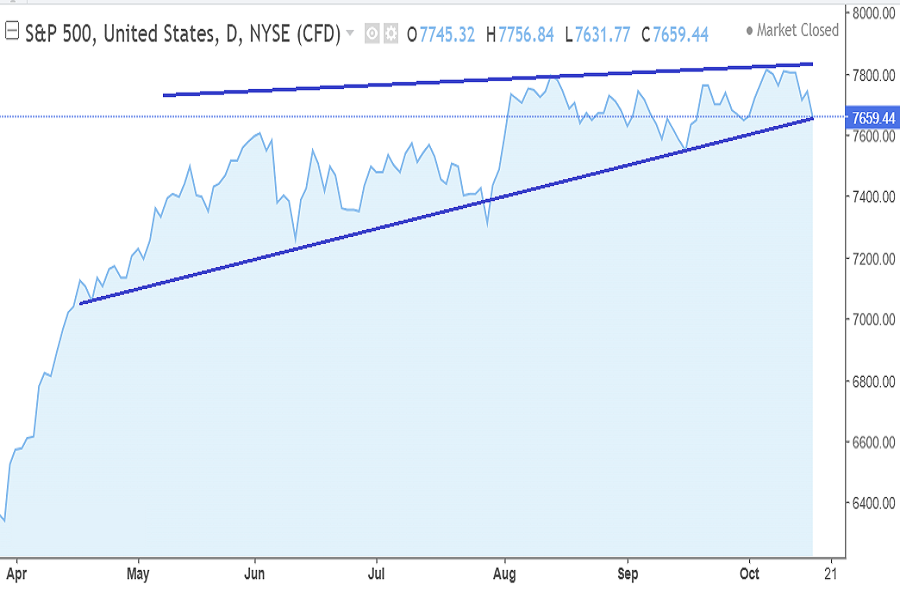
S&P500 index October 12-16 2026
After reaching an all-time high last week, the index is - as expected, taking a pause and undergoing a correction, though this has occurred more rapidly than one might have anticipated. That said, oscillators had already signaled that the index was overbought. It could just as quickly return to growth, potentially as early as next week. While certain technical analysis indicators do not align with our assessment that an upward trend will soon resume, technical analysis itself provides no grounds to question the existing uptrend, nor does it show any signs of a reversal.
2. Dow Jones index (DJI)
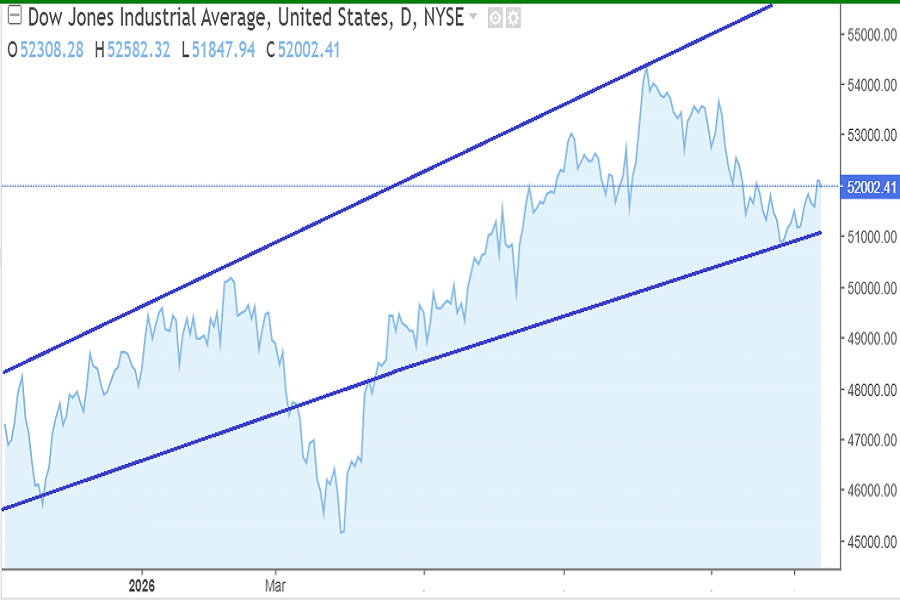
Dow Jones index October 12-16, 2026
The only one of the three indices to remain formally in the green this week is still searching for better form. Last week, we anticipated the conclusion of a price correction and the potential for an upward move. While growth is occurring, the upward momentum remains weak. Even technical analysis indicators have begun to go dormant over shorter timeframes. Perhaps we simply need to allow for more time.
3. Nasdaq 100 index tech review
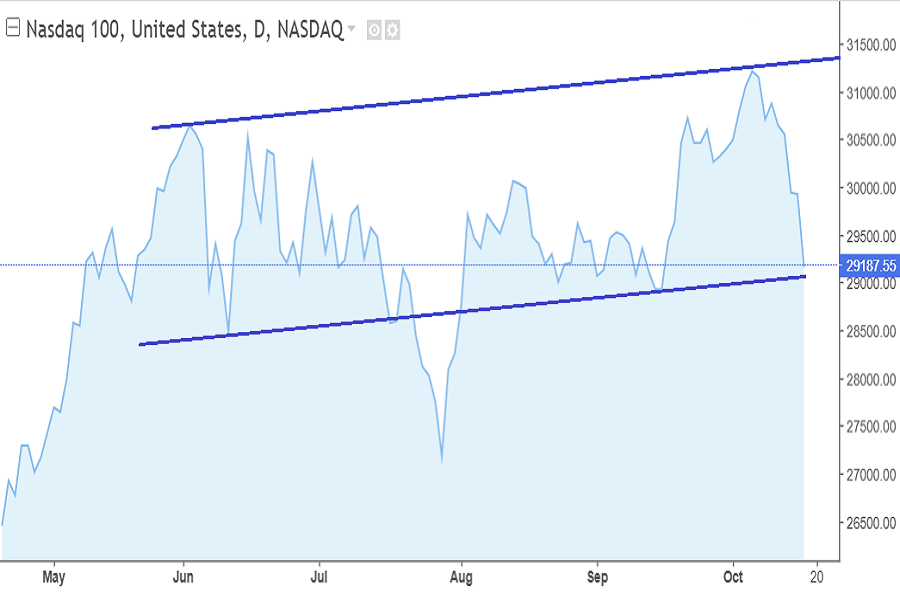
Nasdaq 100 index October 12-16 2026
The most volatile of all the indices has once again demonstrated its high volatility, though, unfortunately, not in the direction investors would have liked. A loss of over 5% in a single week is quite significant for an index; in this instance, it wiped out all the gains made over the past 30 days. Nevertheless, we remain within an upward trend. Despite signals from technical analysis indicators, which were heavily influenced by the recent rally, we anticipate a recovery period ahead. However, this recovery may not be as rapid as one might hope, as the market will remain sensitive to any signals from the Federal Reserve leading up to October 28th - not necessarily negative signals, but sensitive nonetheless. On the other hand, many investors have viewed the pullback from the highs - both for the index itself and for its constituent companies as an opportunity to purchase leading-edge firms at a discount. If you share this perspective, you know what to do.
Key currencies in the middle of October 2026. Fast review
EUR/USD
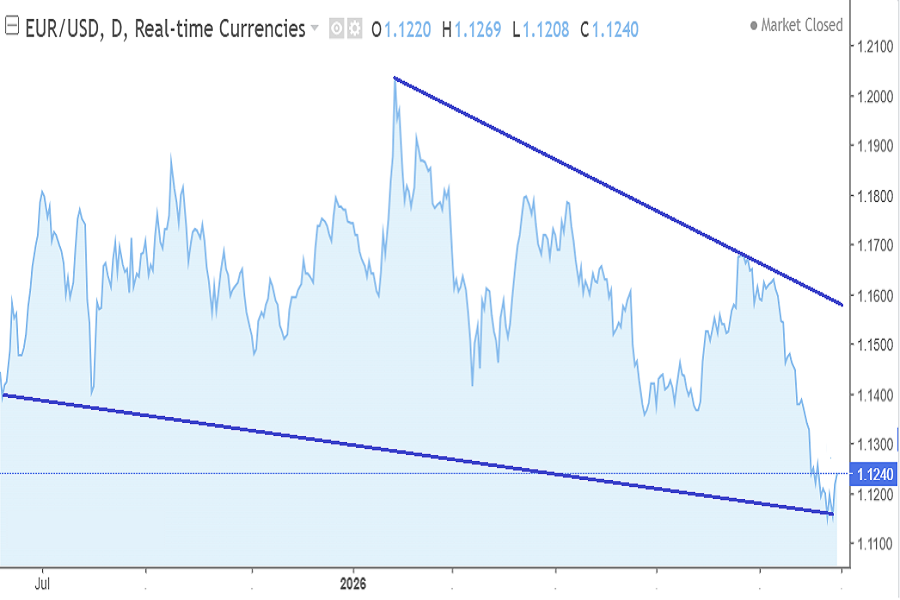
EUR/USD chart, October 2026
This week saw a consolidation in exchange rates. The dollar was weakened by accelerating inflation, while the euro had already been under pressure for some time. The currency pairs remained evenly matched, resulting in price movements that fell within the margin of statistical error. From a technical analysis perspective, this type of consolidation serves as a setup for an upward move, favoring the euro. If we assume that the Federal Reserve leaves interest rates unchanged on October 28, the scenario for a significant price correction will fully materialize.
2. USD/ZAR
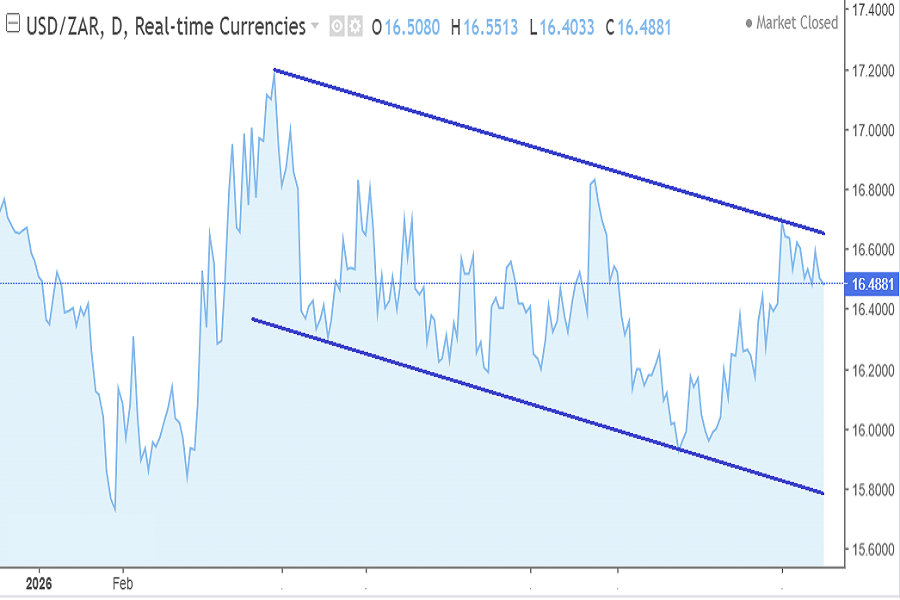
USD/ZAR chart October 2026
The rand moved just 0.2% over the week. There is a positive aspect to this movement: the rand is behaving exactly as we anticipated, following its downward trend (which, for the rand, represents an appreciation). On the other hand, there is less favorable news, as a 0.2% shift effectively amounts to stagnation, though some might characterize it as a moment of stability. Technical analysis indicators have begun to signal in conflicting directions, yet we remain confident in our forecast that the rand will strengthen.
3. GBP/USD
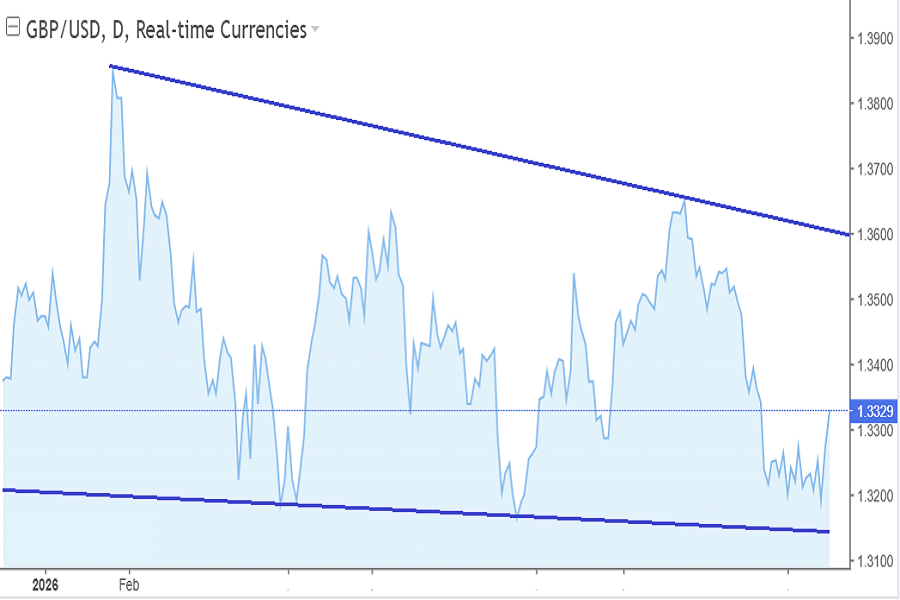
GBP/USD chart October 2026
The pound emerged as the top performer among the three currencies for the week, climbing above 1.3330 on Friday to reach a three-week high. In addition to a weak dollar, it was bolstered by unexpectedly strong data: UK GDP grew in August, driven by the industrial sector. The market has begun pricing in an interest rate hike by the Bank of England as early as November.
Tech indicators show us moderate Buy signal and we believe it's correct. According to our expectation Pound will increase to 1.3400-1.3450 levels and then can reverse down according to the downward trend.
JSE & Global markets in October, Week 2: Summary
This week has been unlike those seen in September or October. Over the past few months, we have not seen such a cooling of interest toward the AI and software sectors, nor such a pronounced shift toward traditional assets, driven primarily by the fact that they fall outside the technology space. That said, even in a week like this, some AI-related companies managed to stage the strongest rallies, proving that every rule has its exceptions.
Whether this shift in investor sentiment and attitude toward AI assets represents a new, lasting trend or merely a pause before a fresh wave of buying remains to be seen. Our own subjective forecast is: no, this will not last long. As soon as investors see the figures in the earnings reports from technology companies, they will begin snapping up their shares once again. Traditional assets will have to find their own, independent justifications for why they deserve investor attention.

Stan Lytynsky
Stan Lytynsky is a well known financial expert with more than 1000 of market reviews. For the last 10 years he wrote reviews for different blogs and websites. In particular he worked for SuperForex and Zetradex forex brokers as a market analyst. Currently he is living in Canada and focused on the African market as the most promising and growing.
Comments
Loading comments…
Log in or sign up free to join the discussion.