JSE TOP-40 in October 2026. Review and forecast

John Nkosi
The companies comprising the index were not included there by chance. They represent the stock exchange’s elite - South Africa’s largest companies with the highest market capitalization. Yet, when viewed collectively, they appear the most vulnerable today; they are struggling to find a foothold and are disappointing investors with their stagnation or lack of clear upward momentum. Why? Let's review right now.
A month ago, it looked as though the Top-40 had found its footing. August had been the JSE’s best month among major markets. The index broke out of its summer consolidation and spent the first week of September above 109,000 points. Five weeks later, almost nothing of that rally remains. The index is back at the 100,000-point line, where it stood in late July. September threw everything at the South African market at once: a Fed rate hike, a SARB rate hike, a correction in gold and platinum, weakness in Naspers and Prosus, and then a weaker rand and record fuel price increases. Let’s look at what happened and where the index might find support.
JSE TOP 40 index a month ago and today
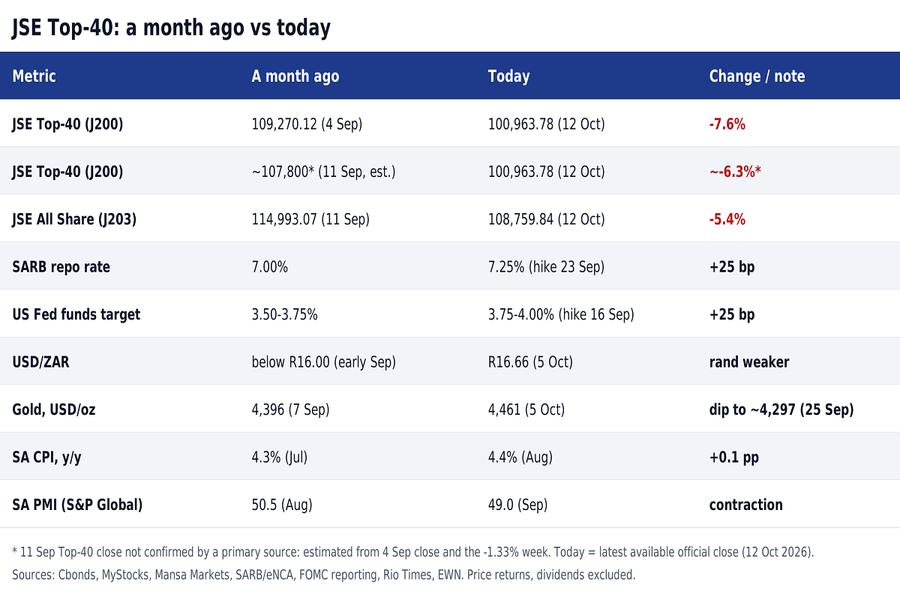
On 4 September, the Top-40 closed at 109,270 points. On 12 October, it stood at 100,964 points, roughly −7.6%. Over the same period, the broader All Share slipped below 109,000. September was the All Share’s worst month since March, at −6.7%. The index gave back all of its August gains and ended the third quarter 15.5% below its February high.
The heaviest blow landed on mining, the sector the Top-40 is built on. In September, gold miners lost about 15% and platinum producers about 7%. Together they knocked more than three percentage points off the index. The second source of pressure was the tech block. Naspers fell 12% and Prosus 8%, following Tencent lower. Among the large caps, only a handful of financial and retail names stayed in positive territory, such as Shoprite and Old Mutual.
The monetary backdrop has turned towards tightening. On 16 September, the Fed under Kevin Warsh unanimously raised its rate to 3.75–4.00%. It was the first hike since 2023, and FOMC projections leave room for one more before year-end. A week later, on 23 September, the SARB also unanimously raised the repo rate to 7.25%. Governor Kganyago said the fuel price shock was intensifying rather than fading. He warned that inflation could exceed 5% in the fourth quarter. The rand did not strengthen on the hike, because the market had already priced it in. On 1 October, the rand lost 1.5% in a single day and fell to its weakest level since late July.
Early October added more bad news on the domestic economy. The composite PMI fell to 49.0, the lowest of the year and in contraction territory. From 7 October, petrol rose by R3.33 a litre to a record R30.25. For an index with significant weightings in banks, retail and consumer companies, that is a direct hit to earnings expectations.
The index tech review for October 2026
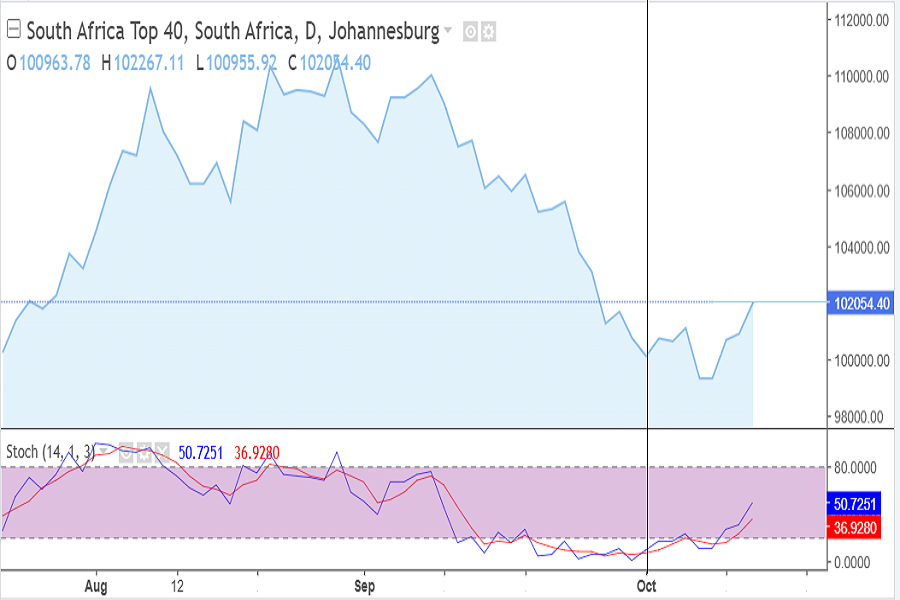
JSE Top40 index in October 2026
The market structure remains bearish. However you can see the rates in the oversold zone. We believe October is going to be a period of the price correction or consolidation for the index.
The key point: no signs of trend reversal but now is the time for upward wave.
Tech indicators still show us Sell signal in the long term and it's true signal.
The index has returned to its summer consolidation zone. In late June and July, it spent a long time in the 101,400–102,000 range, and it is now trading there. A break of the summer base is a warning sign. Confirmation would need several closes below 100,000.
So, the pace of the decline has been steep: about 8% in five weeks with no meaningful bounce. That raises the chance of a technical pause, but a pause on its own does not mean a reversal.
Forecast for JSE TOP-40 index in October 2026
Base case: consolidation in a 98,000–104,000 range through the end of October. The market needs to digest two rate hikes and wait for fresh data: South Africa’s September inflation, the next Fed decision and the direction of the rand. After a sharp decline, sideways trading near the yearly lows is the most likely outcome.
Bull case: a return above 104,000. This becomes possible if three things line up: gold and platinum recover, the rand returns to R16 per dollar, and the Fed signals that the September hike was a one-off. In that case, the 101,400–102,000 zone becomes a launch pad, with 107,800–109,500 as the target.
Bear case: a sustained close below 98,000. This becomes possible if the Fed hikes again, oil keeps rising and South African inflation moves above 5%. In that case, the index would break below its 12-month lows, and confirmed data does not show a clear support level below 97,500.
What to watch: the Fed’s next decision (late October or early November; sources disagree on the date), the SARB meeting in November, the gold price, USD/ZAR and the November fuel price adjustment.
Conclusion
October has not brought the market a reversal so far. It has returned the market to where it started and give another breath before further way ahead. Over the month, the Top-40 lost its entire August gain and is once again at 100,000 points, a level that already served as the floor over the summer. The difference from July is that the backdrop is tougher now. Rates are rising in both the US and South Africa, the rand is weaker, business activity is contracting and fuel prices are at a record. At the same time, the index is oversold on the speed of its decline and is sitting at its yearly lows. The coming weeks will therefore be a test: will the 98,000–100,000 zone hold as the floor of the consolidation, or will it turn into a breakdown point? As long as the index stays below 102,000, the trend remains bearish.

John Nkosi
John is from South Africa and know local financial market as it's own. He works directly for Stocktalk and responsible for making regular JSE market news.
Comments
Loading comments…
Log in or sign up free to join the discussion.