JSE TOP-40 index: June review and forecast

John Nkosi
The TOP-40 index is a benchmark for many investors, an indicator of market sentiment and South Africa's investment attractiveness. It would seem what could possibly go wrong? The index includes stock prices of the largest, strongest players on the market, meaning it should paint a good picture despite the problems of some companies. However, in reality, companies not included in the index are stronger, but they remain unnoticed against a backdrop of an index that has been falling for more than two months. Why the index has become a weak link on the stock exchange? We'll explore this right now.
To understand the weakness of the TOP-40, we need to look at its composition. It's not a pure "South Africa Inc." - it's a concentrated bet on a few heavyweights. The index includes the 40 largest companies by market capitalization on the JSE and is essentially determined by the performance of a narrow group: Naspers/Prosus holdings (through its stake in Tencent), mining companies, and Richemont. This concentration is the root of the problem.
What's fundamentally weighing on the index?
is the main drag. The very same gold and platinum mining stocks that propelled the JSE to records in 2025 have reversed course against the index this quarter. According to Bloomberg (via News24, June 30, 2026), precious metal miners have gone from being a locomotive to a liability, dragging the benchmark index to its worst quarter in more than two years. Currently, the TOP-40 is hovering around 101,833 points, while the RESI 10 (resource subindex) is at around 104,165.
The mining sector – structural discount. The index's second-largest performer is under pressure from its own problems. From peaks above R1,030 in October 2025, Naspers shares have lost around 30%, entering a protracted consolidation phase. The reason isn't operational: the business is growing (revenue is $7.2 billion, e-commerce is up 21%, adjusted EBIT is positive), but investors continue to apply a significant holding discount to the company's valuation due to its stake in Tencent. Goldman Sachs initiated coverage with a neutral rating in June.
Sectors are under pressure from several factors: rand volatility, geopolitics (US-Iran tensions), and fluctuating commodity prices. The rand's effect is twofold: a weak rand benefits exporters and multinationals, but hurts retailers (Shoprite, Woolworths) and companies with dollar-denominated debt.
JSE TOP-40: Finding the Bottom or preparing to unlock te next level?
Since April 17, 2026, quotes have been moving in a downward trend with high volatility. Currently, they are near the local minimum of the last 12 months. There are no signs of consolidation or reversal. The potential for a downside is unlimited, as several years ago, quotes were at levels much lower than current ones. Now is the key moment in testing the 2025 levels. A breakthrough of these levels will open a new downward momentum. A retreat from the lows will signal a reversal or consolidation.
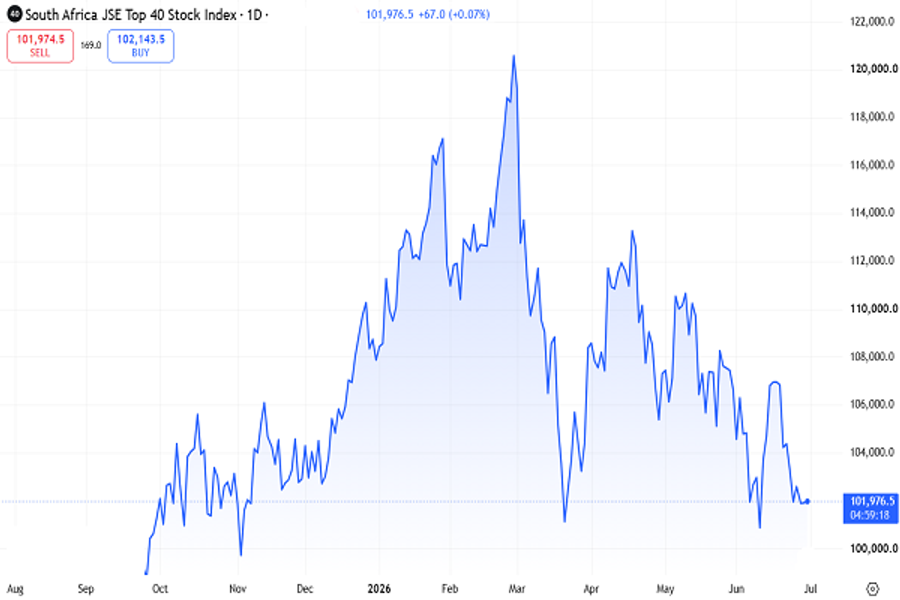
JSE TOP-40 index, chart June 2026
The chart has tested the 200-day moving average (200-MA), which historically serves as a strong support level for long-term investors.
The RSI (relative strength index) indicator and the stochastic oscillator on the daily and weekly timeframes have entered the oversold zone. This signals that the falling momentum is running out and a technical upward rebound is brewing in the market.
The nearest key support zone has formed in the area of 101,000 – 101,500 points. Maintaining this milestone is critical to maintaining the global bullish trend.
Thus tech indicators show us sell signal.
What's next for investors in the JSE Top 40?
Most analysts view the current index pullback not as the beginning of a protracted crisis, but as a window of opportunity for Bargain Hunting.
Scenarios:
: Commodity market stabilization in the second half of the year and the SARB's initial steps to lower interest rates will restore interest in the index. The JSE Top 40 will return to growth and attempt to retest historical highs above 120,000 points by the end of 2026 or early 2027. Banking and retail sectors will be a priority.
If macroeconomic data from major economies (US, China) worsens and geopolitics triggers a new round of inflation, the index could temporarily break local support and enter a deeper consolidation toward the levels seen at the end of 2024.
JSE 40 Investor Summary
A falling Top 40 is a story about concentration, not a diagnosis of the market. The companies worth watching may be the ones outside the index. It can be strong, and unnoticed, precisely because the giants are dragging the headline number down.
The South African market is temporarily oversold due to external factors. For long-term investors, the current levels of the JSE Top 40 offer interesting entry points based on the country's strong financial sector and expected domestic economic reforms.
This article is for educational and informational purposes only and does not constitute financial advice or a recommendation to buy, sell or hold any security. Always do your own research.

John Nkosi
John is from South Africa and know local financial market as it's own. He works directly for Stocktalk and responsible for making regular JSE market news.
Comments
Loading comments…
Log in or sign up free to join the discussion.