USD/ZAR fundamental review & forecast. July version

John Nkosi
ZAR's expectations vs Reality in July
For a long time, USD/ZAR was a predictable currency pair with limited volatility. It seemed nothing threatened the rand's strengthening—no economic indicators in the US or other events. Neither geopolitical events nor rising inflation hindered this, for one simple reason: the course toward higher rates was unquestionable. This was reflected in the price of every stock on the exchange. Everything changed overnight, today. The reality turned out to be completely different from what investors in the market had expected.
The Rand a Month Ago vs. Today
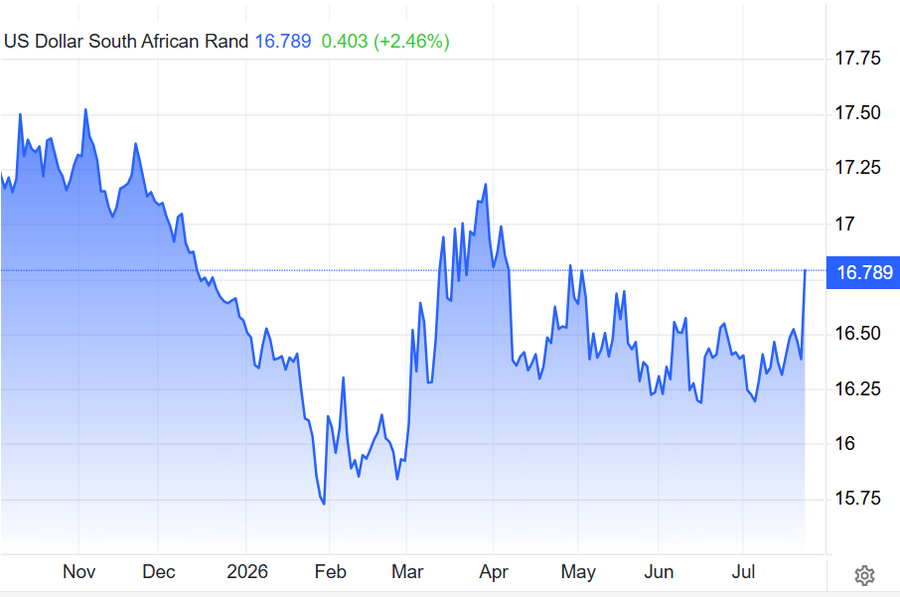
Through June and the first half of July, USD/ZAR was drifting slowly lower — the rand quietly strengthening within a roughly 16.3–16.6 range. The chart looked stable: following SARB's May hike (its first in three years, from 6.75% to 7.00%), markets were pricing in the possibility of another move up amid accelerating inflation. An added risk factor was the escalating Middle East conflict and rising oil prices — but it was the expectation of further SARB tightening that kept the rand from weakening.
Today, it became clear the market had misjudged the outcome. June inflation accelerated to 5.0% y/y, a two-year high, up from 4.5% in May data many saw as the final argument for another rate hike. Instead, the Monetary Policy Committee voted to hold the repo rate steady at 7.00% (Nedbank, for comparison, had priced in a 25bp hike).
The market's reaction was sharp. The pair opened at 16.837, spiked intraday to 16.92 - its highest level since early May and settled near the April 30 closing level (16.7684), which had served as the upper boundary of the range for months. In effect, the rand gave back almost all the strength it had built since late April, even though the broader geopolitical and oil-price backdrop hadn't fundamentally shifted.
Technical Analysis for USD/ZAR
Following today's spike triggered by the SARB decision, the rand weakened significantly, and USD/ZAR broke through the key resistance level around 16.77 that had capped the pair since late April. A breakout like this typically flips daily technical indicators toward Strong Buy, meaning it's a bullish signal for the dollar and bearish for the rand.
USD/ZAR July 2026 chart
That signal shouldn't be dismissed as noise: the chart has genuinely stopped behaving like a clean downtrend. The 16.19 support level has been tested repeatedly over recent months and has held, including a retest in June, after which the pair reversed higher. After such a sharp one-day rally, a short-term pullback would be the logical expectation, but the shift in near-term momentum toward the dollar is currently confirmed by both price action and the indicators.
SWOT picture of Investing in the Rand Today
SWOT-picture of investing in ZAR in July 2026
Bull vs. bear case:
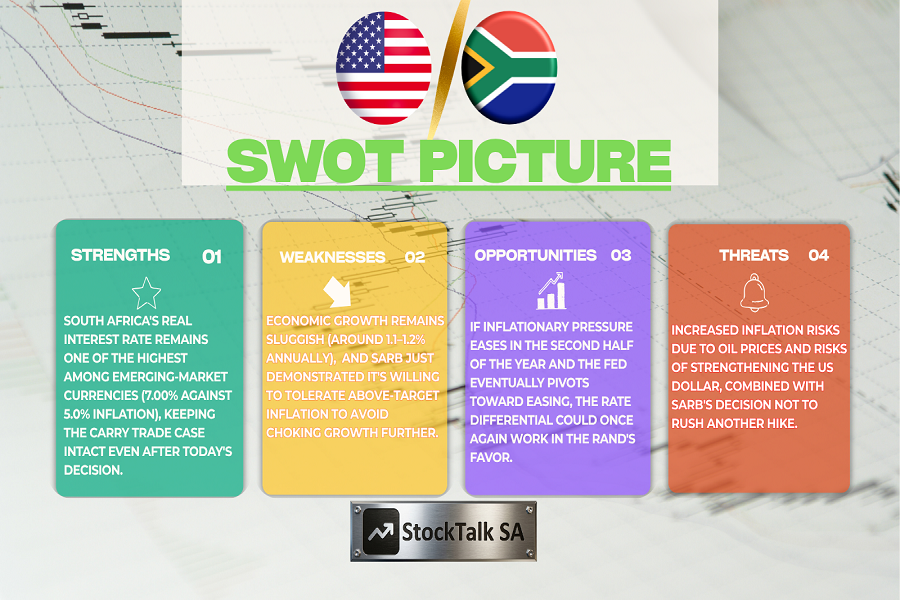
- Bull case: the real rate differential hasn't gone anywhere, and today's move is a reaction to a single decision, not a reversal of the underlying trend. If inflation turns lower from here, SARB has no need to tighten further, and the rand's slow-grind strengthening could resume.
- Bear case: SARB just showed it will tolerate above-target inflation to protect growth — that changes the calculus for carry traders who were pricing in more tightening. Layer on further oil-price pressure from an escalating Middle East conflict, and the pressure on the rand could prove more persistent than a one-day event.
- Right now, the market is voting for the bear case: the break above 16.77 and the flip in the indicators show that's the scenario traders are currently pricing in, not the first one.
USD/ZAR Monthly Forecast and Trading Drivers
1. The US Federal Reserve's interest rate meeting (next Wednesday) will determine the trajectory of the US dollar itself.
2. The US Q2 GDP report (next Thursday) will demonstrate the resilience of the US economy.
The following events will be decisive for the USD/ZAR pair in the coming weeks:: Buying the USD/ZAR pair immediately after a strong daily rally at its peak is not recommended. The optimal strategy is to wait a few days for initial market volatility to subside. Once further consolidation becomes clear, new long positions can be opened on local pullbacks.
Summary
As it turns out, the price movements of the past few months were a vote of confidence, which investors have now repaid. This happens sometimes. This is a reminder of how official decisions can change everything in a single day. A few days ago, we would have said the downward trend was continuing and there were no signs of a reversal. Today, we're saying this isn't just a price correction, but a likely trend reversal. Either way, investors will have to start over in a new reality, where monetary policy tightening isn't a certainty, but a relatively likely future event.

John Nkosi
John is from South Africa and know local financial market as it's own. He works directly for Stocktalk and responsible for making regular JSE market news.
Comments
Loading comments…
Log in or sign up free to join the discussion.