USD/ZAR: fundamental review & forecast

John Nkosi
The Rand in Early June
In early June, geopolitical tensions escalated, supporting the rand on rising gold prices and rising demand for industrial metals.
Our previous analysis of this currency pair indicated a continuation of the steady downtrend (ZAR strengthening against the USD). Current market dynamics fully confirm this forecast. Investors who opened short positions (sell) approximately 20 days ago were forced to wait out a minor short-term correction (drawdown), but subsequently the pair demonstrated a confident, albeit moderate, decline.
What Factors Led to This?
The current strengthening of the Rand is a product of combined external geopolitical factors and domestic macroeconomic developments:
- Geopolitical Conflict (Iran — US): The escalation of conflict between the US and Iran prompted a flight of capital toward defensive commodity assets, triggering a prolonged rally in the gold market, with South Africa acting as a key beneficiary.
- Domestic Inflation: According to the latest statistical data, South Africa's inflation rate dropped to 4.5%, coming in below market consensus expectations. Price stabilization enhances the real yield of local assets and reinforces the Rand.
- SARB Monetary Policy: The South African Reserve Bank's hawkish stance and consecutive interest rate hikes have maintained an attractive yield spread for carry trade operations, capturing foreign capital inflows.
- US Fed Monetary Policy: Despite persistent hawkish signals from the US regulator that locally cushion the USD decline, the global commodity cycle exerts a more dominant influence on the pair's trajectory.
- Other Factors (Additional): These include an improving South African trade balance driven by robust exports of platinum and coal amid Europe's energy transition, alongside improved global sentiment toward resource-rich emerging markets
Technical Analysis
In terms of price action, the USD/ZAR chart since May 2026 looks like Ai-drawn - clean, symmetrical waves and a steady decline without non-market spikes. Today we see another downward impulse in the rand's favour with no signs of being overbought or oversold. Last week the pair already tested the 16.14–16.19 zone. The rand has grounds to test its yearly low, recorded near 15.73 (28 January). Technical indicators are mixed, but the structure remains downward.
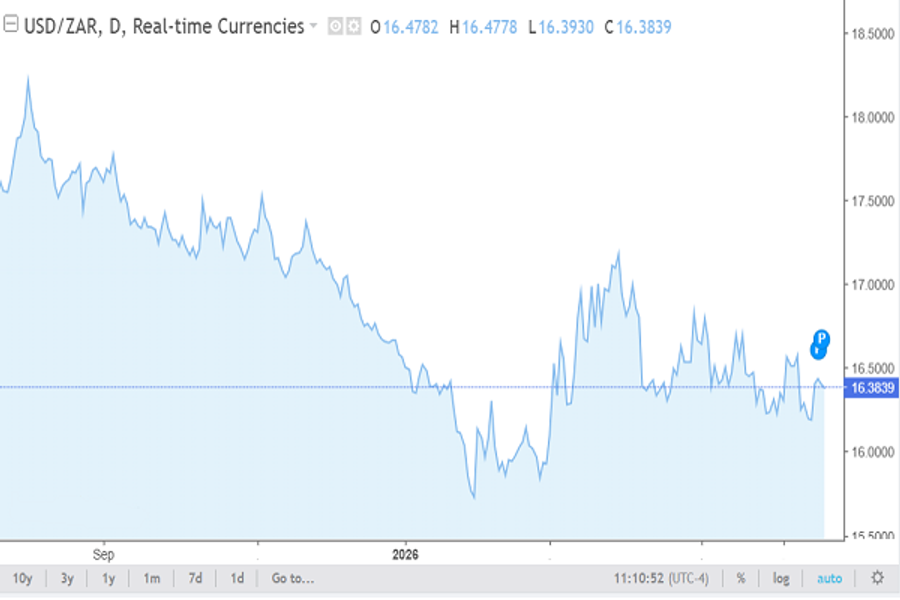
USD/ZAR chart, June 22, 2026
SWOT-picture of investments in Rand
The currency's defining feature is that it responds to geopolitics through two opposing channels. On one side, South Africa is a major gold exporter, so escalation in the Iran–US conflict and a rising gold price support the rand via export revenue. On the other, that same escalation pushes oil higher, and as a net energy importer South Africa faces rising inflation and pressure on the rand. De-escalation reverses both channels: gold and oil fall together, and the rand's fate is then decided by other factors - risk appetite, the carry at a 7% policy rate, and Fed policy. That is precisely the dynamic now in play. The currency's strengths coexist with durable structural weaknesses - sluggish growth and dependence on external conditions. So its current support is real but rests on a shifting balance of forces.
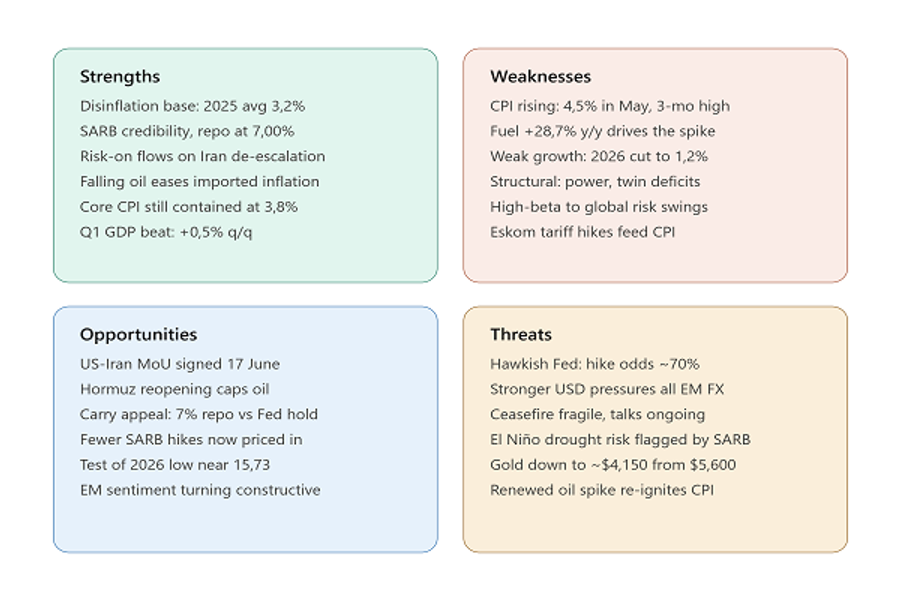
investments in ZAR - SWOT analysis, June 2026
The Rand in the Near Term
Exchange rate dynamics in the coming weeks will be heavily guided by a high-impact macroeconomic calendar:
- Current Week: Attention should be focused on the US Purchasing Managers' Index (PMI) data, revised Q1 GDP figures, and US-Iran geopolitical updates. In South Africa, the Producer Price Index (PPI) will be released, reflecting industrial inflation trends.
- Next Week: The market will closely watch the key US labor market report (Non-Farm Payrolls), South Africa's Trade Balance data, and the S&P Global manufacturing PMI for South Africa.
The baseline scenario projects a continuation of the steady downtrend without deep upward price corrections. There are currently no technical or fundamental signs of a reversal in the long-term trend.
Bottom Line
The rand has firmed to multi-month highs on a combination of Iran–US de-escalation, falling oil, and a still-attractive carry at a 7% policy rate. The move is real and fundamentally supported, but it rests on two fragile pillars - the ceasefire and the Fed pause. While both hold, the path of least resistance for the rand is lower on USD/ZAR, with a potential test of the yearly low. This is no longer the one-way bet it was in May: anyone shorting USD/ZAR should keep a stop above the recent highs and watch the headlines from Switzerland and Fed rhetoric. The base case is a moderate continuation in the rand's favour; the risk scenario is a sharp bounce if the deal falls through.
This article is for educational and informational purposes only and does not constitute financial advice or a recommendation to buy, sell or hold any security. Always do your own research.

John Nkosi
John is from South Africa and know local financial market as it's own. He works directly for Stocktalk and responsible for making regular JSE market news.
Comments
Loading comments…
Log in or sign up free to join the discussion.