Merafe Resources - Special review. An energy deadlock turned into a dividend holiday

John Nkosi
In the world of mining and metallurgy, there's a rule: if your furnaces go dark, your stock plummets. But South African chrome giant Merafe Resources (JSE: MRF) has rewritten that script.
The 2026 H1 report is a proof of incredible operational flexibility. Merafe has shown that it's not "hostage" to its smelters. The company has learned to profit from ore when the energy sector is paralyzed and return to smelting when tariffs normalize.
The company's ferrochrome production has plummeted by a catastrophic 75%. Of the three large smelting complexes in its joint venture with Glencore, only one was operating at half capacity at the beginning of the year. Under normal circumstances, this would have meant bankruptcy and massive layoffs.
However, the numbers on the scoreboard show not a disaster, but a triumph: Merafe's net profit soared 120% to R512 million, revenue rose 36% to R3.43 billion, and the interim dividend jumped fourfold, from 4 to 16 cents per share. How did Johannesburg miners turn industrial collapse into record profits? Let's find out
Anatomy of a Report: Commodity Lifebuoy
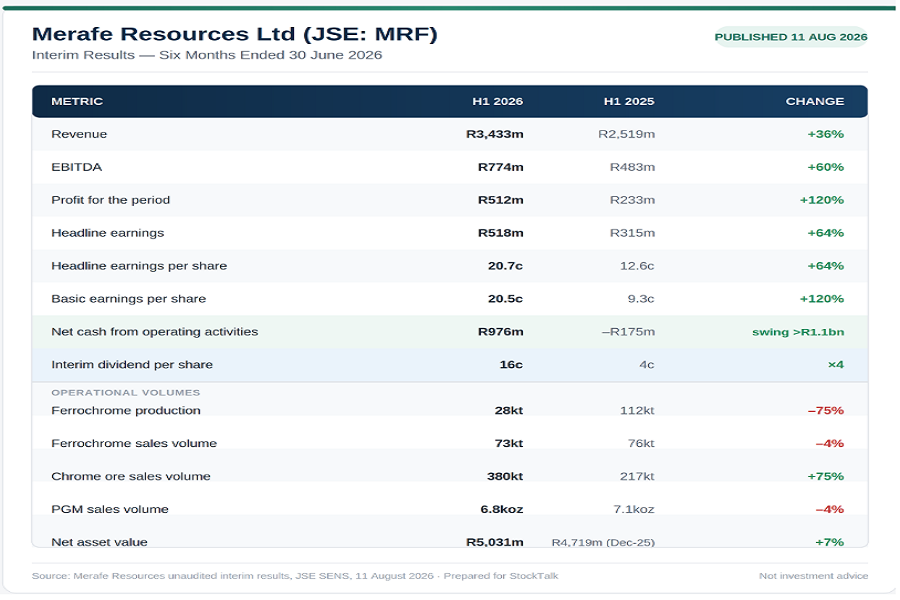
Shocking financial report of H1 for Merafe Resources
The secret to a fantastic first half of 2026 lies in a rapid change in business model. Historically, South Africa has been the world's main center for processing chromium into ferrochrome, a key alloy for stainless steel production. But squeezed in the grip of the energy crisis and Eskom's unrealistic tariffs (electricity costs reached almost R2 per kWh, with a viable threshold of 62 cents), smelting began to make losses.
The most important context for the past two years has been the electricity crisis in South Africa's ferrochrome industry. Electricity accounts for 40% to 60% of the ferroalloy industry's production costs, and Eskom's standard industrial tariff made smelting uneconomic. In September 2025, Venture began layoffs under Section 189 of the Labor Code, and shortly thereafter, Glencore confirmed the closure of the Boshoek and Wonderkop melters, effective January 1, with layoff notices for 2,400 workers. By early 2026, the situation had become critical: only 11 of the country's 66 ferrochrome melters were operational, and Glencore-Merafe had only one furnace out of five.
Then, the Glencore-Merafe Chrome Venture joint venture relied on what had previously been considered a "raw material appendage" - the direct sale of unprocessed chrome ore. Management itself, judging by independent market commentary immediately after publication, points to risks for the second half of the year - a potential oversupply from China and weak global demand for stainless steel.
Technical picture and drivers
Since the beginning of 2026, JSE:MRF shares have risen from a modest 94 cents to local peaks around 150 ZAC (1.50 ZAR), adding over 35%.
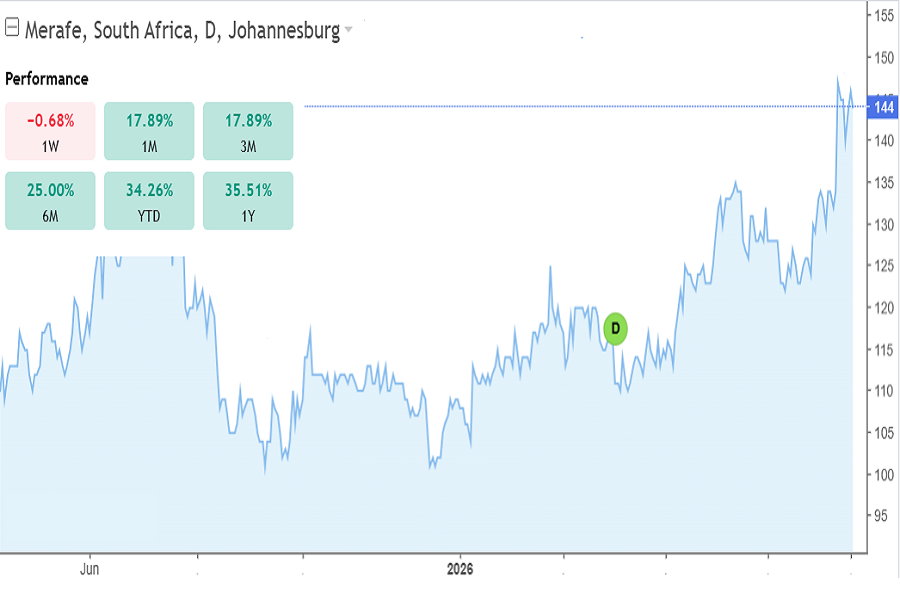
Merafe Resources, chart August 2026
On the daily chart, we see a rapid uptrend, with technical analysis indicators showing a Buy signal. Although the stock appears to be at its highs, Merafe stock has actually reached higher levels of 192-197 ZAC, although this has only happened twice in the last 10 years. However, if a positive scenario materializes, according to forecasts, stocks could rise by another 25% over the next 12 months. Either way, the current uptrend is far from over.
Investment Profile SWOT Summary
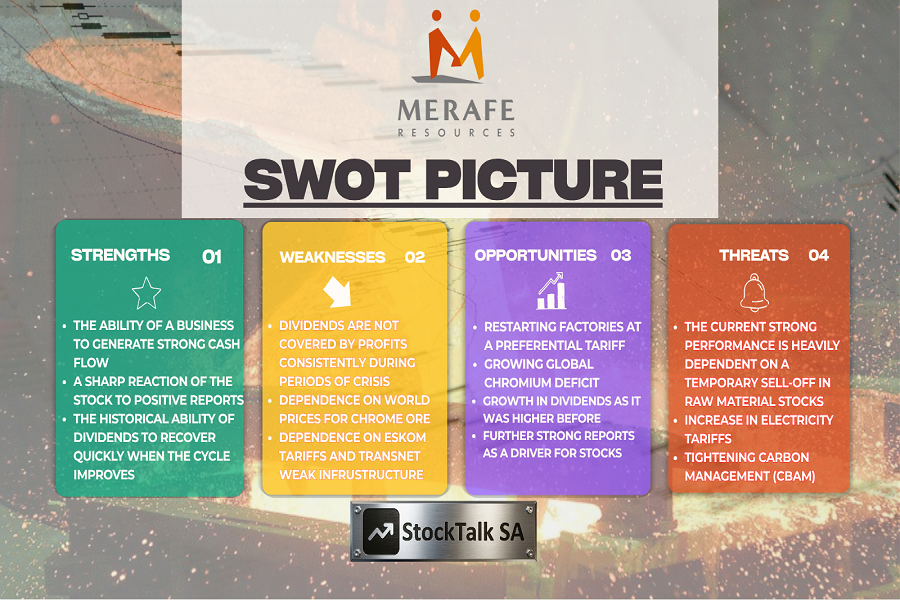
SWOT-analysis of investments in Merafe Resources
Merafe Resources is a classic highly cyclical commodities company focused on chrome ore and ferrochrome. The issuer's main competitive advantage is its joint venture structure (Venture) with mining giant Glencore, which provides operational scale, access to global distribution, and flexibility in inventory management.
Fundamentally, Merafe generates strong free cash flow (FCF) at commodity cycle peaks and maintains a strong balance sheet with minimal debt. However, the business is directly dependent on two external factors: global demand for stainless steel (primarily in China) and systemic risks in South Africa (Eskom tariffs, Transnet logistics issues).
Bull Case (Optimistic Scenario)
- Rising global chrome and ferrochrome prices: The recovery of China's construction and industrial sectors is supporting strong demand and prices for chrome ore.
- Normalization of power supply and tariffs: Successful implementation of tariff agreements with Eskom is allowing the restart of some idle furnaces and an increase in the production of higher-value-added ferrochrome.
- High dividend flow: Stable free cash flow allows for a double-digit dividend yield, attractive to cash-flow-oriented investors.
Bear Case (Worst Scenario)
- Falling demand and prices: Prolonged stagnation in China's steel industry is leading to a correction in chrome ore prices and a decline in margins.
- Rising production costs in South Africa: Further increases in electricity tariffs and cost inflation (PGM/Mining inflation) are making ferrochrome smelting unprofitable, forcing furnaces to be mothballed.
- Infrastructure disruptions: The deterioration of Transnet's logistics system is limiting the physical volumes of ore exported through South African ports.
Merafe's Fundamental Analysis
Analysts note that Merafe is a highly cyclical proxy for Chinese steel demand and chrome prices. At the same time, the joint venture model reduces the company's corporate risks. The market views the stock as an attractive, moderate-risk, income-generating asset, coupled with high shareholder payouts.
With the company focusing on extracting profits from raw materials, and negotiations on reduced tariffs for ferroalloy plants in the final stages, attractive prospects for resuming ferroalloy production are opening up for the foreseeable future. The only significant remaining risk is, of course, competition from China, with its cheaper resources and well-established logistics.
Final conclusion
Merafe Resources demonstrated remarkable operational flexibility. Finding itself in the grip of the South African energy crisis, the company chose not to burn capital on unprofitable smelting operations, but instead redirected the chrome ore produced at its own mines directly for export.
The company has proven its ability to generate record profits and pay double-digit dividends even with the freeze on primary processing.
The return of smelters to operation at a preferential energy tariff, combined with the already established ore exports, creates a powerful double-digit revenue growth effect.
Becoming a net ore exporter temporarily increased Merafe's dependence on spot chrome prices in China and vulnerability to logistical disruptions on South African Railways (Transnet).

John Nkosi
John is from South Africa and know local financial market as it's own. He works directly for Stocktalk and responsible for making regular JSE market news.
Comments
Loading comments…
Log in or sign up free to join the discussion.