StockTalk Retrospective. Burstone Group: much more than a REIT


Burstone Group (JSE: BTN) is a company many investors still remember as Investec Property Fund (IPF). Over its 15 years on the JSE, it has evolved from a local fund with around thirty properties in Gauteng into an international real estate management company with assets in South Africa, Europe, and Australia. Its history is marked by steady growth, large-scale expansion, a pandemic-driven slump in payouts, a period of dangerously high debt levels, and a major deal with Blackstone. Today, BTN is primarily of interest as a dividend stock: as of early September 2026, the share price stands at approximately R9.70 with a dividend yield of around 9.7%, and the 52-week trading range is R7.99–R10.21. Let’s examine how the company reached this point.
History of the company's founding
The history of Burstone dates back to 2008–2010, when the banking and financial giant Investec decided to spin off its commercial and industrial real estate assets into a separate entity. In 2011, the fund listed on the JSE under the name Investec Property Fund (IPF). Initially, the fund’s strategy was based on the classic South African REIT model:
- Acquiring institutional-grade office centers, retail complexes, and logistics properties in South Africa.
- Leveraging the Investec Group’s strong brand and network of contacts to attract tenants.
- Consistently distributing rental income in the form of dividends.
As the South African market reached saturation and macroeconomic risks in the region mounted (including Eskom power supply issues and sluggish GDP growth), IPF’s leadership made the strategic decision to expand beyond the African continent:
- European Logistics (PEL): Between 2017 and 2018, the fund built the Pan-European Logistics (PEL) portfolio, focusing on warehouse and logistics hubs in Germany, Poland, France, and the Netherlands.
- Australian Focus: Concurrently, the fund invested in Australian real estate funds through partnership structures (specifically, the Irongate platform).
A milestone event occurred in 2023: the company finalized a deal to acquire the management rights for its own portfolio from Investec Group (internalization of management) for R1.2 billion. The company became fully independent and rebranded as Burstone Group, while retaining Investec as a cornerstone investor and financial partner.
The Most Challenging Period for Burstone: The Perfect Storm (2020–2022)
The 2020–2022 period proved to be a severe test of the company’s resilience, as it faced a convergence of multiple systemic crises.
1. The COVID-19 Pandemic and Lockdowns
In 2020, shopping centers and office buildings in South Africa were left largely empty. The Fund was compelled to grant tenants rent relief—including discounts and deferrals—totaling hundreds of millions of rand. While the European warehouse segment was less affected, widespread uncertainty brought asset sale transactions to a standstill. 2. Structural Crisis in South African Infrastructure
The company’s South African portfolio contended with frequent power outages (Eskom’s "load shedding") and the deterioration of municipal services. To retain tenants, Burstone had to make urgent, substantial investments in diesel generators, solar panels, and autonomous water supply systems, which temporarily reduced operating margins.
3. Rising interest rates and currency risk
In 2021–2022, the ECB and the South African Reserve Bank (SARB) began aggressively raising interest rates. For a company with debt denominated in both euros and South African rand (ZAR), the cost of servicing loans increased. ZAR/EUR currency volatility complicated balance sheet management.
The Burstone today: stocks on the JSE, dividends, strategy
Today, Burstone is a cross-border operator managing assets valued at over R35 billion (comprising a mix of direct ownership and assets under management, or AUM). South Africa generates about 80% of the group's profit. The rest of - get assets in Australia and Europe.
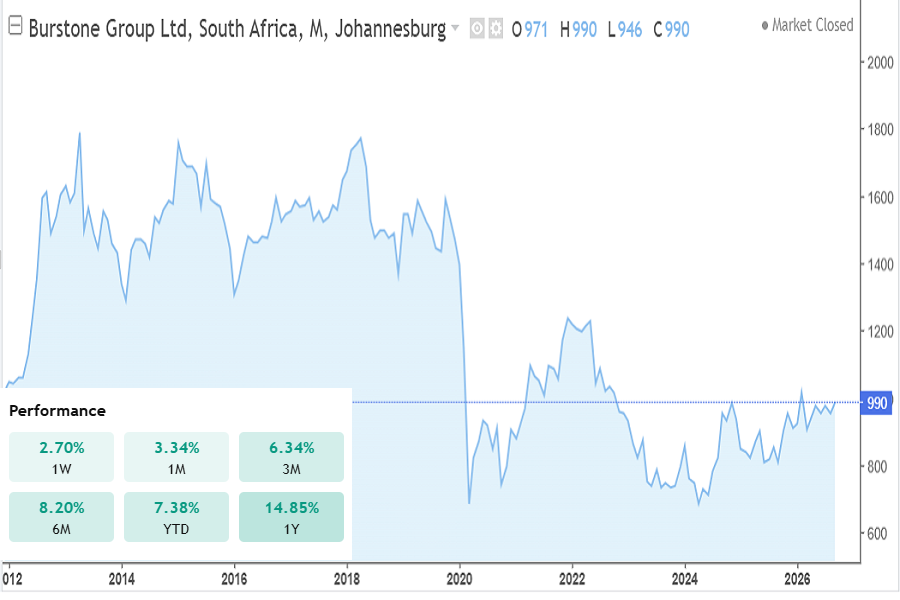
Burstone Group historical chart on the JSE 2012-2026
During its time on the JSE, the company's shares have reached levels as high as R17.62 rand per share; while it might appear at first glance that Burstone shares are not what they used to be, the decline is partly attributable to share buyback programs, and in 2026, the stock is showing growth across all timeframes. The pullback from previous all-time highs can be viewed as representing genuine growth potential for the next three years.
The most promising thing regarding Burstone chart: both fundamentals and tech indicators show Strong Buy signal. In September 2026 investments in real estate became trending among investors. So the Company stocks are in high demand with that.
Dividends payouts have seen periods of decline followed by recovery. Fluctuations remained within a 10% range, and payouts never dropped below a certain level. The days when no dividends were paid at all are long gone; consequently, the stock is now classified as a high-yield dividend play.
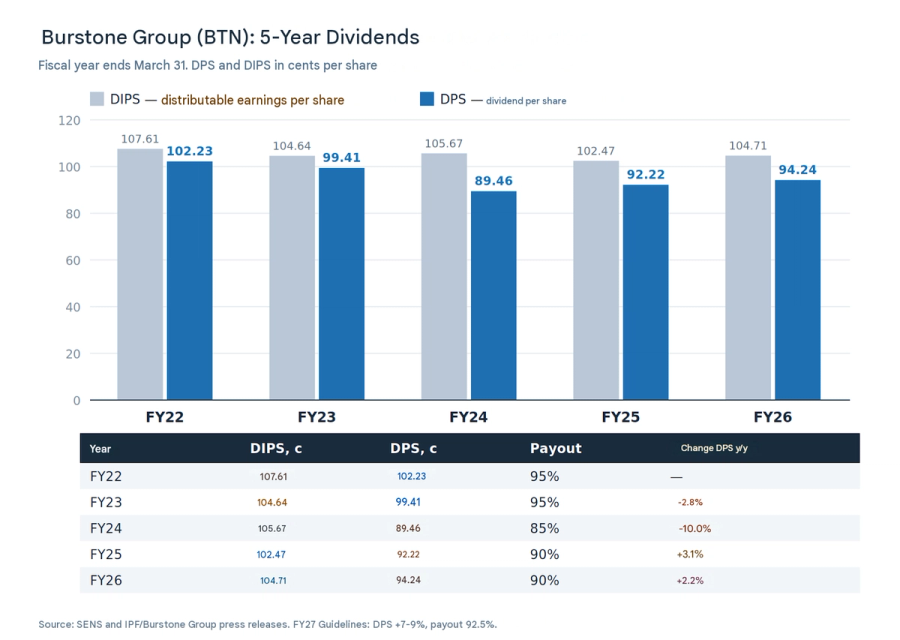
Current dividend yield: In the range of 8.5%–10.5% in ZAR, reflecting the discount to net asset value (NAV) characteristic of the South African market. Burstone themselve forecasts 7–9% dividend growth and 4–6% growth in distributable income for FY2027; the board has approved increasing the payout ratio to 92.5%.
Forecast for Burstone Group
As previously mentioned, the company derives 80% of its revenue from Africa, according to its latest report. Overall, real estate investment appears promising, as property values are steadily rising worldwide- a trend that shows no signs of stopping. For property owners, including those investing through the fund. This translates into increased returns.
Regarding Burstone specifically, there is potential for its properties on other continents to generate higher profits. A key advantage is the diversity of its real estate portfolio: it includes not only retail spaces and office centers, which saw a drop in demand during the pandemic but also advanced warehouse complexes, for which demand is growing in Europe.
However, there are also various macroeconomic, infrastructure, and force majeure risks that could threaten the value of these commercial assets. We have identified two potential scenarios that Burstone will need to navigate in the future.
Bull Case
Growth in asset management revenue (capital-light model): The third-party asset management model in Europe and South Africa will generate stable fee-based income without increasing the company's own debt burden.
Interest rate cycle reversal: Rate cuts by the ECB and SARB will lead to lower debt servicing costs and an expansion of the P/NAV multiple (narrowing the discount to asset value).
European logistics as a growth driver: High demand for warehouse space in CEE (Central and Eastern Europe) and Western Europe, driven by ongoing trends in e-commerce and nearshoring (relocating production closer to Europe). Stabilization in South Africa: Reforms in South Africa’s energy and logistics sectors will reduce property operating costs.
🐻 Bear Case
Prolonged stagnation in South Africa: If the South African economy underperforms, office and retail rental rates will remain under pressure, and the turnover of vacant space will slow down.
Currency risks (ZAR/EUR): A sharp depreciation of the South African rand against the euro complicates the refinancing of euro-denominated debt and increases the cost of international transactions.
Higher-for-longer interest rates: If central banks delay cutting interest rates, real estate valuations (cap rates) will continue to decline, leading to portfolio write-downs.
Summary
Burstone Group Limited has undergone a complex transformation—evolving from a traditional local REIT backed by a parent bank into an independent international real estate asset manager.
The company’s key strength today lies in high-quality diversification—with a focus on the European logistics sector and a gradual shift toward an "asset-light" management model.
The primary risk stems from persistent macroeconomic pressure in South Africa and the real estate sector's high sensitivity to global interest rates. For long-term investors, Burstone represents a classic "value" play, offering a high dividend yield and the potential for value realization as the historical discount of its shares to net asset value (NAV) narrows.

Stan Lytynsky
Stan Lytynsky is a well known financial expert with more than 1000 of market reviews. For the last 10 years he wrote reviews for different blogs and websites. In particular he worked for SuperForex and Zetradex forex brokers as a market analyst. Currently he is living in Canada and focused on the African market as the most promising and growing.
Comments
Loading comments…
Log in or sign up free to join the discussion.