USD/ZAR in September 2026. Fundamental review & forecast

John Nkosi
September 2026 began with significant turbulence for the South African rand (ZAR). After a moderate strengthening in August, the USD/ZAR pair entered a period of increased volatility, trading near the psychological mark of 15.95–16.15 ZAR per US dollar. Market participants are now focused on the divergence of the economic trajectories of the US and South Africa, as well as monetary policy expectations from key central banks (the US Federal Reserve and the South African Reserve Bank). In this review, we will examine the key macroeconomic drivers of both currencies, including the latest South African GDP data, provide a fundamental and technical assessment of the pair, and formulate a forecast for the remainder of September.
The Rand a Month Ago vs. Today
Before the start of August, we analyzed this currency pair and discussed the rand's strong potential for strengthening. And so it happened. In August, the pair fell by 2.4%. The situation has changed today.
Comparing the data from exactly a month ago, the picture is deceptive: the pair is almost unchanged in par value: 16.15 (August 8) versus 16.04 today; the rand is even slightly stronger. But this apparent stability conceals a completely different market.
A month ago, sentiment was the opposite of today's. On August 8, the weak US labor market report for July had just been released, and the market was pricing in a pause or even a softening of the Fed's rhetoric rather than a rate hike. Against this backdrop, gold confidently rose, bouncing off levels around $4,400. South Africa's GDP report had not yet been released. The last known result was growth in the first quarter (+0.4-0.5%), and there was no indication yet of an impending contraction. Brent crude oil was trading around $84, significantly cheaper than it is now.
Over the past month, gold has followed a V-shaped trajectory - rising to $4,646–$4,688 on August 24–28 and then falling back to the current $4,435. Essentially, the price has returned to where it started, but along the way, the entire market logic has reversed. New Fed Chairman Kevin Warsh's hawkish speech at Jackson Hole (August 28) and the unexpectedly strong August employment report (September 4) upended market expectations: from "a pause or soft rhetoric" to a 58–60% chance of a rate hike as early as the September 15–16 meeting. At the same time, oil prices rose almost 16% amid a new wave of strikes between the US and Iran on tankers. In South Africa itself, inflation, on the contrary, calmed down a bit (from a two-year high of 5.0% in June to 4.3% in July), but the economy fell into the negative for the first time in six quarters (-0.2% in the second quarter) – the same decline that one could only guess about a month ago.
What appears to be "treading water" is actually the result of the rand almost single-handedly withstanding pressure from multiple sources (a hawkish Fed, rising oil prices, and a contracting economy), offsetting it with capital inflows into gold and South African bonds in the first half of the month. This makes the current stability more fragile than it appears at first glance: it's the resilience of the moment, not the structural strength of the rand.
Drivers Analysis: USD vs. ZAR
Currently, the focus is on expectations of a Fed rate hike following the publication of the strongest US labor market data in six months. The probability of a rate hike is estimated at over 50%, which favors the USD. The producer price index and the US inflation report for August, both due this week, could trigger a strong market reaction with a reassessment of the likelihood of a rate hike. Geopolitical uncertainty is also returning demand for the safe-haven dollar.
On the other hand, the Rand came under pressure due to weak GDP in Q2. South Africa's economy contracted by 0.2% q/q on a decadal/quarterly basis (against forecasts of a 0.1% contraction), following a revised 0.4% growth in Q1. On an annualized basis (y/y), growth was only 0.9%, compared to expectations of 1.2%. The decline interrupted a six-quarter growth streak. The main negative factors were the contraction in mining (-3.0% due to declines in platinum group metals, manganese, iron, and gold production), wholesale and retail trade (-1.9%), and a decline in manufacturing (-1.8%).
Weak GDP complicates the regulator's task: on the one hand, economic weakness requires lower interest rates, on the other, persistent inflation risks force caution. How will the SARB respond to this situation? Most likely, it will adopt a wait-and-see approach. The likelihood of a rate hike is clearly declining.
Tightening policy in these conditions is hurting an already contracting economy, but holding rates steady amid a likely Fed rate hike risks narrowing the yield differential, which has been one of the rand's main supports all year, along with capital inflows amid the gold rally. It is the robust demand for South African bonds and the strengthening of gold and PGMs that explain why the rand remains one of the strongest emerging market currencies this year, even after its March collapse at the peak of the military escalation.
Technical point of view
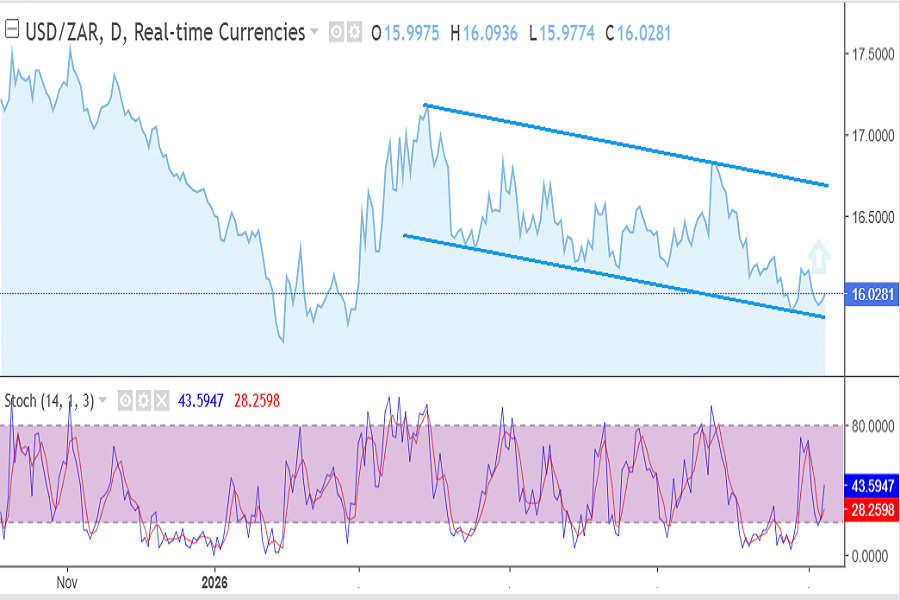
USD/ZAR chart in September 2026
As you can see, the chart shows a downward trend - a stable, classic, wave-like downward channel that leaves no doubt. A local price correction is currently underway. The upward momentum has already begun and could reach 16.10. Technical indicators are showing a sell signal, which is correct in the medium term. Technical analysis suggests a decline in prices to 15.6-15.8 ZAR, but combined with fundamental factors, it's possible that the price correction could be more widespread. Testing of resistance line and the level of 16.50 isn't excluded, although the US presidential administration is against a strong dollar, and the potential for rising commodity prices, including gold, could strengthen the rand even further than it currently is. Even upon testing local maximums, downward trend will continue. The question is what drawdown upon the deals in favour of Rand?
SWOT focus on rand in September
The rand currently has an unusually strong carry fundamental for an emerging market, but a weak real economic fundamental. A 7% SARB rate with inflation at 4.3% offers one of the most attractive real yield differentials among EM currencies, and its direct link to gold and platinum group metals turns the ZAR into a kind of derivative of the precious metals rally. This is precisely what kept the rand one of the strongest EM currencies throughout 2026. But this rally is now stalling: South Africa's economy has contracted for the first time in six quarters, and two external risks. The Federal Reserve's hawkish turn and a new escalation around the Strait of Hormuz are simultaneously hitting the rand. The rand's strength today rests not on the resilience of the economy itself, but on capital flows, which are still willing to lend to it despite its weakness.
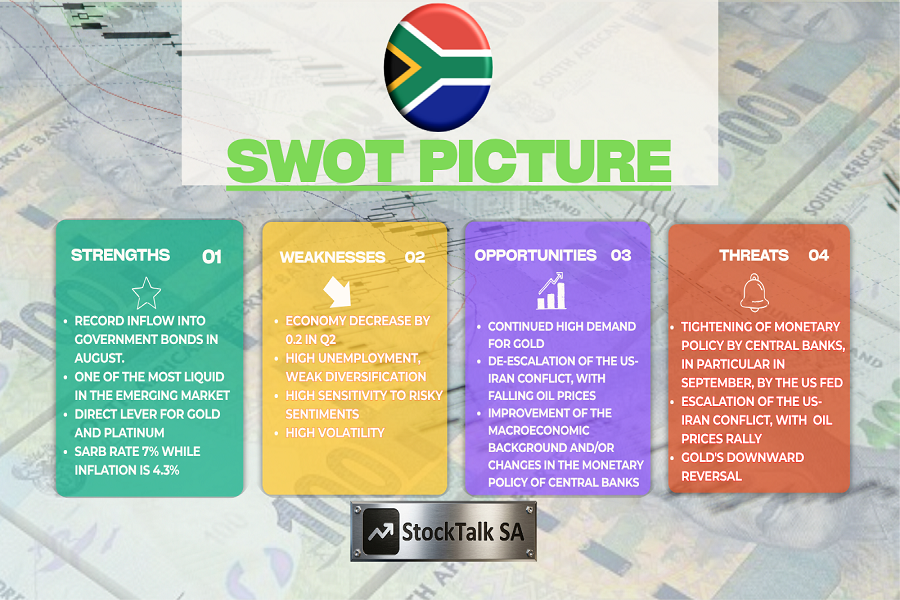
SWOT of investments in ZAR in September 2026
Forecast for USD/ZAR
The next two weeks will pass between two key decisions. The FOMC on September 15-16 and the SARB on September 23 and are likely to be volatile and headline-grabbing.
A tight Fed. Strong US inflation data next week will anchor expectations for a rate hike on September 16. In this case, the dollar will receive additional support, and USD/ZAR could test the 16.20-16.50 range, especially if the SARB decides to hold the rate a week later.
Soft data, no hike. If inflation data is weaker than expected, the market could partially unwind bets on a Fed rate hike, which could cause the pair to return to the lower end of the range, around 15.90-16.00.
The regulator finds itself in a difficult position: the economy is already contracting, but inflation (4.3%) is still above target, and oil prices are rising again amid the Gulf conflict. If the Fed raises rates on September 16, the SARB will have additional incentive to follow suit. At least rhetorically ("hawkish hold") or with an explicit 25 bp hike - to protect the yield differential and avoid triggering capital outflows. The worst-case scenario for the rand is holding the SARB rate while the Fed hikes rates, but this combination is currently the least likely based on current market expectations.
Geopolitics remains the main source of unpredictability: further escalation around the Strait of Hormuz (new strikes on tankers, attempts to block shipping) will put pressure on the rand through rising oil prices and imported inflation, even if it simultaneously supports gold. The base case scenario is that the pair will continue to trade in the 15.90-16.50 range until clarity on both decisions appears, with a bias towards 16.20+ if the Fed's hawkish stance is confirmed.
Conclusions
USD/ZAR enters September in a state of consolidation: weak South African GDP (the first contraction in six quarters) added to the negative sentiment for the rand, but the reaction was muted. The market had already priced in the negative figures. Two external events are far more significant for the pair's direction in the coming weeks: US inflation ahead of the Federal Reserve meeting on September 15-16 and the SARB decision on September 23, as well as the trajectory of the US-Iran conflict, which has once again begun to push up oil prices and, consequently, the rand.

John Nkosi
John is from South Africa and know local financial market as it's own. He works directly for Stocktalk and responsible for making regular JSE market news.
Comments
Loading comments…
Log in or sign up free to join the discussion.