Wesizwe Platinum - special review: A Year in the Dark, and the Storm That Followed

John Nkosi
Wesizwe Platinum and their story
Wesizwe Platinum Limited is a South African mining company under the joint strategic control of the Chinese corporation Jinchuan Group and the South African community of Bakubung (Bakubung tribe). The Company is focused on the exploration and production of platinum group metals (PGMs), including platinum, palladium, rhodium and gold.
It would seem that mining such metals would bring enormous profits, and investing in the company a sure bet. Add to this reliable international owner and investment in WEZ seem even more exciting. However, the reality has proven harsh: retail investors have found themselves held hostage by the situation when WEZ was excluded from trading on the JSE, and the company itself appears unprofitable and requires additional financing. Whether the main shareholders will be willing to save the company remains to be seen.
What happened with Wesizwe Platinum? The suspension, step by step
The trouble began with a deadline Wesizwe couldn't meet. The JSE suspended trading in Wesizwe's shares on 3 June 2025 after the company failed to publish its audited annual financial statements and Integrated Annual Report for the year ended December 2024 within the prescribed period. On the JSE, that consequence is close to automatic - miss the reporting window, and trading stops until you comply.
The root cause wasn't ordinary foot-dragging. A cyberattack in December 2024 hit the availability of Wesizwe's financial reporting systems, derailing the audit timeline. What the company initially framed as a short delay kept stretching out.
Then it got materially worse. When the 2024 financials were finally released on 30 September 2025, they carried a disclaimer of opinion from the independent auditor - meaning the auditors were unable to express an opinion on the accounts at all, one of the most serious outcomes an audit can produce. In response, the company resolved to embark on a full re-audit of the 2024 year-end to clear those disclaimers, which pushed the interim and 2025 results out even further.
Each deferral kept the shares frozen. Wesizwe repeatedly revised its timelines, eventually targeting the 2025 audited financials for no later than 30 April 2026. It then delivered: the company published its results for the year to December 2025 and its Integrated Annual Report, and formally engaged the JSE to lift the suspension. The JSE reinstated trading, and shareholders were able to transact from 12 June 2026.
A clean compliance ending: except that the operational story underneath had changed dramatically in the meantime.
The strategic earthquake: Bakubung restructured
While the market's attention was on missed deadlines, the company quietly rewrote its entire production plan. The board discontinued Wesizwe's 1-million-tonnes-per-annum production strategy at the Bakubung mine with immediate effect, and Bakubung Minerals began Section 189A consultations with organised labour over a restructuring that may affect nearly 500 employees.
This matters more than any single set of accounts. Section 189A of the Labour Relations Act governs large-scale retrenchments - so this isn't a tweak, it's a fundamental reset of what Bakubung is meant to be.
Bakubung is one of South Africa's largest greenfield platinum group metal projects in the Bushveld Complex, with construction having begun in 2011 and full production originally targeted for 2020; the project has been chronically delayed for over a decade. Abandoning the flagship production target signals the original thesis for the mine is no longer the plan management is willing to fund.
The ownership question and the conflict brewing
To understand the shareholder tension, you have to understand who actually controls Wesizwe. The company is controlled by a Chinese consortium made up of Jinchuan Mining and the China-Africa Development Fund - the former a Chinese government–controlled mining giant, the latter a state-backed development finance institution. Their influence is not passive: Chinese executives have historically held the deputy chairman, CEO and finance director roles, shaping strategy from the top.
The funding picture reinforces that grip. Bakubung was financed through a roughly $650 million (R11 billion) loan from the China Development Bank, and the group has been deeply loss-making — its 2023 results showed a R25 million loss with no revenue at group level.
Against that backdrop, South African retail shareholders have begun to organise, putting out a public call for minority holders to "unite" and make their voices heard ahead of the AGM.
What we can say plainly is why this is a classic minority-shareholder flashpoint. When a single consortium controls the board, the funding, and the executive seats, ordinary shareholders have limited leverage outside of the AGM. Coordinating votes is one of the few real tools they have, which is exactly what the public call to organise is about. The AGM, scheduled for 30 June 2026, is the venue where any of this plays out.
The price action: technical review
We usually analyze the chart here, but since the quotes were frozen, chart analysis is practically impossible. We'll simply note that the resumption of trading was certainly received positively by investors: it was a step in the right direction.
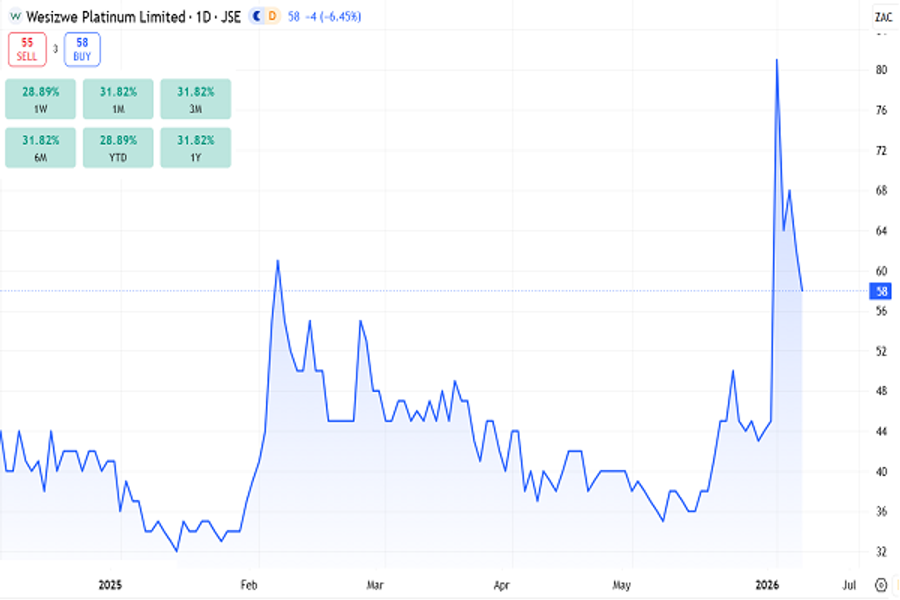
Wesizwe price chart, June 2026
So the honest technical read is this: WEZ is in a volatile post-suspension repricing phase with no reliable trend structure yet. The levels worth watching as the chart rebuilds are the obvious ones the reopening printed roughly 45c as the prior anchor and pre-suspension floor, and roughly 101c as the post-resumption high. Until a few weeks of continuous trading accumulate, treat anything between them as noise rather than signal.
What the experts and the auditors are actually flagging
The single most important fact about Wesizwe isn't the cyberattack or even the suspension. Back in the interim results for H1 2024, the auditor expressed a disclaimer specifically because the directors could not provide certain agreements from the major shareholder confirming committed funding for the foreseeable future. In plain terms: the company's status as a going concern depends on a letter of support from its Chinese majority owner, and that letter wasn't forthcoming on the auditor's timeline. The auditor could not confirm whether preparing the accounts on a going-concern basis was even appropriate.
It runs deeper still. The approval to extend funding beyond the existing cap of roughly US$1.519 billion required sign-off from China's National Development and Reform Commission (NDRC) - a Chinese government body, with Wesizwe working alongside Jinchuan to finalise the updated funding application.
Whether Wesizwe can keep funding Bakubung depends on a decision made by a Chinese state regulator, not by the South African board or its minority shareholders.
Retail shareholders aren't just annoyed about a suspension: they are minority owners of a company whose survival is gated behind a foreign state-controlled majority shareholder and a foreign government approval process they have no influence over. When funding, the board seats, the executive roles and the going-concern letter all sit on one side of the table, the minority's leverage is almost entirely confined to the AGM. The "unite" call is what shareholder powerlessness looks like when it organises.
On the market-risk side, the independent data services are blunt. One widely-used analytics provider flags that Wesizwe's debt is not well covered by operating cash flow the company is running at an operating cash loss and that the share is more volatile than 90% of South African stocks, typically moving around 9% per week, which it classes as a major risk. Independent commentary also stresses that Bakubung is a single-asset, single-strategy operation, and that abandoning the 1 Mtpa production model does not remove that concentration risk: it arguably sharpens the question of what the asset is even for now.
It's worth being honest about coverage, too: Wesizwe is thinly followed. There is no deep bench of sell-side analysts publishing price targets here the way there is for Implats or Sibanye. The "expert view" on WEZ is really the auditors, the funding documents, and a small number of market-data risk flags — and all of them point the same direction.
SWOT-picture of investments in Wesizwe today
Wesizwe's SWOT is asymmetrical and that's a conclusion in itself. Its strengths are real, but almost all are potential: high-quality Bushveld Orebodi, a 30-year-old LOM, and a powerful state-backed company with access to financing from China Development Bank. The problem is that these assets aren't yet convertible into cash: the company doesn't generate revenue at the group level and is operating with an operating loss.
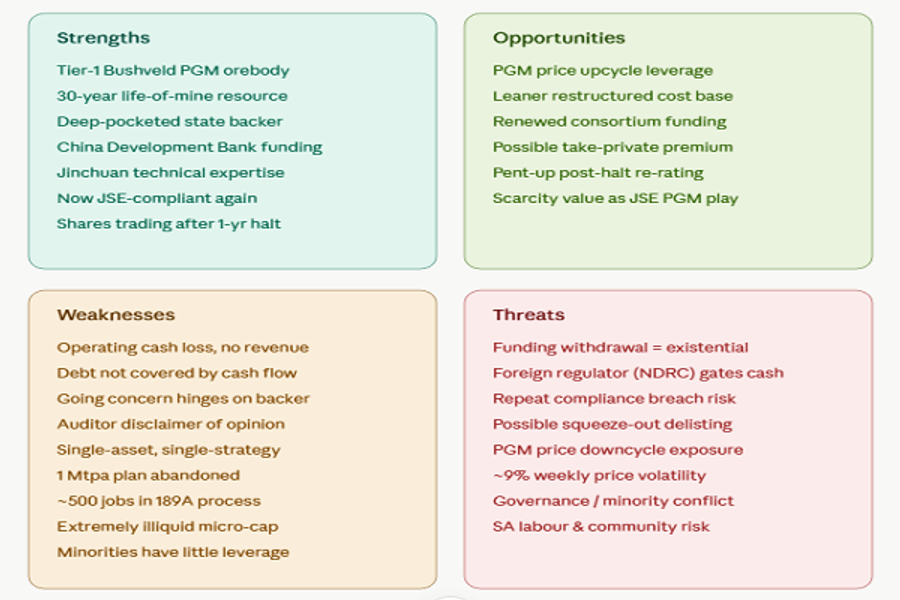
SWOT-picture of investments in Wesizwe Platinum, June 2026
Weaknesses and threats, on the other hand, are structural and active. The central node of the entire profile depends on the Chinese consortium's willingness to continue financing, and approval of this financing is gated by a foreign regulator (NDRC). Everything else revolves around this: the auditor's disclaimer, the abandonment of the flagship 1 Mtpa strategy, ~500 jobs in the 189A process, extreme illiquidity, and the impotence of minority shareholders. Possibilities (PGM upcycle, restructuring effect, possible premium upon take-private, post-halt re-rating) are primarily speculative scenarios, not baseline cases.
How likely are a shutdown and a delisting?
Risk of operations being suspended or wound down is meaningful and elevated. The going-concern question has not been permanently resolved; it has been managed, year by year, by securing renewed funding support from the Chinese consortium. Bakubung produces little to no group revenue, runs at an operating loss, and has just had its flagship production strategy scrapped with up to ~500 jobs entering retrenchment consultations. As long as Jinchuan and the China Development Bank keep funding the asset, operations continue. The danger is concentrated in a single dependency: if that funding support were ever withdrawn or not renewed, the company would face an existential crisis quickly, because it cannot fund itself from its own cash flows. So the operational risk is best described as low-probability-but-catastrophic in any given quarter, conditional almost entirely on the majority shareholder's continued willingness to fund.
Risk of delisting is real, on two distinct paths. The first path is involuntary: Wesizwe has already demonstrated it can breach JSE reporting requirements badly enough to be suspended for a full year. A repeat compliance failure (another audit problem, another disclaimer that can't be cleared) could put the listing back in jeopardy. The second path is the one minority shareholders likely fear more is a voluntary delisting. When a dominant shareholder controls a loss-making company whose shares have been illiquid and troubled, taking it private is a recognised endgame. Nothing in the public record says this is planned, and we will not claim it is. But it is exactly the structural setup in which minorities worry about being squeezed out at an unfavourable price, which again explains the urgency of organising before the AGM.
Our honest framing: delisting risk over the medium term is materially higher than for a normal JSE-listed miner, on both the compliance and the take-private paths, even though neither is confirmed or imminent today.
The verdict: interesting or avoid?
For the ordinary retail investor Wesizwe is an asset to approach with extreme caution, and for most people, to avoid. Wesizwe is a highly illiquid, volatile micro-cap with significant unresolved risks. This is not a considered "buy the dip" opportunity; it is a distressed, single-asset, loss-making developer whose continued existence depends on funding decisions made by a foreign state-owned shareholder and a foreign government regulator, whose auditors have repeatedly been unable to give a clean opinion, and whose flagship strategy was just abandoned. The post-resumption price spike to ~83c (and intraday 101c) is reopening volatility and pent-up order flow finding a level — it is not evidence of a recovery in the underlying business. Buying into that spike means paying up, in an extraordinarily illiquid stock, for an asset carrying going-concern and governance risks most JSE shares simply don't have.This is not a considered "buy the dip" opportunity; it is a distressed, single-asset, loss-making developer whose continued existence depends on funding decisions made by a foreign state-owned shareholder and a foreign government regulator, whose auditors have repeatedly been unable to give a clean opinion, and whose flagship strategy was just abandoned. The post-resumption price spike to ~83c (and intraday 101c) is reopening volatility and pent-up order flow finding a level — it is not evidence of a recovery in the underlying business. Buying into that spike means paying up, in an extraordinarily illiquid stock, for an asset carrying going-concern and governance risks most JSE shares simply don't have.
Who might find it "interesting"? Only a specific, risk-tolerant type: a speculator who fully understands they are making a binary bet on the Chinese consortium continuing to fund Bakubung (and possibly on a future take-private offer), who is sizing the position as money they can afford to lose entirely, and who is comfortable with a stock that can move ~9% in a week on a few hundred thousand rand of volume. That is a trade, not an investment, and it should be labelled as such.
For everyone else, the cleaner decision is to watch, not own and the single most important date to watch is the AGM on 30 June 2026, where the funding outlook, board composition and any strategic direction (including any hint on the listing's future) are most likely to surface.
Bringing it together
Wesizwe is a case study in why governance and operational reality matter more than any chart pattern. At the same time should be noted: no matter which company are you investing in - there's a risk of situation like this, when the main shareholder decide fate of your funds and the JSE can ban the company from trades due to its violations as a result of management activity.
The suspension was a symptom; the disease was a cyberattack-crippled audit, an auditor's disclaimer, and a flagship mine whose original plan has now been abandoned. The reopened share price isn't telling a clean story — it's screaming uncertainty, with a more-than-120% intraday range on a stock that normally trades a few hundred thousand rand a day.
The next real catalyst is the AGM on 30 June 2026. Until then, this is a stock defined by open questions, not answers.
This article is for educational and informational purposes only and does not constitute financial advice or a recommendation to buy, sell or hold any security. Always do your own research.

John Nkosi
John is from South Africa and know local financial market as it's own. He works directly for Stocktalk and responsible for making regular JSE market news.
Comments
Loading comments…
Log in or sign up free to join the discussion.