Lecture 1: Course Overview & The Big Benefits of Dividend Investing
Introduction course "Investing for the lazy and the busy". Passive income via dividends and unit trusts.

Thandiwe Mbeki
Published · Updated
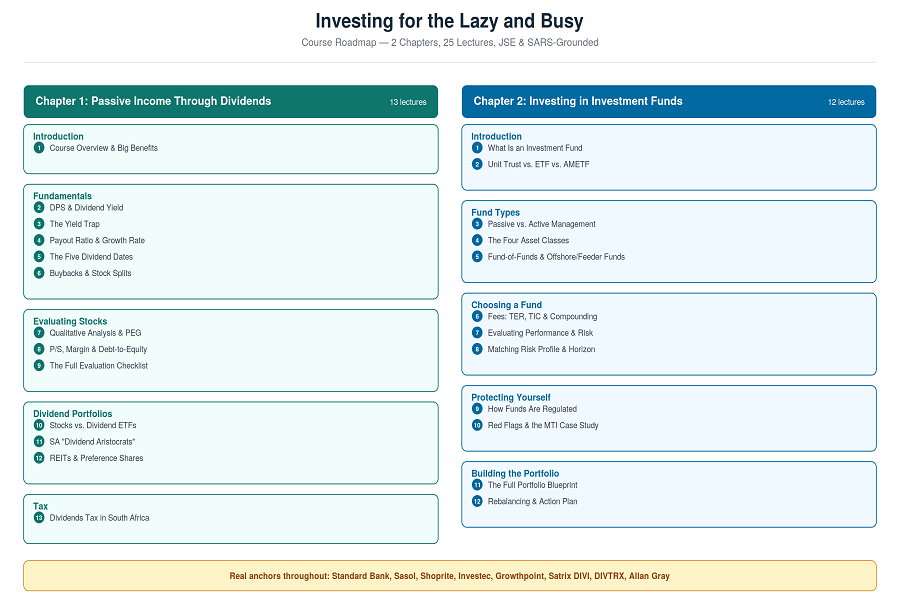
Investing for the lazy and the busy course roadmap
Lecture 1: Course Overview & The Big Benefits of Dividend Investing
Welcome
If you've picked up this course, chances are you don't want a second job. You already have one or a business, or a family, or all three and the last thing you need is a strategy that demands you watch price charts every morning. That's exactly the gap dividend investing fills. It's an approach built for people who want their money working for them, not the other way around.
By the end of this chapter, you'll be able to:
- Evaluate and select solid dividend-paying stocks - not just the ones with the flashiest yield
- Turn dividends into a real, regular income stream you can actually plan around
- Spot the difference between a dividend that's consistent and growing versus one that's a ticking time bomb
- Build a portfolio of dividend payers designed to grow steadily over years, not spike and crash over weeks
Everything here is built around the Johannesburg Stock Exchange (JSE) and South African tax rules - not US examples that don't translate to your reality.
Why Dividends Are the Original "Lazy" Income Strategy?
A dividend is simply a company sharing its profit with you, the shareholder, usually paid out twice a year on the JSE. You don't have to sell anything to get it. You don't have to time the market. You just have to own the share on the right date (we'll cover exactly which date in Lecture 6).
This matters because it removes the two hardest parts of active trading: predicting price movement and being glued to a screen. A dividend investor's core question isn't "what will this stock do next week?" - it's "will this company still be a healthy, profitable business that keeps sharing its earnings in five or ten years?" That's a much easier question to sit with, and it's one you can research over a weekend rather than monitor daily.
A Real Anchor: Standard Bank Group (JSE: SBK)
To keep things grounded rather than theoretical, we'll use real JSE companies as recurring examples throughout this course. Standard Bank Group is a useful one to start with: it has paid a dividend for more than a decade, and its current trailing dividend yield sits in the region of 5%, with a payout ratio in the high-50s percent - meaning it's distributing a little over half its earnings and keeping the rest to reinvest in the business. That balance (paying shareholders while still funding growth) is exactly the profile we'll teach you to look for.
One honest caveat, in the interest of not oversimplifying: Standard Bank's dividend has been cut before during a rough patch, even though it has grown overall over the past decade. No dividend is contractually guaranteed: a share is not a bond. That distinction is important enough that we'll come back to it in Lecture 9 ("Is a Dividend Guaranteed?").
The Dividend Snowball
The real power of this strategy isn't the yield you get in year one: it's what happens when you reinvest that dividend to buy more shares, which then pay you a dividend too, which buys more shares, and so on.
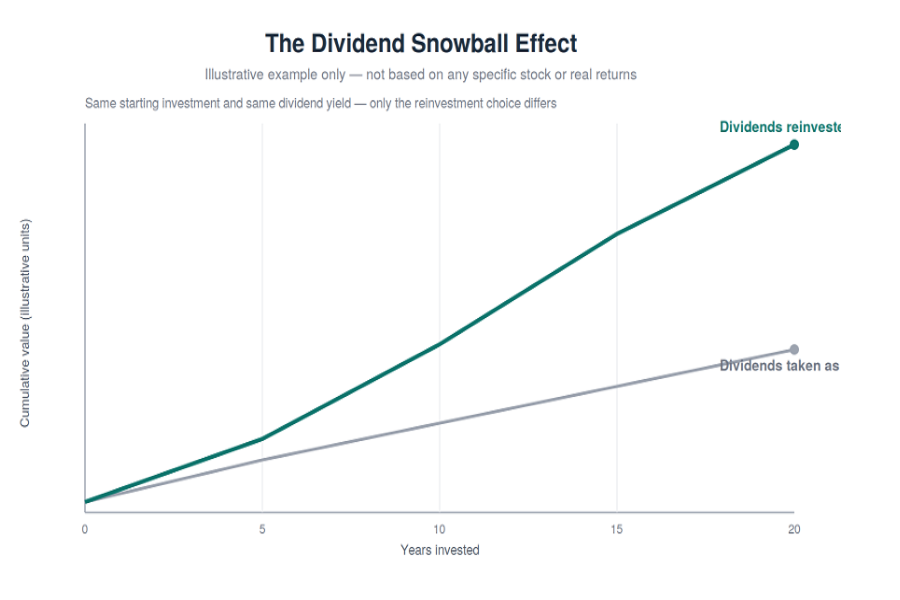
The dividend snowball effect - picture
Here's the effect in simplified, illustrative terms (this chart uses made-up numbers to show the shape of the effect, not a real stock's actual returns. We'll get to real numbers once we're evaluating specific shares):
Pivoted toward supplementary lecture content explorationPivoted toward supplementary lecture content exploration
Notice the two lines start identically and drift apart only because of what you do with the payout. Nothing else changes. That gap is the entire argument for reinvestment, and it's why we'll spend Lecture 11 specifically on the reinvest-vs-cash decision.
A Quick Word on Tax (Full Detail Comes Later)
In South Africa, dividends are subject to a 20% Dividends Withholding Tax (DWT), deducted automatically before the money reaches your account. You don't file anything extra for it in most cases. There are exemptions (retirement funds, for instance), and REITs are taxed differently again. We'll cover this properly in the tax lecture near the end of the chapter, once you have the vocabulary to make sense of it.
What's Ahead in This Chapter
- The fundamentals: dividend per share, yield, payout ratio, growth rate, and the key dates you need to know
- How to evaluate a stock: the checklist of ratios that separates a genuinely healthy dividend payer from a value trap
- Building a portfolio: individual shares versus dividend-focused ETFs, and what "dividend aristocrats" looks like on the JSE
- Lesser-known dividend vehicles: REITs and preference shares, both very much alive on the JSE
- Tax: what SARS actually takes and when
One Thing to Try Before Lecture 2
Pick two or three JSE-listed companies you already know something about - your bank, your cellphone provider, a retailer you shop at. Just note down whether you think they pay a dividend. Don't research it yet. We'll come back to this exact list once you have the tools to actually evaluate it properly, so you can see how your gut instinct compares to the real numbers.
Track your portfolio
Log your holdings and see performance against the JSE All Share.
Go to your portfolio