Lecture 1 (Module 1). Order types and execution
Let's review trading basics: order types and execution

Thandiwe Mbeki
Published · Updated
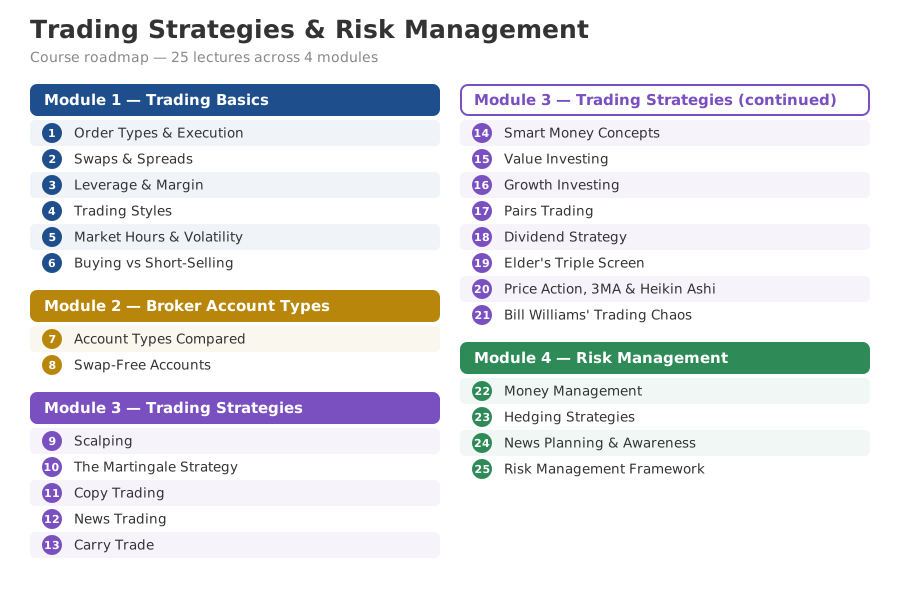
Course Roadmap
Lecture 1: Order Types & Execution
Why Order Types Matter
Before a trader can build a strategy, they need to master the mechanics of getting in and out of the market. An order type is simply an instruction to your broker about when, at what price, and under what conditions a trade should execute. Choosing the wrong order type doesn’t just cost convenience. It can turn a well-planned trade into an unplanned loss, or cause a good entry to be missed entirely.
There are two broad categories to keep in mind throughout this lecture:
- Entry orders — how you get into a position (Market, Buy Limit, Sell Limit)
- Exit orders — how you get out of a position, either to protect capital or to lock in gains (Stop-Loss, Take-Profit, Trailing Stop)
Let’s go through each one.
Market Order
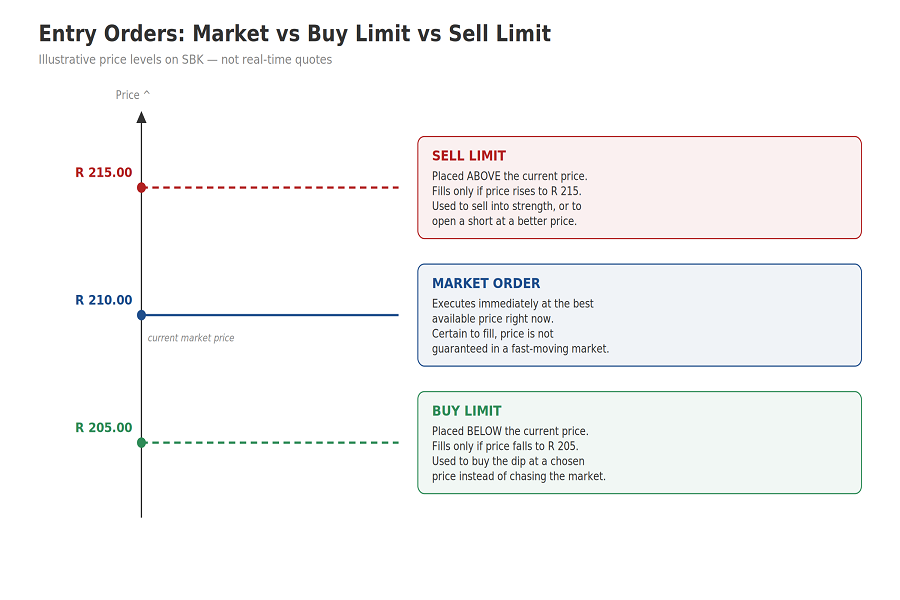
A Market Order is an instruction to buy or sell immediately, at the best price currently available. It is the simplest and most common order type — you click “Buy” or “Sell,” and the trade fills right away.
The trade-off: execution is guaranteed, but price is not. In a fast-moving or thinly-traded market, the price you actually get filled at (the “fill price”) can differ slightly from the price you saw on screen. This gap is called slippage. For a large, liquid JSE share, slippage on a market order is usually small; for a small-cap stock or during a volatile news event, it can be meaningful.
Use a market order when speed of execution matters more than getting an exact price. For example, exiting a losing position quickly, or entering right as a breakout confirms.
Limit Orders: Buy Limit & Sell Limit
A Limit Order does the opposite of a market order — it trades price certainty for a guarantee of timing. You specify the exact price you’re willing to trade at, and the order only fills if the market reaches that price. It will never fill at a worse price than you set, but it might not fill at all if the market never gets there.
- A Buy Limit is placed below the current price. You’re saying: “I don’t want to buy now, I want to buy cheaper.” Common use: waiting to buy a pullback in an uptrend instead of chasing the current price.
- A Sell Limit is placed above the current price. You’re saying: “I don’t want to sell now, I want to sell higher.” Common use: taking profit on a long position at a target price, or opening a short position at a price you consider overextended.
Order types entry
Figure 1 shows all three entry orders relative to a current price of R 210.00 (illustrative). Note that a limit order is a passive order. It sits and waits. It is not a guarantee against slippage either: in a fast gap (for example, a stock opening sharply higher or lower than the previous close), a limit order can be skipped entirely if price jumps straight past it.
Stop-Loss
A Stop-Loss is an order that closes a losing position automatically once the price moves against you by a defined amount. It is the single most important risk-management tool available to a trader. It converts an open-ended risk (“how much could I possibly lose?”) into a defined, known risk decided before you enter the trade.
A stop-loss can be set:
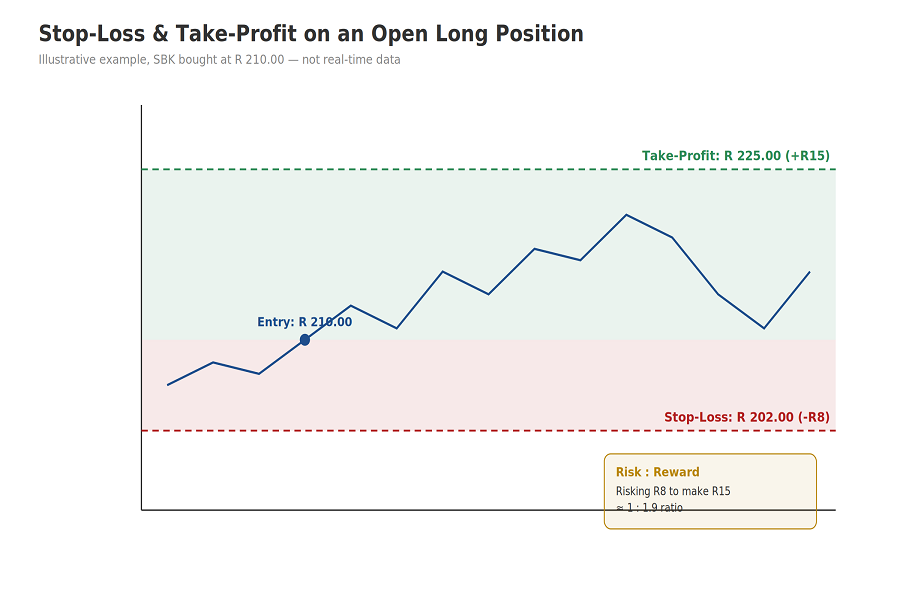
- As a fixed price level (e.g., “close if SBK falls to R 202.00”)
- As a percentage of the entry price
- Based on technical structure - below a recent swing low, below a support level, or a multiple of the Average True Range (ATR)
Important nuance: a standard stop-loss is a trigger, not a guarantee of the exact fill price. Once triggered, it becomes a market order and is subject to the same slippage risk described above. Some brokers offer a Guaranteed Stop-Loss Order (GSLO) that fills at exactly the price you set regardless of gaps, usually for an extra fee or wider spread. This is worth checking with your specific broker, since availability varies.
Take-Profit
A Take-Profit is the mirror image of a stop-loss: an order that automatically closes a winning position once it reaches your target price, locking in the gain without you needing to watch the screen.
Setting a take-profit forces a trader to define, in advance, what “success” on this specific trade looks like - which naturally leads to thinking about the relationship between the two numbers: how much you’re risking (distance to stop-loss) versus how much you stand to gain (distance to take-profit). This is the risk: reward ratio, and it’s one of the most important concepts in trade planning: a strategy that wins less than half the time can still be profitable if its average winner is large enough relative to its average loser.
Order type S.L/T.P
Figure 2 shows a long position entered at R 210.00, risking R 8.00 down to a R 202.00 stop-loss, targeting R 15.00 up to a R 225.00 take-profit is a risk: reward ratio of roughly 1:1.9. Notice that both exit orders are placed at the same time you enter the trade, not decided emotionally after the position is already open and moving against you.
Trailing Stop
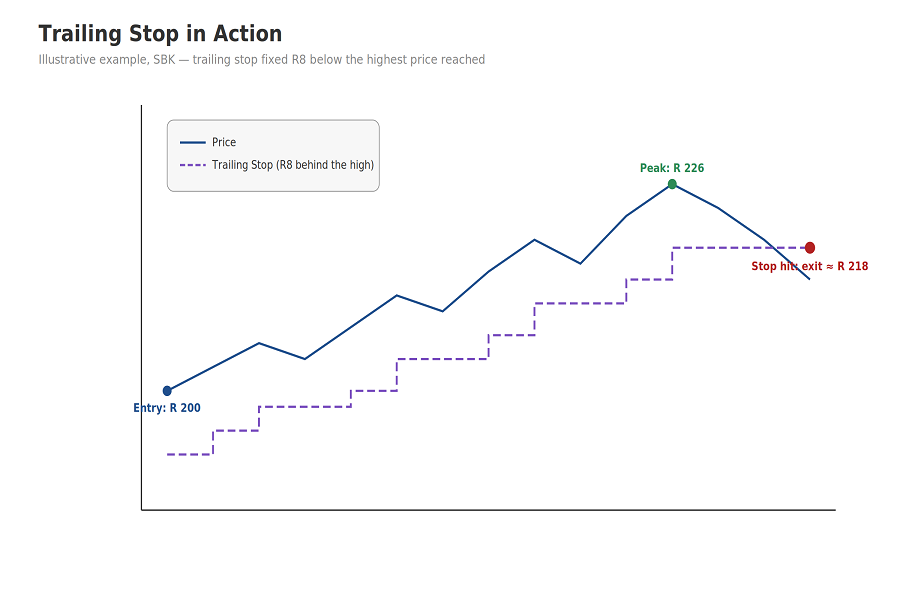
A Trailing Stop is a dynamic stop-loss that moves in your favour as the trade becomes profitable, but never moves against you. You set a fixed distance behind the current price (in points, Rand, or as a percentage) as price rises, the stop rises with it, always staying that same distance behind the highest point reached. If price pulls back, the stop does not move down. It holds its ground, and if price falls far enough to hit it, the position closes automatically.
This solves a real psychological problem: once a trade moves into a solid profit, many traders either exit too early (out of fear of giving the gain back) or hold on too long (hoping for more, and watching the profit evaporate). A trailing stop removes that decision from the moment of maximum emotional pressure and replaces it with a rule set in advance.
Order types. Trailing Stop
Figure 3 illustrates a trailing stop set R 8.00 behind the highest price reached. Notice the step pattern: the stop line stays flat through every pullback, only “ratcheting” upward when a new high is made. Price eventually peaks at R 226.00 and pulls back; the trailing stop - last set at R 218.00 - is hit, and the position exits there. The trade still locked in most of the move (R 200.00 → R 218.00) even though the absolute peak wasn’t captured. That trade-off giving up the very top of the move in exchange for protecting the bulk of the gain is the whole point of the tool.
A practical note: not every broker or platform offers a true server-side trailing stop (one that keeps working even if you close the app). Some only offer it as a feature of the trading terminal itself, meaning it stops functioning if the platform is closed. Always check which type your broker provides before relying on it.
Putting It Together: A Full Trade Plan
A complete trade on, say, Standard Bank (SBK) might combine several of these orders at once:
- Entry: a Buy Limit at R 205.00, waiting for a pullback rather than buying at the current R 210.00
- Stop-Loss: R 198.00 (a defined, pre-decided maximum loss)
- Exit — Option A: a fixed Take-Profit at R 218.00
- Exit — Option B: instead of a fixed take-profit, a Trailing Stop of R 7.00, to let the position run further if the trend continues, giving up the fixed target in exchange for potential upside
The choice between a fixed take-profit and a trailing stop isn’t right-or-wrong — it depends on the strategy. Fixed targets suit range-bound or mean-reversion setups; trailing stops suit trend-following setups where the whole idea is not to cap the upside.
Common Mistakes to Avoid
- Trading without a stop-loss at all - treating “I’ll just watch it closely” as a substitute for an actual order. Markets move fastest exactly when you’re not watching.
- Setting a stop-loss too tight relative to the stock’s normal volatility, getting stopped out by ordinary noise before the trade has a chance to work.
- Moving a stop-loss further away once a trade starts losing, to “give it more room”. This is one of the fastest ways to turn a small planned loss into a large unplanned one.
- Using a market order in a fast news-driven moment without accepting that slippage can be significant - a limit order, though not guaranteed to fill, avoids an unexpectedly bad price.
Summary
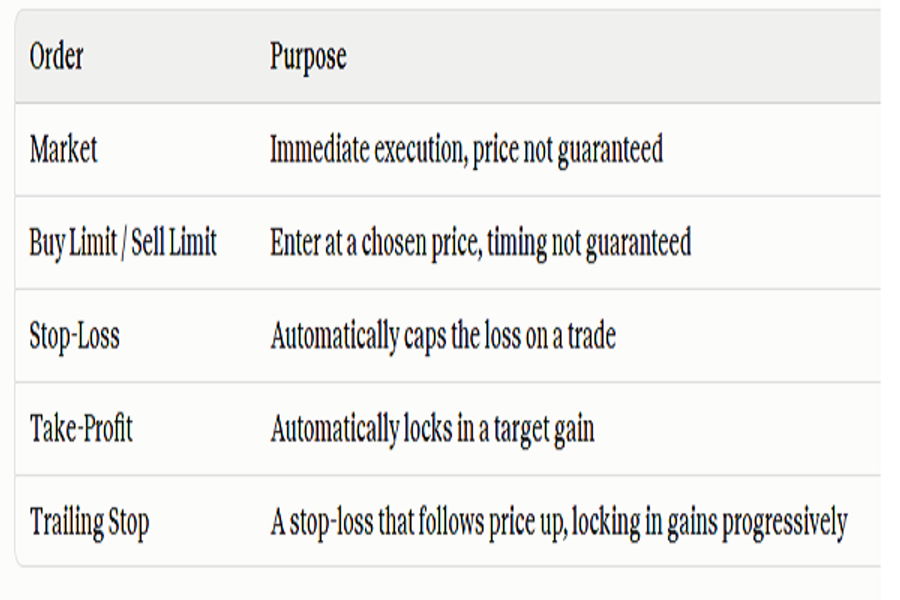
Every order type in this lecture exists to remove a decision from the moment of maximum emotional pressure - the instant the market is moving fast and money is on the line and replace it with something decided calmly, in advance. That principle carries through everything else in this course.
Track your portfolio
Log your holdings and see performance against the JSE All Share.
Go to your portfolio