Lecture 2 (Module 1). Swaps & Spreads
Swaps & spreads means how much you pay to the broker for every single deal. So everyone must know how does it works.

Thandiwe Mbeki
Published · Updated

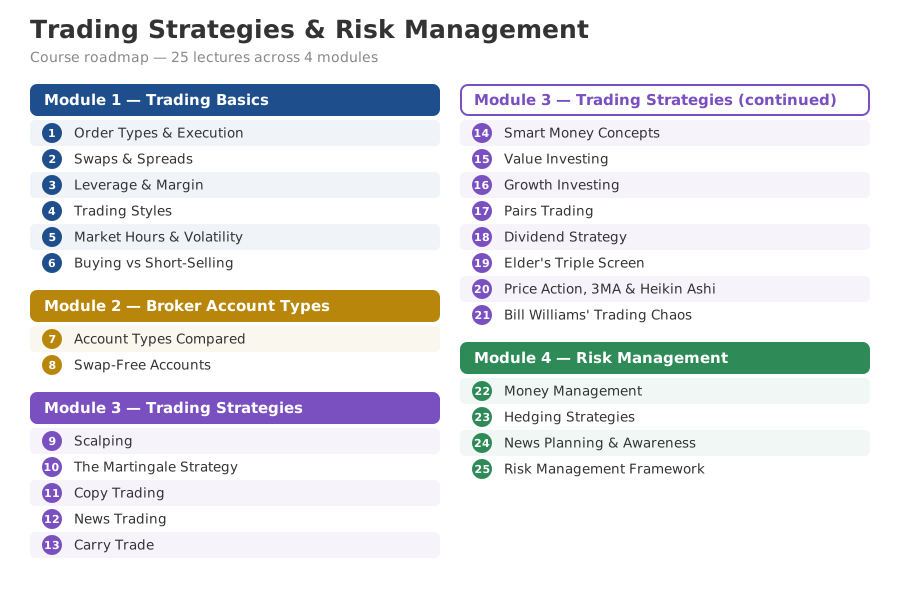
Roadmap
Lecture 2: Swaps & Spreads — The Hidden Cost of Holding a Position
Introduction
Every trade carries two costs that have nothing to do with whether your analysis was right or wrong: the spread you pay to open the trade, and the swap you pay (or occasionally earn) for holding it overnight. Neither shows up as a dramatic loss on a chart. They’re quiet, mechanical costs baked into how leveraged trading works. Ignore them, and a strategy that looks profitable on paper can quietly bleed money in practice.
What Is a Spread?
Every tradable instrument has two prices at any given moment:
- The Bid — the price at which you can sell
- The Ask (or “Offer”) — the price at which you can buy
The Ask is always slightly higher than the Bid. That gap is the spread, and it is how most brokers and market makers earn revenue on your trade. Instead of charging a separate commission, the cost is built into the price itself.
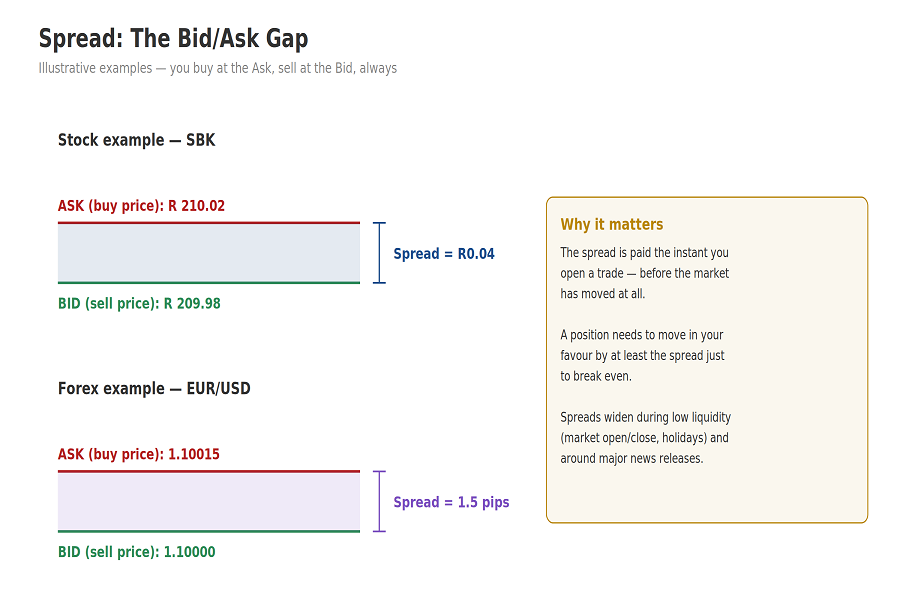
Spread = Bid/ASK Gap
Figure 1 shows this in practice. Buy SBK and the position is already R0.04 “underwater” the moment it opens - not because the market moved, but simply because you bought at the Ask and would have to sell at the (lower) Bid if you closed immediately. The same logic applies to EUR/USD, just measured in pips instead of cents.
Two spread types worth knowing:
- Fixed spread stays the same regardless of market conditions. More predictable, but brokers offering it usually build in a slightly wider margin to protect themselves during volatile periods.
- Variable (floating) spread moves with market liquidity. It’s tighter in calm, liquid conditions and can widen sharply around news releases, market open/close, or public holidays with thin trading volume.
Practical implication for strategy choice: spread matters enormously to a scalper making dozens of trades a day (it’s a direct, repeated cost against a small target), and matters far less to a long-term investor making a handful of trades a year.
What Is a Swap?
A Swap (also called a rollover fee) is the cost or occasionally the credit, applied to a leveraged position that is still open at the end of the trading day and carried over to the next. It exists because a leveraged position is, in effect, a loan: you’re controlling more exposure than your own capital, and someone is financing the difference overnight.
- In forex, the swap reflects the interest rate differential between the two currencies in the pair. If you’re long the higher-yielding currency, you may actually earn a positive swap; if you’re long the lower-yielding one, you typically pay.
- In CFDs on stocks, the equivalent charge is usually called an overnight financing fee rather than “swap,” but the mechanism is conceptually the same: financing cost on the leveraged/borrowed portion of the position.
- Swap can be positive or negative depending on the direction of your trade (long vs short) and the specific instrument — it is never a flat, universal number.
The triple-swap convention: because spot currency and CFD trades typically settle two business days later, most brokers charge triple the normal swap on one day of the week, commonly Wednesday - to account for the weekend, when no trading days occur but financing still accrues. The exact day can vary by broker, so this is worth confirming with your own broker’s contract specifications rather than assuming.
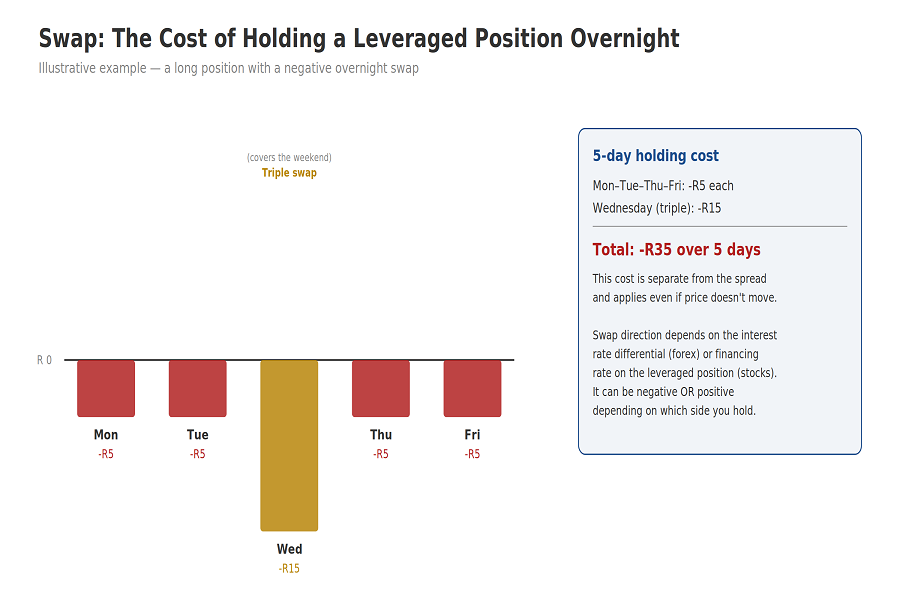
Swap overnight
Figure 2 illustrates a hypothetical long position charged -R5 per night, tripled on Wednesday to -R15 - a total holding cost of -R35 across a single trading week, before the position has even moved. For a swing or position trader holding for weeks or months, this cost compounds and deserves a place in the trade’s overall cost-benefit math, right alongside spread.
How to Manage Swap Exposure?
- Close before rollover — day traders sidestep swap entirely by never holding a position past the daily cutoff time (this varies by broker, typically around 21:00–22:00 UTC, tied to the New York close).
- Use a swap-free account — many brokers offer swap-free (sometimes called “Islamic”) accounts, which remove overnight interest charges, often in exchange for a wider spread or a flat administration fee instead. We’ll cover the specific trade-offs of these accounts in the next lecture.
- Check the swap direction before entering — on some pairs and instruments, holding long actually earns a positive swap. This won’t make or break a strategy, but it’s a small, real factor worth knowing before opening a multi-day position.
- Factor it into position sizing on longer holds — a swing trade held for three weeks needs its expected profit to clear roughly 15–21 days of swap cost, not just the spread paid on entry and exit.
Common Mistakes to Avoid
- Ignoring swap entirely when backtesting or planning a swing/position trade is a strategy that looks profitable on price movement alone can turn marginal once real holding costs are included.
- Assuming spread is the same across all instruments and times - a spread that’s tight during the London/New York overlap can widen substantially overnight or around a holiday.
- Confusing “swap-free” with “cost-free” as the next lecture will cover, swap-free accounts remove the interest charge but rarely remove all costs; the broker recovers that cost somewhere else.
Thus, Spread and swap are the two quiet costs of leverage. Understanding them isn’t optional detail, it’s part of knowing what you’re actually paying to participate in the trade.
Build your watchlist
Track the stocks you just learned about — get price alerts and daily updates.
Go to your watchlist