Lecture 3 (Module 1). Leverage & Margin
Leverage is the first trading condition you need to know on your account before the It's very important to know.

Thandiwe Mbeki
Published · Updated

Roadmap
Lecture 3: Leverage & Margin — Cross vs Isolated Margin
What Is Leverage?
Leverage lets you control a position larger than the capital you actually deposit. Expressed as a ratio like 1:10 or 1:100, it means every R1 of your own money controls R10 or R100 of market exposure.
Leverage doesn’t change how much the market moves. It changes how much that movement is worth to your account. A 1% move on an unleveraged position is a 1% gain or loss on your capital. The same 1% move at 1:100 leverage is a 100% swing on your capital. Leverage is a multiplier applied equally to profit and to loss. It has no opinion about which direction you’re right.
What Is Margin?
Margin is the amount of your own capital a broker requires you to set aside to open a leveraged position. It’s the collateral, not a fee. It’s typically expressed as a percentage of the full position size, and it’s mathematically the inverse of leverage: 1:10 leverage requires 10% margin, 1:100 leverage requires 1% margin.
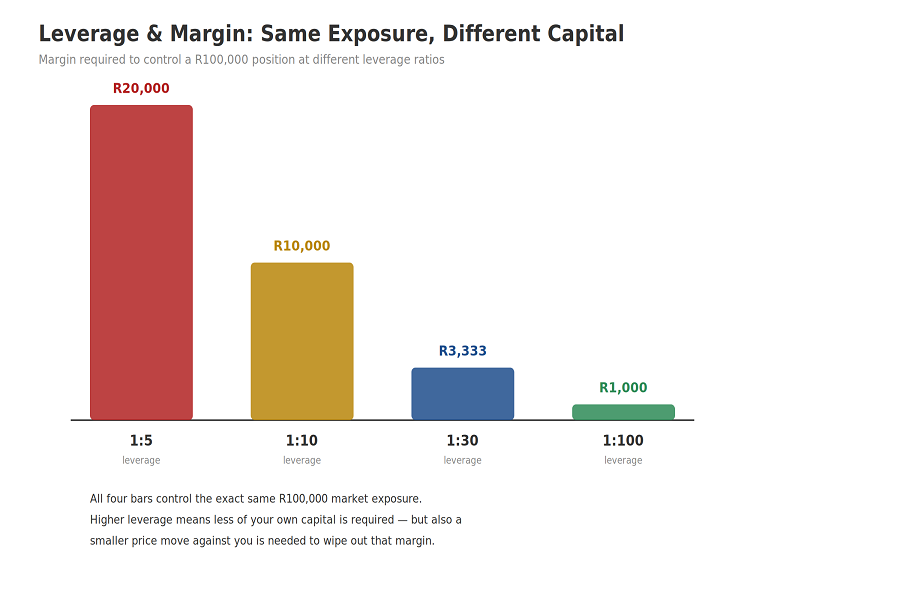
Leverage Margin Ratios
Figure 1 shows the same R100,000 exposure requiring anywhere from R20,000 down to just R1,000, depending on the leverage ratio chosen. The lower bars look attractive: less capital tied up, more positions possible with the same account but they come with a sharper edge: at 1:100, a 1% adverse move wipes out the entire margin behind that position. At 1:5, the market would need to move 20% against you to do the same. Leverage doesn’t create risk out of nothing. It compresses how much room you have before that risk becomes real.
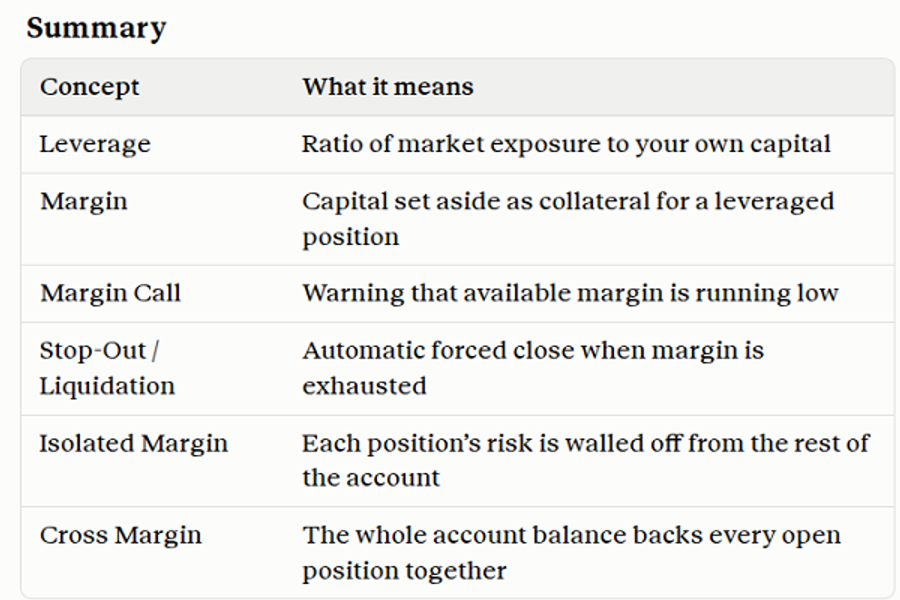
Margin Call & Liquidation (Stop-Out): if a position moves against you and your account’s available margin falls below a threshold set by the broker, you’ll typically get a margin call - a warning that more funds are needed or the position will be reduced/closed. If the losses continue and margin falls further, the broker’s system will automatically close the position (often called a stop-out) to prevent the account balance from going negative. This is not a penalty. It’s a protective mechanism, though it can feel abrupt if you weren’t tracking your margin level.
A note on regulation: maximum leverage available to retail clients varies by broker, instrument, and regulatory jurisdiction, and these limits do change over time. Always check your specific broker’s current terms rather than assuming a number from this lecture still applies.
Cross Margin vs Isolated Margin
Once you have more than one position open at a time, there’s a second decision to make: how your available margin is allocated across those positions.
- Isolated Margin — each position gets its own, ring-fenced amount of margin. A loss on one position can only ever consume the margin assigned to that specific position; the rest of your account balance is untouched.
- Cross Margin — your entire account balance acts as a single shared pool of margin backing every open position simultaneously.
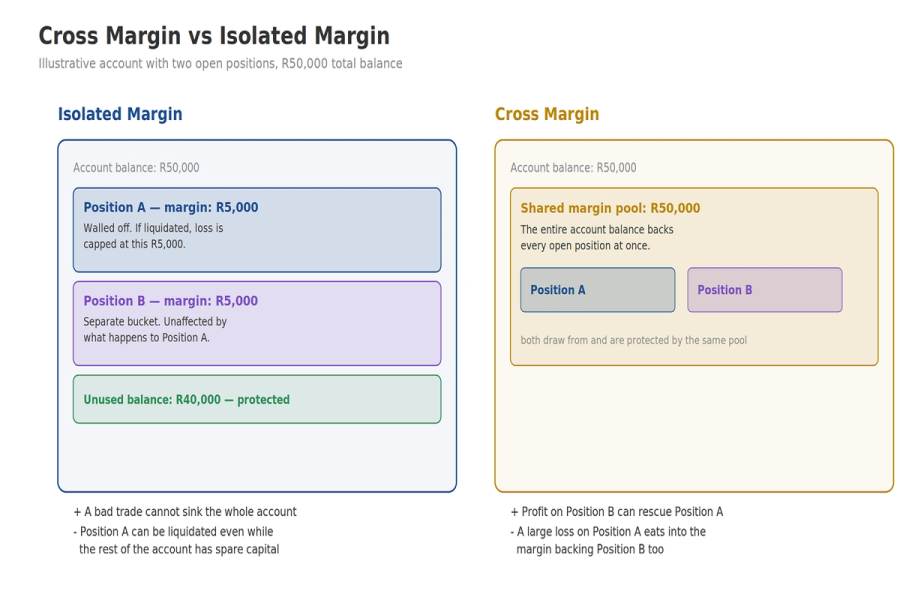
Cross vs isolated margin
Figure 2 lays out the trade-off directly. With Isolated Margin, Position A can be liquidated while Position B and the rest of the account stay completely unaffected -good containment, but it also means Position A gets liquidated at its own limit even if you had plenty of spare capital sitting unused elsewhere in the account. With Cross Margin, that spare capital and any floating profit on Position B automatically extends Position A’s survival room but the reverse is also true: a large loss on Position A quietly erodes the cushion protecting Position B, and in a bad enough scenario, one losing trade can drag the whole account toward a stop-out.
Which to choose depends on how you trade:
- Running several independent, unrelated strategies at once → Isolated Margin generally makes more sense, so one bad idea can’t damage the others.
- Running a single well-planned position, or positions you actively manage together as one view (e.g., a hedge pair) → Cross Margin can make sense, since you want the account’s full capital working as one buffer.
A Worked Example
Suppose a trader has a R50,000 account and opens two positions, each requiring R5,000 margin at their chosen leverage.
- Isolated: Position A drops sharply and is liquidated, capping the loss at R5,000. The trader still has R45,000 available, and Position B is completely undisturbed.
- Cross: the same drop in Position A draws down the shared pool. If Position B is also underwater at the same time, the combined drawdown reduces the margin cushion faster than either position would alone — increasing the chance that both get liquidated instead of just one.
This is precisely why margin mode is a risk-management decision, not just a technical account setting. It determines whether your positions fail independently or fail together.
Common Mistakes to Avoid
- Treating “how much can I open?” as the only leverage question. The real question is “how much room do I have before this position is at risk of liquidation?”
- Using Cross Margin by default without realizing it. Many platforms default new accounts to cross margin. Check your account settings rather than assuming.
- Sizing a position based on margin required rather than total exposure. R1,000 margin at 1:100 still means a R100,000 position is moving your account, not R1,000.
Leverage decides how much the market can move you; margin mode decides how far that movement is allowed to spread across your account. Both are set before a single price tick happens, which is exactly when they should be.