Lecture 4 (Module 1). Trading Styles
Day Trading vs Swing Trading vs Investing. You will find out what is difference and choose yours own style of trading.

Thandiwe Mbeki
Published · Updated

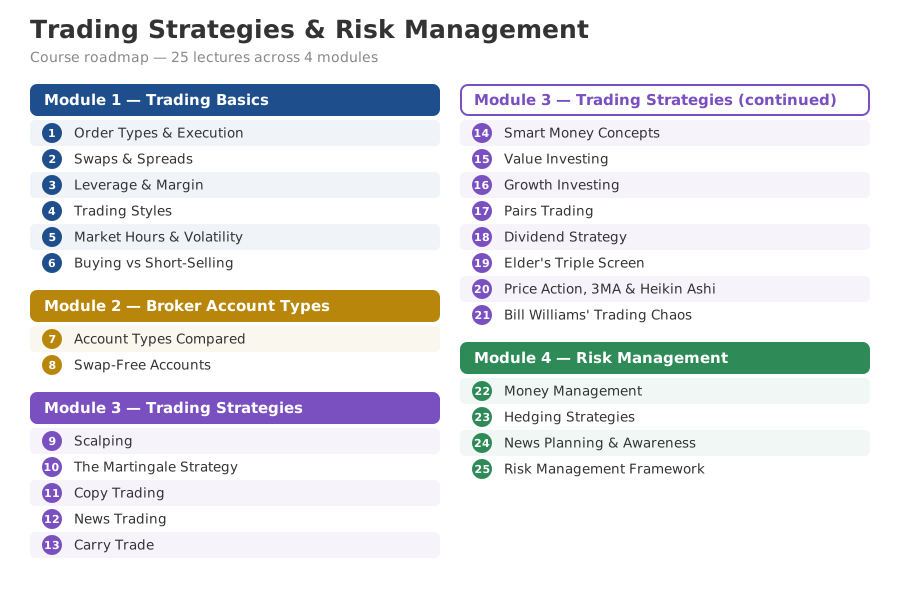
Lecture 4: Trading Styles — Day Trading vs Swing Trading vs Investing
What Is Day Trading?
Day trading means opening and closing every position within the same trading day: no position is ever held overnight. Its defining characteristics:
- No overnight exposure. Because everything is closed by the end of the day, day traders avoid swap costs entirely (Lecture 2) and are never affected by an overnight or weekend gap.
- High trade frequency. Day traders often take multiple trades per session, which means the spread (Lecture 2) becomes a real, recurring cost rather than a one-off.
- Active, hands-on time commitment. This is not a “check in twice a day” style. It typically demands sustained attention during the session, since decisions need to be made in minutes, sometimes seconds.
- Technical, short-timeframe focus. With no time for fundamentals to play out, day trading leans almost entirely on price action, order flow, and short-term technical structure.
- Emotionally demanding. The combination of speed, frequency, and leverage (Lecture 3) makes day trading one of the more psychologically intense trading styles.
What Is Swing Trading?
Swing trading holds positions for several days to a few weeks, aiming to capture a single meaningful “swing” in price - a trend leg, a breakout, or a reversal rather than the whole trend or a single day’s noise.
- Moderate time commitment. A daily check-in is usually enough; it doesn’t require watching the screen continuously.
- Exposed to overnight and weekend risk. Unlike day trading, positions are held through market closes, which means swap costs (Lecture 2) apply, and a weekend news event can cause the market to open at a very different price than it closed - a gap the swing trader cannot react to until the market reopens.
- Blends technical structure with catalysts. Still largely chart-driven, but swing traders often pay attention to upcoming earnings dates, economic releases, or sector news that could drive the multi-day move they’re trying to capture.
What Is Investing?
Investing operates on a horizon of months to years, built around the idea that a company’s underlying value: earnings, growth, competitive position - will eventually be reflected in its share price, regardless of short-term price noise.
- Low day-to-day time commitment. Periodic review (quarterly results, annual portfolio check-ins) rather than daily monitoring.
- Fundamental analysis leads. Financial statements, valuation multiples, and business quality matter far more than short-term chart patterns.
- Cost structure is minimal. Without daily trading, there’s no repeated spread cost, and most long-term investment accounts aren’t subject to overnight swap charges at all.
- Compounding is the main engine, not any single well-timed trade which is why this style tolerates, and even relies on, short-term volatility rather than trying to avoid it.
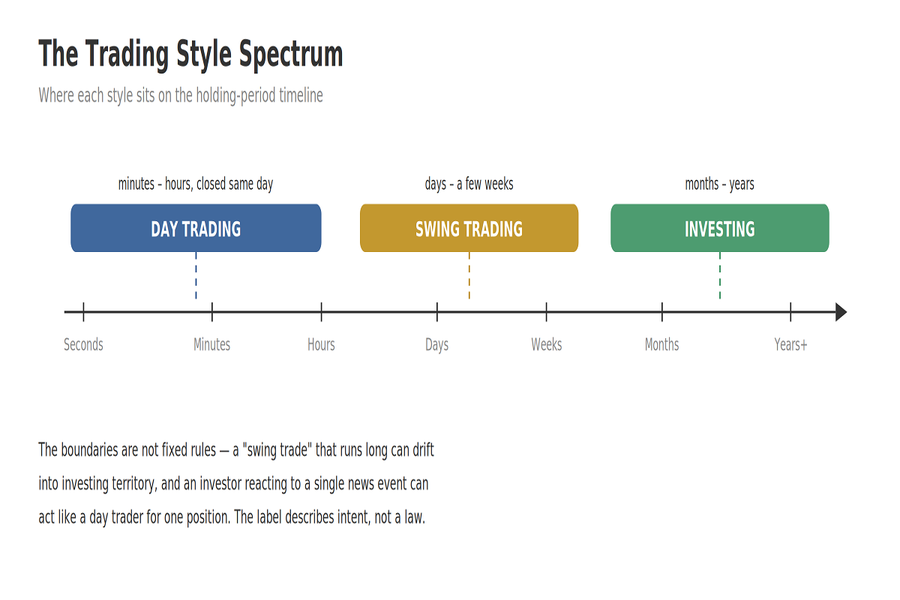
Trading style spectrum
Figure 1 places the three styles on a single timeline. The boundaries aren’t rigid - a swing trade that keeps working can quietly become a long-term holding, and a fast-moving news event can make even an investor act like a day trader for a single position. What defines the style is less the exact number of days held and more the intent going in: is this a quick tactical trade, a multi-week thesis, or a long-term position in the business itself?
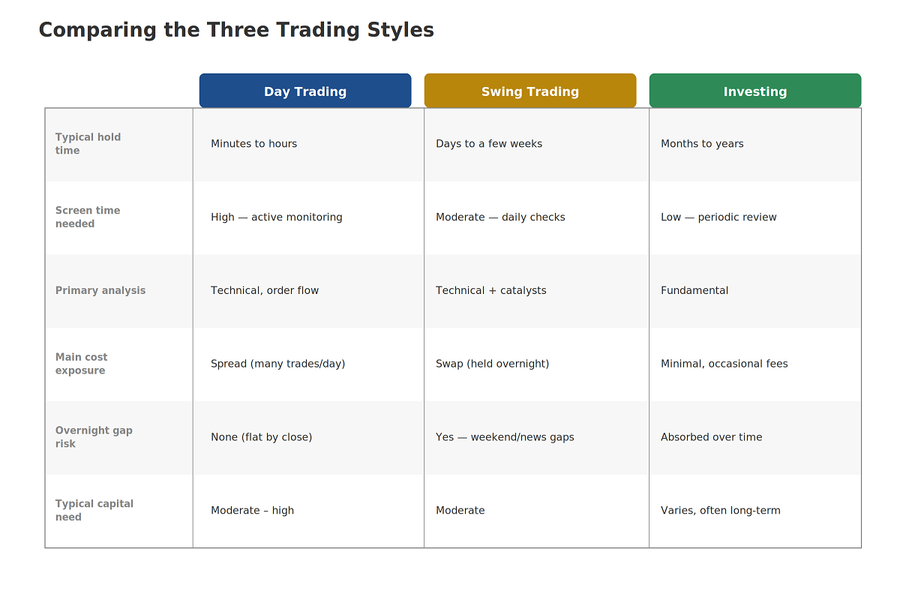
Comparing styles
Figure 2 lays the three styles side by side. A few things stand out when they’re compared directly:
- Cost structure flips depending on style. Day traders fight the spread; swing traders fight the swap; investors mostly avoid both, paying instead in the form of patience.
- Time commitment and capital need don’t move together in a simple way. Day trading typically demands both significant time and meaningful capital (to generate worthwhile returns from small intraday moves without over-leveraging). Investing can start small and scale slowly, trading capital efficiency for a much longer payoff horizon.
- None of these is inherently “better.” They suit different amounts of available time, different risk tolerances, and different personality types. A trader who feels anxious watching a screen all day is unlikely to enjoy day trading regardless of how good their technical analysis is.
Choosing a Style and a Common Trap
New traders often don’t consciously choose a style. They drift into one, or worse, blend two without meaning to. The most common version of this: entering a trade with a day-trading mindset, then holding it overnight “just to see” once it moves against them, hoping it recovers. This isn’t swing trading. It’s a day trade that skipped its own risk plan, now carrying swap costs and gap risk nobody accounted for. It also often happens in reverse: an investor buys a stock for the long term, then panics and sells during a routine short-term dip, converting a long-term decision into a badly timed short-term one.
The fix isn’t complicated, but it does require discipline: decide the style and therefore the time horizon, the exit plan, and the position size before entering the trade, not while it’s already open and moving.
Common Mistakes to Avoid
- Day trading part-time around a full-time job. Reacting to price with divided attention tends to produce worse entries and exits than either full-time day trading or a slower style that doesn’t need constant monitoring.
- Under-capitalizing a day-trading account, then over-leveraging to compensate - a direct link back to Lecture 3’s leverage/margin trade-offs.
- Switching styles mid-trade without deliberately deciding to, usually driven by emotion rather than plan.
Summary
Day trading, swing trading, and investing aren’t different skill levels. They’re different tools suited to different amounts of time, capital, and temperament. The style should be chosen deliberately, in advance, based on what fits your life and risk tolerance, not discovered by accident halfway through a trade that didn’t go the way you expected.
Build your watchlist
Track the stocks you just learned about — get price alerts and daily updates.
Go to your watchlist