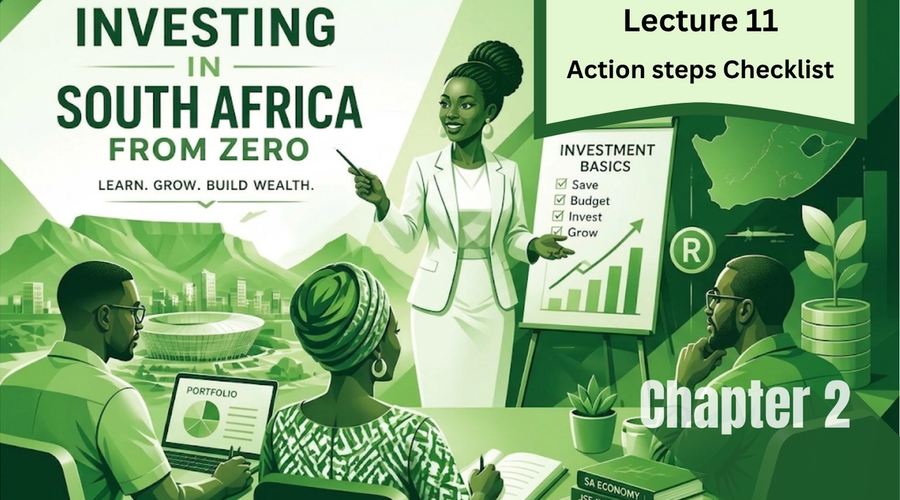
Lecture 11 (Chapter 2). Action Steps checklist
Here is a checklist to come from theory - to action

Thandiwe Mbeki
Published · Updated
Your First Steps as an Investor
The journey this course has covered
Twenty-two lectures ago, this course started with a simple question: what is the stock market, and how does it actually work? Since then, you've learned to read a company's financial statements, understand what moves entire markets, compare companies using valuation multiples, read a chart, evaluate bonds and property investments, build a diversified portfolio matched to your own risk profile, manage risk on individual positions, recognise your own psychological blind spots, and apply Benjamin Graham's disciplined approach to buying businesses at sensible prices. That's a genuinely complete foundation. Most people who call themselves "investors" never learn even half of it formally.
A practical checklist for what to actually do next
1. Get your financial foundation in order before investing a rand. Build an emergency fund covering 3–6 months of essential expenses in an easily accessible account, and pay down any high-interest debt (credit cards, store accounts) first. The guaranteed "return" from clearing 20%+ interest debt beats almost any realistic investment return.
2. Open and use a Tax-Free Savings Account. This is one of the simplest, highest-value tools available to South African investors, and it wasn't covered elsewhere in this course, so it belongs here: a TFSA lets your dividends, interest, and capital gains grow completely free of tax. As of 1 March 2026, you can contribute up to R46,000 per tax year, with a R500,000 lifetime limit and because withdrawals don't restore used-up lifetime allowance, a TFSA works best treated as a long-term, "don't touch" account rather than a place to park short-term savings.
3. Verify your broker before depositing anything. Go back to Lecture 1.2's checklist: confirm FSCA licensing, understand the fee structure, and check how your funds and shares are actually held.
4. Define your time horizon and risk profile honestly - before choosing a single share or fund, know roughly how long the money can stay invested and how much volatility you can genuinely tolerate without panic-selling.
5. Start broad before going narrow. If you're genuinely new, a diversified ETF is a more forgiving starting point than picking individual shares. It removes single-company risk while you build experience reading statements and multiples on real, live companies.
6. Practice analysis on paper before committing real money. Pick two or three real JSE companies, pull their actual financial statements, calculate their multiples, and estimate a rough Graham's Number before your first real trade, not after.
7. Write your reasoning down for every position, as covered in Lecture 9. The price, the reasoning, the time horizon. This single habit is your best defence against FOMO, panic, and the rest of the psychological patterns covered.
8. Keep building from here. Learn other courses - "Investing for the lazy and busy", "Guru of technucal analysis".
A closing thought
Benjamin Graham wrote that the intelligent investor is a realist who sells to optimists and buys from pessimists - not someone with a special gift for prediction, but someone with the discipline to apply sound analysis consistently and resist the emotional pull of the crowd. Nothing in this course requires natural talent. It requires the willingness to read a balance sheet before buying a share, to write down your reasoning, and to stay calm when Mr. Market has a bad day. That's a learnable discipline, and you now have the foundation for it.
Track your portfolio
Log your holdings and see performance against the JSE All Share.
Go to your portfolio