Lecture 10 (Chapter 2). Value investing according to Graham
In this lecture you will find out the most known strategy upon investing - a Graham strategy and his criteria to choose a reliable Company.

Thandiwe Mbeki
Published · Updated

Benjamin Graham's Value Investing Strategy
Who Benjamin Graham was, and why he still matters
Benjamin Graham is widely regarded as the father of value investing. An economics professor and investor whose books, Security Analysis (1934, co-authored with David Dodd) and The Intelligent Investor (1949), laid out a disciplined, business-focused approach to buying shares that remains influential nearly a century later. His most famous student, Warren Buffett, has repeatedly credited Graham's principles as the foundation of his own investing career. Graham's core insight was radical for its time: a share isn't a lottery ticket or a piece of paper whose price you're trying to predict. It's a fractional stake in a real business, and you should analyse and price it accordingly.
Mr. Market: Graham's most famous idea
Graham illustrated the market's behaviour through a now-famous allegory: imagine you own a stake in a business alongside a business partner named Mr. Market. Every single day, Mr. Market shows up and offers to either buy your stake or sell you his, naming a price. The catch: Mr. Market is emotionally unstable. Some days he's euphoric and names a wildly high price; other days he's despondent and names a wildly low one, regardless of how the underlying business is actually performing.
The lesson: you are never obligated to transact with Mr. Market. His daily mood swings are useful only when they work in your favour. You can buy when his pessimism offers you a bargain price, and you can ignore him entirely (or sell to him) when his euphoria offers an inflated one. This single idea reframes market volatility from something to fear into something a disciplined investor can potentially exploit, precisely because most other participants react emotionally to Mr. Market's mood rather than evaluating the business itself - exactly the FOMO and panic-selling patterns covered in the previous lecture.
Margin of safety: Graham's central risk-management principle
If Mr. Market's mood swings mean price can diverge from a business's real value, the natural next question is: how do you protect yourself when your own estimate of that value turns out to be wrong? Graham's answer was the margin of safety - the gap between a share's estimated intrinsic value and the price you actually pay for it. Buying meaningfully below your own estimate of a business's worth builds in a cushion: even if your analysis is somewhat too optimistic, or something unexpected goes wrong with the business, a large enough margin of safety can still protect you from a poor outcome. This is conceptually the same protective logic behind the position-sizing and risk management covered in Lecture 8, applied to the price you pay rather than the size of the position.
Graham's 7 criteria for the defensive investor
In The Intelligent Investor, Graham laid out a practical checklist for what he called the "defensive" investor. Someone seeking a sound, conservatively selected portfolio without needing to become a full-time analyst. The seven criteria draw directly on tools you've already learned in this course.
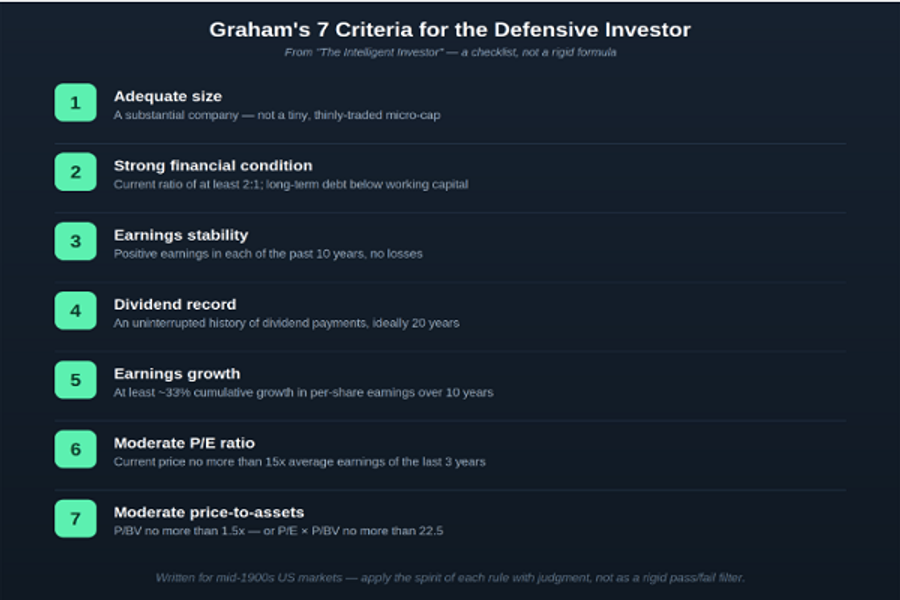
Grahams Criteria upon investing
Adapting Graham's criteria for the JSE, sensibly
Graham wrote these rules for the mid-1900s American market, and applying them literally to today's JSE runs into practical friction worth naming directly:
- The 20-year uninterrupted dividend history (criterion 4) is a very high bar even for excellent JSE companies. South Africa's modern listed corporate history, and the disruptions of load-shedding, currency volatility, and periodic recessions, mean few companies have a spotless two-decade record. Many experienced value investors treat this criterion more flexibly - looking for a long, consistent (rather than literally unbroken) dividend history without abandoning the underlying principle: a company that has reliably rewarded shareholders over many years demonstrates real durability.
- Criteria 6 and 7 (P/E and P/BV) map directly onto the multiples covered in the course is a useful, concrete way to apply what you've already learned. A stock passing both a moderate P/E and a moderate P/BV simultaneously is, in Graham's framework, unlikely to be significantly overpriced on either an earnings or an asset basis at once.
- Criterion 1 (adequate size) is relative to the market you're in - "large" on the JSE looks different from "large" on the NYSE; the underlying point (avoid highly illiquid, thinly-traded micro-caps where prices can be volatile for reasons unrelated to the business) still applies directly to South African markets.
The list is best used as Graham intended: a disciplined checklist that filters out obviously risky or overpriced candidates, not a rigid pass/fail test where missing one criterion by a small margin should automatically disqualify an otherwise sound company.
Key takeaways
- Benjamin Graham founded value investing on the idea that a share represents real ownership in a business, to be analysed and priced accordingly. Not a speculative bet on price movement alone.
- The Mr. Market allegory frames daily price volatility as an opportunity to exploit selectively, not a signal to react to emotionally.
- Margin of safety - buying meaningfully below your estimate of intrinsic value is Graham's core protection against errors in your own analysis.
- His 7 criteria for defensive investors combine financial statement analysis and valuation multiples into a practical screening checklist.
- Applying Graham's rules to the JSE requires sensible adaptation, particularly around the strict dividend-history requirement, while keeping the underlying discipline intact.
Graham's Number and Estimating Intrinsic Value
A single number that combines two of Graham's criteria
Look back at criteria 6 and 7 from the last lecture: a moderate P/E (no more than 15x average earnings) and a moderate P/BV (no more than 1.5x), with Graham noting the product of the two shouldn't exceed roughly 22.5. Graham's Number turns this combined rule into a single, calculable ceiling price:
Graham's Number = √(22.5 × EPS × Book Value per Share)
The result is a rough estimate of the maximum price a defensive investor should be willing to pay for a share, by Graham's own moderate-valuation standard - combining earnings power (EPS) and asset backing (book value) into one figure, using tools you already know from Modules 3 and 5.
A worked example: Standard Bank
Using real, current figures for Standard Bank Group (JSE: SBK):
- EPS (trailing twelve months): R27.77 , alongside a trailing P/E of 10.62 and a PEG ratio of 0.95
- Book value per share: R179.94 , as of December 2025, having grown at an average rate of roughly 7.6% per year over the past 12 months
Graham's Number = √(22.5 × 27.77 × 179.94) = √112,431 ≈ R335
Standard Bank's share price closed at R316.57 on 20 August 2026 , trading in a day's range between a low of R315.26 and a high of R323.99 — sitting a little below Graham's Number of roughly R335. By this specific test, the share doesn't look obviously overpriced.
Why this single number isn't the final word?
Here's the important caveat, and it's worth sitting with rather than skipping past: the same source used for Standard Bank's book value above also publishes its own separate valuation estimate using a different methodology (a discounted cash flow approach), which puts fair value at just R236.57. Flagging the stock as significantly overvalued at current prices. That's a meaningfully different conclusion from what Graham's Number suggests, calculated from the very same company, at the very same time.
This isn't a contradiction to be resolved. It's a genuine, useful lesson: different valuation methods embed different assumptions, and reasonable methods can disagree. Graham's Number is a simple, easily calculated screening filter, not a precise verdict on what a share is "really" worth. It works best on businesses like banks. Asset-heavy, with earnings closely tied to a real, measurable balance sheet (echoing Lecture 5.2's point that P/BV is most meaningful for exactly this kind of company). It becomes far less useful, or even meaningless, for asset-light businesses with little book value (many technology or services companies), or for currently unprofitable companies with no EPS to plug into the formula at all.
Intrinsic value is an estimate, not a fact
This connects to a broader point worth carrying forward from this entire course: "intrinsic value" is always an estimate, built from assumptions, not a precise, objectively knowable number. Graham's Number, a discounted cash flow model, and a peer-multiple comparison (Lecture 5) can all produce genuinely different estimates of the same company's worth and that's expected, not a sign one of them is simply wrong.
This is exactly why Graham's margin-of-safety principle from the last lecture matters so much in practice: rather than chasing a single "correct" intrinsic value figure, the discipline is to build a reasonable, conservatively-assumed estimate using tools like this one, and only act when there's a meaningful gap between that estimate and the market price - large enough to remain comfortable even if your estimate turns out to be a little too optimistic.
Bringing the course full circle
Graham's approach draws on nearly everything covered in this course: reading financial statements to find EPS and book value, understanding valuation multiples and their sector-specific limitations, and perhaps most importantly, the emotional discipline from Lecture 9 to act on calculated estimates rather than Mr. Market's mood swings. Value investing isn't a shortcut or a secret formula; it's a systematic way of applying everything this course has taught, with patience and a margin for error built in.
Key takeaways
- Graham's Number (√(22.5 × EPS × Book Value per Share)) combines Graham's P/E and P/BV ceilings into a single estimated maximum fair price.
- It's most meaningful for asset-heavy, earnings-stable businesses like banks, and far less useful for asset-light or unprofitable companies.
- Different valuation methods (Graham's Number, DCF models, peer multiples) can produce genuinely different estimates of the same company's worth. This reflects differing assumptions, not necessarily an error.
- Intrinsic value is always an estimate, not a precise, knowable fact, which is exactly why a margin of safety matters.
- Value investing combines the analytical tools from earlier modules with the emotional discipline covered in Lecture 9.
Explore StockTalk tools
Charts, screeners, and analyst estimates — put what you just learned to work.
Explore tools