Lecture 9 (Chapter 2). Investor Psychology
In this lecture you will find out how to deal with emotions upon investing

Thandiwe Mbeki
Published · Updated

Investor Psychology: FOMO, FOBO, and Common Beginner Mistakes
Why this lecture might be the most important one in the course?
Every module so far has covered analysis: reading statements, evaluating multiples, understanding macro conditions. None of it protects you from the single biggest threat to most beginner investors: their own emotional reactions to market movement. Extensive research in behavioural finance consistently shows that investor psychology, not lack of analytical skill, is what separates good long-term outcomes from poor ones. This lecture names the specific patterns worth recognising in yourself.
The cycle of market emotions
Markets move in cycles, and so do investor emotions: predictably, and almost always at the worst possible moments relative to price.
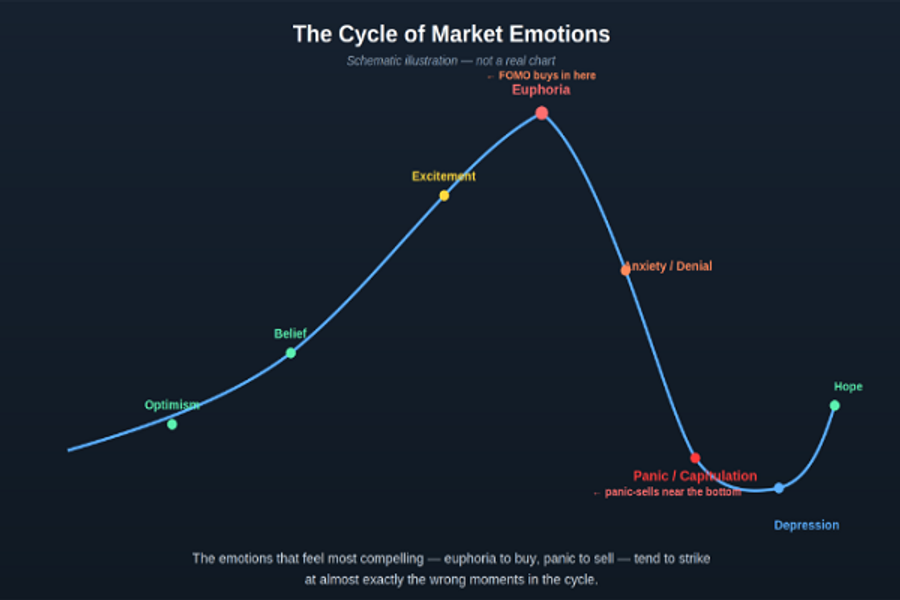
Market emotion cycle
Notice where the two named biases in this lecture's title strike: FOMO tends to pull people in right at euphoria, near the top; panic tends to push people out right at capitulation, near the bottom. Both are the emotionally easiest decisions to make in the moment and both are, statistically, close to the worst possible timing.
FOMO - Fear Of Missing Out
FOMO is the anxiety of watching an investment (or an entire market) rally sharply and feeling compelled to buy in, driven less by independent analysis than by watching other people apparently getting rich and not wanting to be left behind. It's amplified enormously by social proof - seeing friends, colleagues, or social media posts celebrating gains creates real psychological pressure to participate, regardless of whether the valuation still makes sense at that point.
The practical danger: by the time a rally has generated enough excitement to trigger widespread FOMO, a meaningful part of the gain has often already happened. Buying purely because of FOMO means buying near the point where risk is highest and further upside may be limited. The opposite of the "buy low" instinct that disciplined investing depends on.
FOBO - Fear Of Better Options
Less commonly discussed than FOMO, but just as damaging: FOBO is the anxiety that a better opportunity exists somewhere else, making it difficult to commit fully to any single decision. In practice, this shows up as:
- Constantly switching between stocks or strategies before any of them have had time to play out
- Endless research and comparison without ever actually investing, waiting for the "perfect" option that doesn't exist
- Second-guessing a reasonable, already-researched decision the moment a different opportunity catches your attention
FOBO is particularly costly for long-term investing, since it directly undermines the patience that strategies like value investing or dividend growth investing depend on. An investor who abandons a sound position after a few months because something else looks more exciting rarely lets any single strategy actually work.
Other biases worth recognising
- Loss aversion is the tendency to feel the pain of a loss roughly twice as strongly as the pleasure of an equivalent gain, which drives people to hold losing positions too long (hoping to "get back to even") while selling winners too early.
- Confirmation bias seeking out information that supports a decision you've already made, while unconsciously dismissing evidence that contradicts it.
- Anchoring - fixating on a specific reference price (often what you originally paid) as though it's still relevant to whether a share is a good buy or sell today, when the market doesn't know or care what you paid.
- Recency bias - assuming recent conditions (a strong rally, a sharp downturn) will simply continue, rather than recognising markets move in cycles.
- Herd mentality - following the crowd's behaviour on the assumption that many people can't all be wrong at once. One of the underlying mechanics that fuels both FOMO and panic selling.
Common practical mistakes that follow from these biases
- Investing without a plan - buying reactively based on a hot tip, headline, or social media post, without any framework for why, at what price, or for how long.
- Panic selling during downturns - locking in a loss permanently by selling during the worst of a decline, precisely when the emotional pressure to sell is strongest and the price is often already depressed.
- Chasing performance - piling into whatever has performed best recently, often just as that trend is exhausting itself.
- Overtrading - buying and selling frequently based on short-term noise, which racks up brokerage costs (Lecture 1.2) and taxes while rarely improving long-term results.
- Revenge trading - taking on a larger, riskier position immediately after a loss in an attempt to "win back" the money quickly, usually compounding the damage instead.
- Mistaking familiarity for safety - only investing in companies or brands you personally recognise and like, which is not the same thing as those companies being good investments at their current price.
A practical defence: write your reasoning down before you act
One of the simplest, most effective habits against all of the above: before buying or selling anything, write down why - the specific reasoning, at that specific price, with a rough sense of the time horizon involved. When emotion later pushes toward an impulsive decision, having your own calmer, earlier reasoning in writing makes it much easier to notice when you're about to act on FOMO, panic, or FOBO rather than on the analysis you actually did.
Key takeaways
- Markets move in a repeating emotional cycle, and the most emotionally compelling moments to act (euphoria, panic) tend to be close to the statistically worst times to do so.
- FOMO pulls investors toward buying after a rally has already run; FOBO prevents investors from committing fully to any single, well-reasoned decision.
- Loss aversion, confirmation bias, anchoring, recency bias, and herd mentality are additional biases worth recognising in your own decision-making.
- Common resulting mistakes include panic selling, performance-chasing, overtrading, and revenge trading after a loss.
- Writing down your reasoning before acting creates a checkpoint that makes emotional, in-the-moment decisions easier to catch before you act on them.