Lecture 12. Market Instruments
In this lecture we will review market tools: shares and bonds, futures and options, derivatives. What is it and their difference.

Thandiwe Mbeki
Published · Updated

Shares and Bonds: The Basic Differences
Two very different ways to invest in the same company (or country)
Shares and bonds are the two most common building blocks of an investment portfolio, and beginners often lump them together as "the stock market stuff." In reality, they represent fundamentally different relationships with the entity you're investing in.
A share (stock) makes you a part-owner. When you buy Standard Bank shares, you own a small slice of the bank itself - its assets, its future profits, its risks.
A bond makes you a lender. When you buy a bond, you're not buying ownership - you're lending money to whoever issued it (a government or a company), and they promise to pay you back the full amount on a set date, plus regular interest along the way.
That single distinction - owner vs. lender explains almost every other difference between the two.
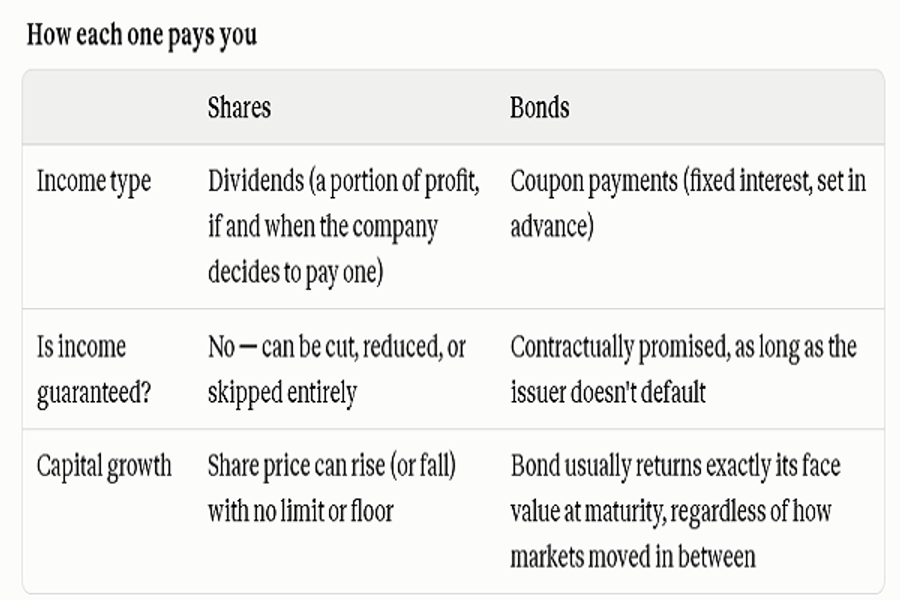
How each one pays you
A dividend is a discretionary reward for ownership: the board of directors decides whether to pay one, and can reduce or cancel it if the business needs the cash elsewhere. A bond coupon, by contrast, is a legal obligation. If a company fails to pay bondholders on schedule, that's a default, with serious legal consequences. A missed dividend carries no such consequence.
Who gets paid first if something goes wrong
This is the difference that matters most in a worst-case scenario. If a company runs into serious financial trouble and has to be liquidated, there's a strict order of who gets paid from what's left:
- Secured creditors and bondholders - paid first, from whatever assets remain
- Preference shareholders
- Ordinary shareholders - paid last, and often receive nothing if the company's debts exceed its remaining assets
This is why bonds are generally considered lower-risk than shares of the same issuer: bondholders have a legal claim that sits ahead of shareholders in the queue. It's also why shares carry more upside potential. That extra risk is compensated, over the long run, with a higher expected return.
Price behaviour: growth potential vs. price stability
A share's price can theoretically rise indefinitely if the company keeps growing and investors keep valuing it higher. There's no ceiling. It can also fall to near zero if the business fails. This makes shares more volatile day to day, but historically, equities have delivered the strongest long-term returns of any major asset class, precisely because investors are compensated for taking on that ownership risk.
A bond, on the other hand, is built around a fixed promise: the issuer commits to repaying its face value (also called par value) on a set maturity date. Between now and maturity, a bond's market price can still move up or down, mainly driven by changes in interest rates but if you hold it to maturity, you know in advance exactly what you'll get back, assuming the issuer doesn't default. That predictability is the main reason investors, especially those nearing retirement or wanting to protect capital, hold bonds alongside shares.
Two real South African examples
- A JSE-listed share: buying Standard Bank Group shares means you own part of the bank. Your return depends entirely on how the bank performs and how the market values that performance - there's no promise of any specific outcome.
- A South African government bond (an RSA bond): buying one means you're lending money to the South African government. You receive fixed coupon payments on a schedule, and get your capital back at maturity, assuming the government continues to meet its obligations, which is generally considered lower risk than lending to most individual companies, though not risk-free.
Why most portfolios hold both
Shares and bonds tend to respond differently to the same economic events which is exactly why combining them is a core idea in portfolio construction (we'll build on this properly in Module 8). Shares offer growth potential but with real volatility; bonds offer income and capital stability but with a capped return. Neither is "better": they serve different roles depending on your goals, time horizon, and how much volatility you can tolerate.
Key takeaways
- A share makes you a part-owner of a company; a bond makes you a lender to a company or government.
- Dividends are discretionary and can be cut; bond coupons are a contractual, legally-enforced obligation.
- In a liquidation, bondholders are paid before ordinary shareholders - this is the core reason bonds carry lower risk.
- Shares have unlimited upside potential and higher volatility; bonds offer a fixed, predictable return if held to maturity.
- A well-constructed portfolio typically uses both, because they behave differently in the same market conditions.
Futures and Options: What They Are, and Why a Beginner Should Know About Them
Derivatives: instruments that derive their value from something else
Shares and bonds give you direct ownership or a direct loan relationship. Futures and options are different. They're derivatives: contracts whose value is derived from the price of an underlying asset (a share, an index, a currency, a commodity) rather than being ownership of that asset itself.
You won't need these to start investing, and most long-term investors never touch them. But you'll see the terms constantly in financial news and on trading platforms, so it's worth understanding what they actually are and why they carry meaningfully more risk than simply buying a share.
Futures: a locked-in agreement to buy or sell later
A futures contract is an agreement between two parties to buy or sell a specific asset at a specific price on a specific future date, regardless of what the market price actually is when that date arrives.
Say a futures contract commits you to buying the JSE Top 40 Index at a set level in three months' time. If the index is higher than that level on the settlement date, you profit. You locked in a lower price than what it's now worth. If the index is lower, you lose - you're committed to paying more than the current market value.
Two things make futures fundamentally riskier than buying a share outright:
- You're obligated to complete the trade. Unlike simply choosing not to sell a losing share, a futures contract requires settlement on the agreed date.
- They're traded on leverage. You typically only put down a fraction of the contract's full value (called margin) to control the full position. This magnifies both gains and losses - a small adverse price move can wipe out a large percentage of your margin.
The JSE offers futures on its own index (like the Top 40) as well as single-stock futures on individual JSE-listed companies, mainly used by more experienced traders for speculation or for hedging an existing portfolio against price moves.
Options: the right, but not the obligation
An option is similar in spirit but structurally different in one important way: it gives you the right - not the obligation to buy or sell an asset at a set price (called the strike price) before or on a specific date.
There are two basic types:
- A call option gives you the right to buy the underlying asset at the strike price. You'd buy a call if you expect the price to rise: if it rises above the strike, you can buy at the cheaper, locked-in price.
- A put option gives you the right to sell the underlying asset at the strike price. You'd buy a put if you expect the price to fall: it lets you sell at a price higher than where the market has dropped to.
To get this right, you pay an upfront fee called a premium. This is the most you can lose as a buyer of an option: if the price doesn't move in your favour, you simply let the option expire unused, and your loss is capped at the premium you paid. This is the key structural difference from futures: an option buyer's downside is limited and known in advance, while a futures contract's downside is not.
(Selling, or "writing," options is a different story: a seller does take on an obligation if the buyer exercises the option, and that risk can be substantial. This is well beyond from-scratch territory, so we'll leave it there for now.)
Why beginners are told to stay away — for now?
Futures and options aren't inherently "bad" instruments. Professional investors and fund managers use them constantly, often to reduce risk rather than increase it (for example, a fund holding a large JSE portfolio might use futures to hedge against a market downturn without having to sell its actual shares). The problem for beginners is specific:
- Leverage cuts both ways violently. A relatively small, sensible-looking position can produce losses far larger than what you initially put down, especially with futures.
- Timing matters far more than with shares. Both instruments have expiry dates. You can be completely right about a company's or market's long-term direction and still lose money if the move doesn't happen before your contract expires.
- They require active, frequent monitoring - not something well suited to someone still learning to read a balance sheet or place a basic share order.
For this course, the practical takeaway is simple: understand what these terms mean when you encounter them, but as a beginner, build your foundation with shares, bonds, and funds first. Derivatives are a tool for a later stage of your investing journey, once you understand the underlying assets they're built on.
Key takeaways
- Futures and options are derivatives. Their value comes from an underlying asset, not ownership of it.
- A futures contract is a binding obligation to transact at a set price on a set date; losses (and gains) are amplified by leverage.
- An option gives you the right, not the obligation, to transact at a set price - your maximum loss as a buyer is limited to the premium paid.
- Both instruments have expiry dates, meaning you need to be right about both direction and timing.
- These are advanced tools best approached after you're comfortable with shares, bonds, and fund investing.
Investment Funds: Unit Trusts, ETFs, and Mutual Funds
The core idea: pooling money together
A fund is simply a pool of money from many investors, combined and invested together, usually across a basket of shares, bonds, or other assets rather than each investor picking individual holdings themselves. When you buy into a fund, you own a proportional slice of everything the fund holds, not a direct stake in any single underlying company.
For a beginner, funds solve two problems at once: instant diversification (your money is spread across dozens or hundreds of holdings instead of riding on one company) and professional or rules-based management (someone else or an algorithm tracking an index - decides what to buy and sell).
In South Africa, the two structures you'll run into most often are unit trusts and ETFs. They achieve a similar outcome but work quite differently under the hood.
Unit trusts: bought and sold through the fund manager, not the exchange
A unit trust (also called a collective investment scheme) is not traded on the JSE at all. Instead, you buy and sell units directly through the fund manager — companies like Allan Gray, Coronation, or Ninety One. Usually once a day, at a price calculated after markets close (the Net Asset Value, or NAV, per unit).
Key characteristics:
- Priced once a day, based on the closing value of everything the fund holds
- Open-ended: the fund creates or cancels units as money flows in or out, so there's no fixed number of units in issue
- Can be actively managed (a manager and analyst team actively picks holdings, aiming to beat a benchmark) or, less commonly in the unit trust world, passively managed
- Usually requires a minimum monthly debit order or lump sum to start, set up directly with the fund manager
ETFs: traded on the JSE like a share
An ETF (Exchange-Traded Fund) holds a basket of assets too, but the units themselves are listed and traded on the JSE, just like an ordinary share through your regular stockbroker, at a live price that moves throughout the trading day.
Key characteristics:
- Priced continuously during trading hours, based on real-time buying and selling - not just once a day
- Most ETFs are passively managed, meaning they simply track an index (like the JSE Top 40 or the All Share) rather than trying to beat it. Though actively managed ETFs (AMETFs) also exist and combine active stock-picking with the exchange-traded structure
- Bought and sold exactly like a share, using the same brokerage account you'd use for individual stocks
- Generally has lower minimum investment requirements than many unit trusts, since you can often buy a single unit
A well-known South African example is the Satrix range - Satrix Top 40, for instance, tracks the JSE Top 40 Index, giving you exposure to South Africa's 40 largest listed companies in a single trade.
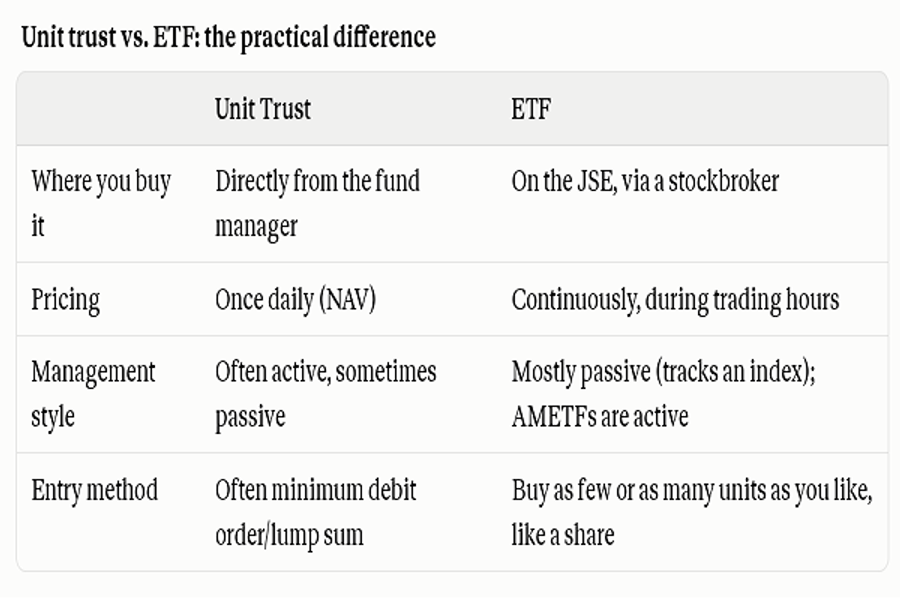
Neither structure is objectively "better". A unit trust suits someone who wants to set up an automatic monthly contribution and not think about timing; an ETF suits someone who wants share-like flexibility and to see exactly what price they're transacting at, in real time.
The cost that matters most: fees
However you access a fund, its ongoing cost is usually expressed as a Total Expense Ratio (TER). The percentage of your investment taken each year to cover management and administration. This fee is deducted automatically from the fund's value; you won't see it as a separate line-item charge, but it compounds over time and meaningfully affects your long-term return. Passively managed funds (most ETFs) typically carry lower TERs than actively managed unit trusts, since there's no research team actively picking stocks.
Where to go deeper
This lecture is intentionally an overview. Choosing between individual funds, understanding fund-of-funds structures, offshore feeder funds, and spotting fraudulent "investment schemes" disguised as funds is covered in full depth in our dedicated course, Инвестиции для ленивых и занятых. If funds end up being your preferred way to invest, that course is the natural next step after this one.
Key takeaways
- A fund pools many investors' money into one diversified basket of holdings, managed on their behalf.
- Unit trusts are bought directly from the fund manager, priced once a day; ETFs trade on the JSE all day, just like shares.
- Most ETFs are passively managed and track an index; unit trusts are more often actively managed (though passive unit trusts exist too, and actively managed ETFs - AMETFs - blur the line further).
- The Total Expense Ratio (TER) is the ongoing cost of holding a fund, and it compounds over time. Worth comparing before choosing between similar funds.
- This is a broad overview; a full dedicated course covers fund selection and risk in much greater depth.
Build your watchlist
Track the stocks you just learned about — get price alerts and daily updates.
Go to your watchlist