Lecture 11 (Chapter 2). Broker & Market Basics
Here we will review market basics - How does it work?

Thandiwe Mbeki
Published · Updated

What Is the Stock Market and How Does It Work?
The basic idea
A stock market is a marketplace where pieces of ownership in companies, called shares or stocks, are bought and sold. When a company wants to raise money to grow, it can offer a slice of itself to the public instead of borrowing from a bank. Anyone who buys that slice becomes a part-owner of the company, with a claim on its future profits and, in most cases, a vote at shareholder meetings.
In South Africa, this marketplace is the Johannesburg Stock Exchange (JSE) - Africa's largest exchange by market capitalisation, and home to companies like Standard Bank, Naspers, Sasol, and Shoprite. When people say "the market went up today," for South African investors that usually means the JSE All Share Index (ALSI) - a basket that tracks the combined performance of nearly all JSE-listed companies, moved higher.
Two markets in one
It helps to think of the stock market as having two layers:
The primary market is where shares are created and sold for the first time. This happens through an Initial Public Offering (IPO). A company sells new shares directly to investors and receives the money to fund its operations, expansion, or debt repayment. This only happens once per share, at listing.
The secondary market is what most people mean by "the stock market" day to day. It's where existing shareholders trade shares with each other. You're not buying from the company anymore, you're buying from another investor who already owns the stock, and the company itself doesn't receive any money from that trade. When you buy Standard Bank shares today, you're buying them from whoever currently holds them, not from the bank itself.
How a trade actually happens
The JSE doesn't set prices — it matches buyers and sellers. Every share has:
- A bid price is the highest price a buyer is currently willing to pay
- An ask (or offer) price is the lowest price a seller is currently willing to accept
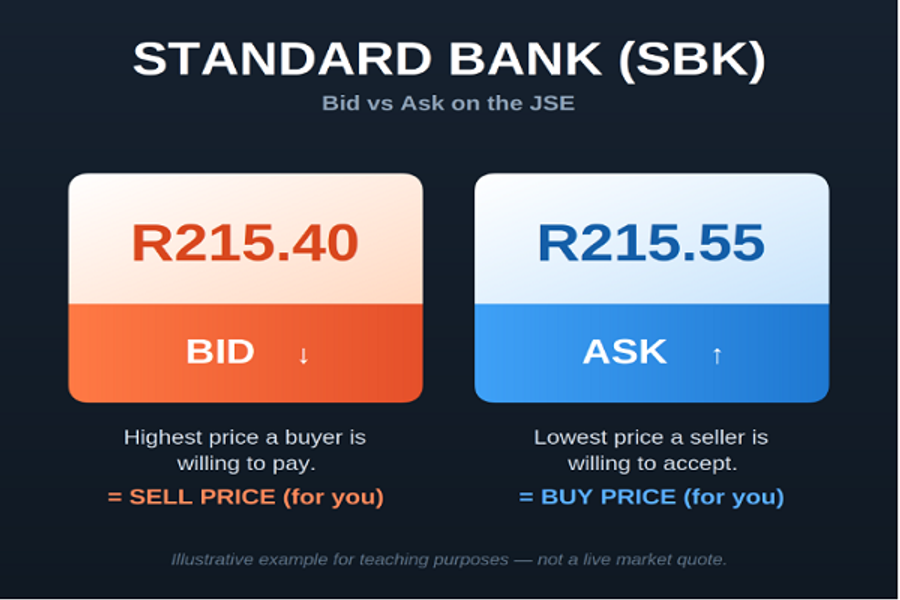
When a buyer's bid matches a seller's ask, a trade executes automatically through the exchange's electronic system, and that becomes the share's new "last traded price." This happens thousands of times a second across the exchange, which is why prices move continuously throughout the trading day. They're a live reflection of what buyers and sellers currently agree a company is worth.
You, as an individual investor, don't place orders directly on the JSE. You go through a licensed stockbroker, who routes your order to the exchange. That's the next lecture's topic.
Why prices move
A share's price isn't set by the company - it's set by supply and demand, driven by what investors believe the company is worth now and what they expect it to be worth in the future. That belief is shaped by things like:
- Company-specific news: earnings results, a new CEO, a product launch, a scandal
- Industry trends: a rise in the gold price lifts mining shares like Harmony Gold or Gold Fields
- Macroeconomic conditions: interest rate changes, inflation data, currency moves (we'll dig into this in Module 4)
- Market sentiment: sometimes prices move on emotion and momentum as much as on fundamentals (Module 9)
This is why a genuinely good, profitable company can still see its share price fall. If investors expected even more, or the broader market is nervous, sentiment can outweigh solid fundamentals in the short term.
Market capitalisation: sizing up a company
One number you'll see constantly is market capitalisation (market cap) - the total value the market currently places on a company:
Market Cap = Share Price × Number of Shares in Issue
For example, if a company has 1 billion shares in issue and each trades at R50, its market cap is R50 billion. Market cap is what lets you compare companies of very different share prices on equal footing: a R50 share and a R500 share tell you nothing about which company is "bigger" until you multiply by shares in issue.
Key takeaways
- The stock market lets you buy small ownership stakes in real companies, traded through an exchange like the JSE.
- New shares are created once, in the primary market (IPO); after that, they trade endlessly between investors in the secondary market.
- Prices are set by matching buyers and sellers - not by the company or the exchange.
- Share prices move based on company news, industry trends, macro conditions, and investor sentiment.
- Market capitalisation (price × shares in issue) is the standard way to measure a company's size.
How to Choose a Reliable Broker
Why you can't trade directly on the JSE?
As covered in the last lecture, you don't place buy or sell orders on the JSE yourself: you go through a stockbroker, a licensed intermediary that has direct access to the exchange's trading system. The broker executes your order, holds a record of your shareholding (or arranges custody through a central depository), and usually gives you a trading platform or app to place orders, track your portfolio, and access research.
Choosing a broker is one of the first real decisions a new investor makes, and it matters. Your broker holds your money and your shares, so trust and regulation come before convenience.
Step 1: Confirm the broker is licensed
In South Africa, any firm offering brokerage or investment services must be authorised by the Financial Sector Conduct Authority (FSCA), the regulator responsible for market conduct in financial services. Before opening an account anywhere, you can:
- Search the FSCA's public register of licensed Financial Services Providers (FSPs) for the broker's name or FSP number.
- Confirm the license is active, not suspended or withdrawn.
- Check whether the broker is a member of the JSE itself (JSE-member firms are listed on the exchange's own site). This matters if you want direct JSE execution rather than going through a broker that merely offers access via a third party.
A broker operating without a valid FSCA license is not a grey area. It's illegal to use, regardless of how professional its marketing looks. This single check filters out the majority of scams before you go any further.
Step 2: Understand how your money and shares are protected
A licensed broker in South Africa is required to keep client funds in segregated trust accounts, separate from the firm's own operating money. This means that even if the brokerage itself ran into financial trouble, client cash isn't part of its general assets available to creditors.
Your actual shareholdings are typically held either:
- In your own name via the exchange's central securities depository, or
- In a nominee account, where the broker (or a custodian) holds shares on your behalf in bulk, but keeps a clear record of what belongs to you.
When comparing brokers, it's worth understanding which model they use, since it affects things like how quickly you can move your shares to another broker later, and whether you receive shareholder documentation directly.
Step 3: Compare the fee structure
Brokerage fees vary by provider and change over time, so rather than chasing the "cheapest" broker on any given day, focus on the structure:
- Brokerage/commission per trade - usually either a flat fee or a percentage of trade value, sometimes with a minimum.
- Platform or account fees - some brokers charge a monthly or annual account fee regardless of trading activity.
- Currency conversion fees - relevant if the broker also gives you access to offshore markets (US, UK, etc.), since converting rand to foreign currency usually carries its own cost.
- Minimum deposit or minimum trade size - some platforms are built for very small, frequent investors (fractional shares), others expect larger lump sums.
South Africa has a range of established brokers that beginners commonly start with, from bank-linked platforms (like a broking arm attached to a major bank) to independent, digital-first brokers such as EasyEquities, PSG Wealth, Sharenet, and Sanlam iTrade, among others. Each has a different fee model and target user, so it's worth comparing two or three directly on the specific things you'll actually use. Buying local shares, ETFs, or offshore stocks, rather than picking based on brand recognition alone.
Step 4: Check the platform itself
Beyond regulation and cost, a few practical things are worth testing before committing real money:
- Is the trading platform (web or app) stable and easy to place an order on?
- Does it show real-time or delayed prices, and is that clearly labelled?
- What research, company data, or news is bundled in for free?
- How responsive is customer support if something goes wrong with an order or a deposit?
Many brokers let you open an account with no obligation to fund it immediately, so you can explore the platform itself before deciding.
Step 5: Look at reputation — with the right context
Online reviews are worth glancing at, but in South African brokerage specifically, treat them with caution. Two things distort the picture:
Almost every SA broker has a mediocre-to-poor public rating. Review platforms structurally attract complaints far more than satisfied silence. Happy clients rarely leave reviews, frustrated ones do. A low aggregate score is close to the industry norm here, not a disqualifying signal on its own. What matters is the pattern of complaints relative to competitors, not the raw number.
A slow withdrawal is not automatically a red flag. Every licensed broker in South Africa operates under FICA (the Financial Intelligence Centre Act), which requires anti-money-laundering (AML) checks before releasing client funds. These checks are legally mandatory and get stricter around:
- Large withdrawals
- Withdrawing the full account balance (vs. a partial amount)
- Withdrawing shortly after a deposit, or withdrawing profit rather than the original deposit
A broker that takes days to release a large, full-balance withdrawal may simply be doing its compliance job. This applies even to well-run, fully licensed brokers, not just questionable ones.
What's actually worth watching is how the broker handles it: does it explain the delay, give a real timeline, and respond when you follow up? A broker that goes silent, keeps shifting its story, or stalls small routine withdrawals with no compliance justification is a far stronger warning sign than a single slow payout on a large AML-flagged transaction.
Beyond withdrawals, checking the broker's FSCA enforcement history and any affiliation with recognised financial institutions remains a useful, more objective signal.
Key takeaways
- You must trade through a licensed broker: verify its FSCA registration before opening an account, every time.
- Regulated brokers keep client funds in segregated trust accounts, separate from the firm's own money.
- Compare brokers on fee structure (brokerage, platform fees, currency conversion, minimums), not just on a single advertised rate.
- Test the platform itself - stability, pricing transparency, and support quality matter day to day.
- Reputation checks (reviews, complaint patterns, regulatory history) catch problems that marketing won't show you.