Lecture 5 (Module 1). Market hours & Volatility
Market hours is when the magic happens on the stock market and your deal is up or down. It can be your work schedule or just a moment to open the trading terminal, check what is news and close.

Thandiwe Mbeki
Published · Updated
What Is Volatility?
Volatility measures how much and how fast a price moves over a given period — it says nothing about direction, only about the size and speed of the swings. A stock can be volatile while trending strongly upward, trending downward, or going nowhere in a choppy range. High volatility means bigger price swings (more opportunity, but also more risk per trade); low volatility means smaller, slower movement.
Volatility isn’t constant throughout the day or the week — it’s driven largely by how many participants are actively trading at any given moment, which in turn is driven by market hours.
JSE Trading Hours
The JSE trades Monday to Friday, from 09:00 to roughly 16:50–17:00 South African Standard Time (SAST, UTC+2), with a closing auction concluding the session. South Africa does not observe daylight saving, so this window is stable year-round relative to UTC.
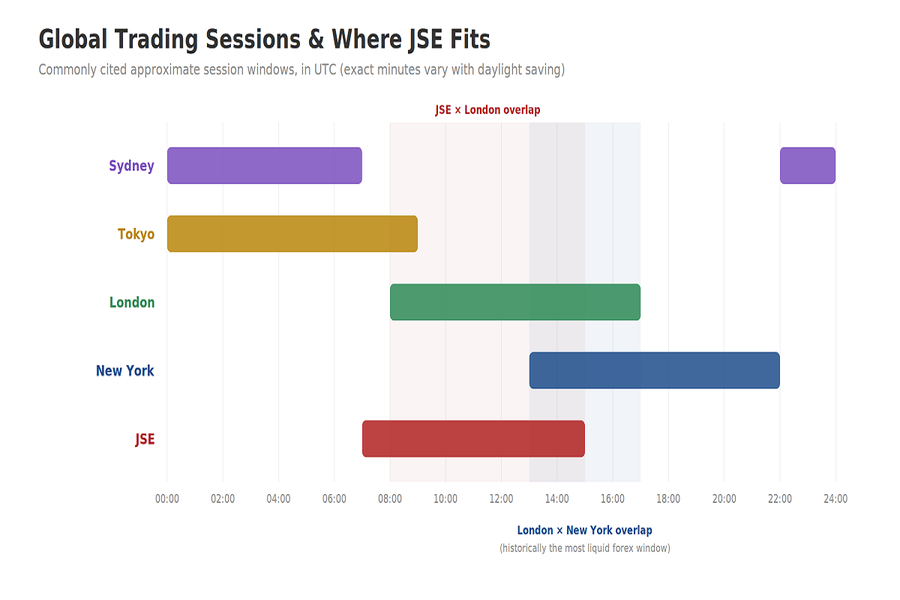
Figure 1 places the JSE session against the four major forex trading sessions. Two things stand out:
- JSE overlaps significantly with London — roughly 08:00 to 15:00 UTC (10:00–17:00 SAST). Since many JSE-listed companies are dual-listed or have substantial international revenue (Naspers, the major miners, banks with African/global operations), European market sentiment can visibly influence JSE price action during South African trading hours.
- The JSE closes before New York really gets going. By the time the London–New York overlap — historically the most liquid window in the forex market — begins around 13:00 UTC (15:00 SAST), the JSE session is already in its final couple of hours, and the exchange is closed well before the New York session peaks. This matters for anyone trading JSE-listed instruments alongside US-linked news: a major US announcement landing after the JSE close won’t be reflected in JSE prices until the next trading day’s open.
The forex market itself never closes during the week as one regional session winds down, another is opening, which is why forex is often described as a 24-hour market (excluding the weekend, when it closes from Friday evening to Sunday evening, local time zones considered).
The Intraday Volatility Pattern
Even within a single trading session, volatility isn’t evenly distributed. Most equity markets - the JSE included - tend to follow a recognisable shape through the day.
Sharedintraday_volatility_pattern.png
Figure 2 shows this “smile” shape: a burst of volatility right at the open (overnight news, global developments, and a backlog of orders all get processed within the opening minutes), a quieter “midday lull” as fewer participants are actively trading, and another pickup heading into the close as traders position for the overnight gap. This is a general tendency, not a rule for any specific day: a single major news release can override the whole pattern in an instant.
Why This Matters for Strategy
- Day traders often deliberately avoid the first few minutes after the open, when spreads can be temporarily wider and price action more erratic, preferring to wait for the initial volatility to settle into a clearer direction.
- Scalpers (a strategy we’ll cover in Module 3) specifically seek out high-liquidity windows like session overlaps, since tighter spreads and faster execution matter enormously at their trade frequency.
- Swing and position traders care less about intraday timing and more about which session is likely to react to a catalyst — for example, timing an entry around a JSE-listed, globally-exposed stock ahead of a European economic release.
- Anyone holding JSE positions overnight should be aware that US market-moving news landing after 17:00 SAST won’t be priced into JSE shares until the next session opens: a real source of overnight gap risk distinct from the swap cost covered in Lecture 2.
Common Mistakes to Avoid
- Trading the first few minutes after the open without adjusting for wider spreads and erratic price action, expecting the same conditions as midday.
- Assuming JSE hours align with US market hours when reacting to US news. The JSE is typically closed by the time major US catalysts (like an FOMC decision) actually land.
- Ignoring the midday lull when backtesting a strategy is a system that performs well using data concentrated in high-volatility windows may look worse (or need adjusting) if applied blindly through quiet midday hours.
Summary
Market hours determine how many participants are active, and participant count is one of the biggest drivers of volatility. The JSE’s session overlaps meaningfully with London but closes before New York peaks, the forex market runs continuously through four regional sessions, and even within a single session, volatility tends to follow a recognisable open-lull-close pattern. Timing isn’t just about when you trade. It’s about how much movement you’re likely to be trading into.
Track your portfolio
Log your holdings and see performance against the JSE All Share.
Go to your portfolio