JSE & Global markets weekly: last week of October 2026

This week marks the end of October and, as expected, has been one of the most important in the stock market. In the US and around the world, people were awaiting the Federal Reserve's interest rate decision, while stock exchanges were busy publishing earnings reports from major companies. As Friday approached, volatility increased. A week that was expected to dispel doubts about artificial intelligence only reinforced them. Investor sentiment was far from rosy: rates are trending higher, AI is too expensive, and gold is falling. Unsurprisingly, four of the five indices reviewed ended the week lower. Surprisingly, some stocks actually showed gains against this backdrop.
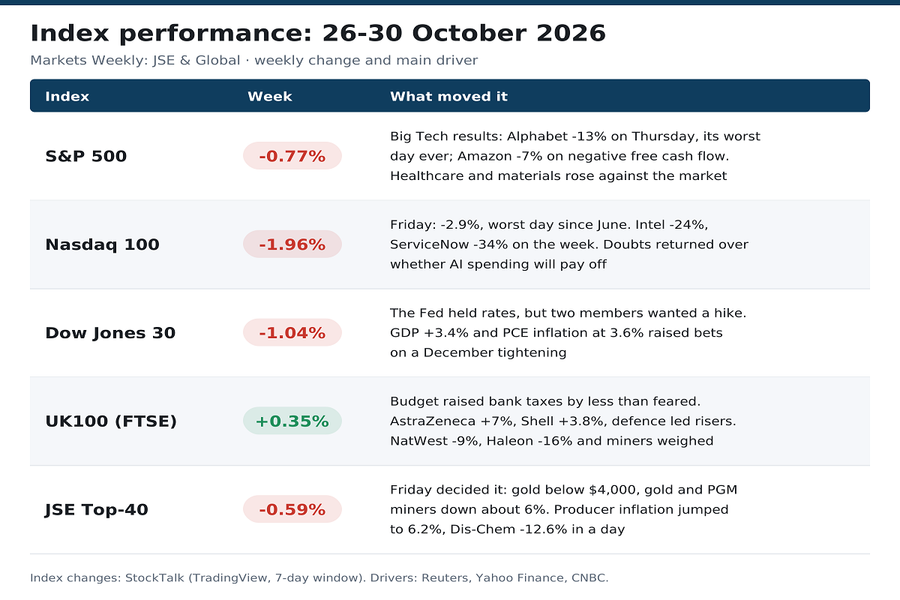
Wall Street fell across the board. The Nasdaq 100 lost almost 2%, and even the Dow, which leaned on defensive stocks a week earlier, slipped 1%. The FTSE 100 edged up, posting its first monthly gain in three months. The JSE Top-40 ended slightly lower, after a sharp drop in gold on Friday wiped out the week’s earlier gains.
JSE market weekly review for the end of October 2026
The week was packed with corporate results and events, which certainly fuelled volatility. But a day-by-day look shows a sharply contrasting picture. Activity was subdued early in the week and picked up markedly towards the end. That makes sense: investors were waiting for clarity on the US macro picture and for most of the week’s corporate results. On Wednesday, the Fed left rates unchanged, but two committee members voted for an immediate hike. On Thursday, strong US GDP and inflation data strengthened bets on further tightening. Most of the week’s reports landed on Friday, including Dis-Chem, which suffered its worst day since 2018. In the end, Friday decided the result: gold fell below $4,000 an ounce, gold and platinum miners dropped about 6%, and the Top-40 closed the week down 0.59%. At home, producer inflation jumped to 6.2% in September from 5% in August, with oil still above $100 a barrel.
Rally of the week title goes to Pick n Pay (JSE: PIK), +14.1%
The retailer received two positive signals. On Thursday, 23 October, Pick n Pay dropped its plan to cut about 22,000 store jobs after reaching an agreement with the SACCAWU union. The dispute had dragged on since May, and in June the labour minister had to step in. Then on Monday, 26 October, the company reported results for the half-year to 30 August. The headline loss per share narrowed to 40.71 cents from 59.77 cents a year earlier, the total headline loss shrank 31.9% to R299 million, and group turnover rose 2.4% to R60.5 billion.
Discount chain Boxer remains the main engine: turnover grew 6.3% to R24.1 billion and trading profit rose 8.1% to R1.0 billion. The core Pick n Pay chain narrowed its trading loss by 16.9% to R516 million, while like-for-like sales in company-owned South African supermarkets rose 2.4%, ahead of internal price inflation of 1.5%. On results day, the shares rose as much as 5.7% to R22.32, the highest since May. The job is not done: the chain is still loss-making, the break-even target is set for the 2029 financial year, and CEO Sean Summers warned that the second half will be tough because of expensive oil.
Strongest report, published this week wasn't easy to get because a lot of reports published and the winner is Datatec (JSE: DTC)
Technology group Datatec reported results for the half-year to 31 August. Gross invoiced income rose 18.3%, adjusted EBITDA increased 16.7% to $150 million, and underlying earnings per share jumped 56.5%. The interim dividend was raised 50% to 15 US cents. Both core businesses set records: IT services firm Logicalis International grew EBITDA 36% to a record $71 million, while distributor Westcon posted record order intake and record half-year EBITDA. The weak spot was Logicalis Latin America, where gross invoiced income fell 16% and EBITDA turned slightly negative for the first time, prompting a restructuring away from telecom customers. The market’s reaction was muted, at about plus 0.5% on results day.
Fall of the week we can call Dis-Chem's quotes on JSE this week: Their stocks lost -13.74% for just a few trading days
Pharmacy chain Dis-Chem reported half-year results to the end of August on Friday, 30 October, and the market responded with the stock’s worst day since May 2018: down 12.63% to R24.42, a three-year low. Revenue rose 8% to R23 billion, but expenses grew faster, by 12.1%. As a result, headline earnings per share fell 12.8% to 64.3 cents, and the interim dividend was cut 12.9% to 25.62 cents. The money is going into the future: about R240 million has been invested in a digital platform through the company’s innovation hub, alongside a costly rollout of “Stores of the Future.” Dis-Chem shares are down about 30% this year, while main rival Clicks rose 1% on the same day.
Glad to hear JSE is growing. This week we have a listing event but yes - it's about ETF fund again.
A new actively managed ETF from EasyETFs, the EasyEquities platform, has joined the JSE, managed by investment firm MitonOptimal. The fund invests in South African equities with a capital protection strategy: according to EasyEquities, it aims to capture the long-term growth of the South African market while limiting the impact of downturns.
JSE TOP-40 index fast tech review
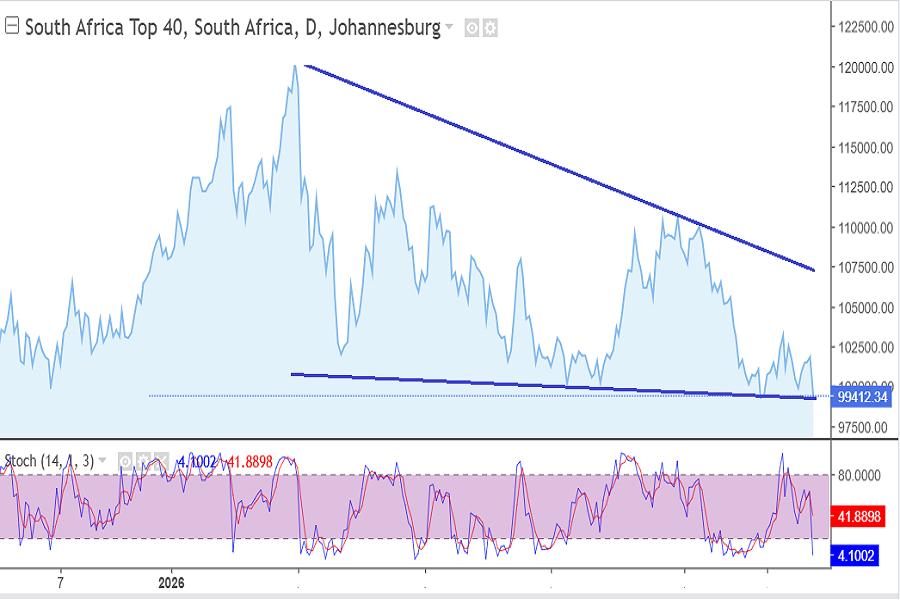
The index proved to be one of the most resilient of the five other indices this week, despite all the negative factors, but remained below the psychological 100,000-point mark. The downtrend has every chance of continuing in November, particularly due to relatively low gold prices, oil prices above $100, and the risk of a rate hike. Technical analysis indicators are showing a sell signal, and we see no arguments against it.
UK stock market at the end of October 2026
London’s biggest companies avoided dramatic moves this week: the most notable was AstraZeneca’s 7% one-day jump after a restructuring plan. The real rallies and falls came from smaller names.
The main event was Chancellor John Healey’s first Budget. Taxes on banks and gambling firms were raised by less than expected, which lifted stocks early in the week, while the gilt market barely reacted.
Rally of the week on LSE won by Pensana (LSE: PRE), stocks of which added +26.12%
A UK company building the Longonjo rare earths mine in Angola. The industry depends almost entirely on China, so projects outside China attract strong investor interest.
On Monday, 26 October, the shares jumped 21% on a financing update. The key news: investor Cascade, which has committed $165 million but invested only $15 million so far, expects to release a “substantial tranche” within the next 14 days. Talks are also under way to raise $75-90 million of equity in the Angolan subsidiary Ozango Minerais. Construction of the mine is 30% complete, binding commitments cover more than 60% of procurement, first commissioning is targeted for January 2028 and full production for September 2028.
This is relief rather than a breakthrough. Slow financing has long held the project back, and about a month earlier Pensana had to scale back construction. The market welcomed signs that money is finally on the way. Both the Cascade tranche and the Ozango deal remain expectations rather than completed transactions.
Fall of the week belongs to Vanquis Banking Group (LSE: VANQ), -39.21%
A UK bank specialising in lending to customers with limited or damaged credit histories. Its main products are credit cards and car finance for people mainstream banks usually turn down. The business is high-yielding but highly sensitive to its customers’ finances.
For the bank to loose 39% is extremely painful thing but this is how financial sector works nowadays. On Thursday, 29 October, the bank published its third-quarter update and sharply cut its profitability outlook. The shares fell 34% to 48.05 pence, and were down almost 37% at one point. Lending is growing: customer balances rose 21% year on year to £3.21 billion.
The problem is quality. Credit card charge-offs are rising, personal insolvencies are increasing, and some customers are struggling with the cost of living. The bank raised its provisions for expected losses and posted a small loss for the third quarter. The new return on tangible equity targets are much weaker than before:
- 2026: negligible returns.
- 2027: low single digits instead of low double digits, if weak credit performance persists.
- 2028: low double digits instead of mid-teens.
This is the second blow in three months. In late July, after half-year results, Vanquis shares lost more than 20% when the bank first pushed its return targets back to 2028. Back then the shares traded around 115 pence; now they are worth less than half that.
Listing on the LSE is a rare thing but we have it this week.
TEK4 Group (AIM) stocks started its way on the stock exchange right on Monday and for 5 trading days added 32% over initial IPO price.
Founded in 2002 and based in Leicestershire, the company designs and builds precision drilling machines for aero engine and industrial gas turbine components, including cooling holes in turbine blades. Its customers include Rolls-Royce, GE and Pratt & Whitney, and it has more than 200 machines in service. In its 2026 financial year, revenue was £16.2 million with an operating margin of 27.7%, and the company has no debt.
The shares were placed at 200 pence, raising £24.75 million and valuing the company at £42 million at admission. So if you believe newcomer is promising, you have to connect to LSE and perhaps buy some number of their stocks.
UK100 index - fast tech review for the last week of October 2026
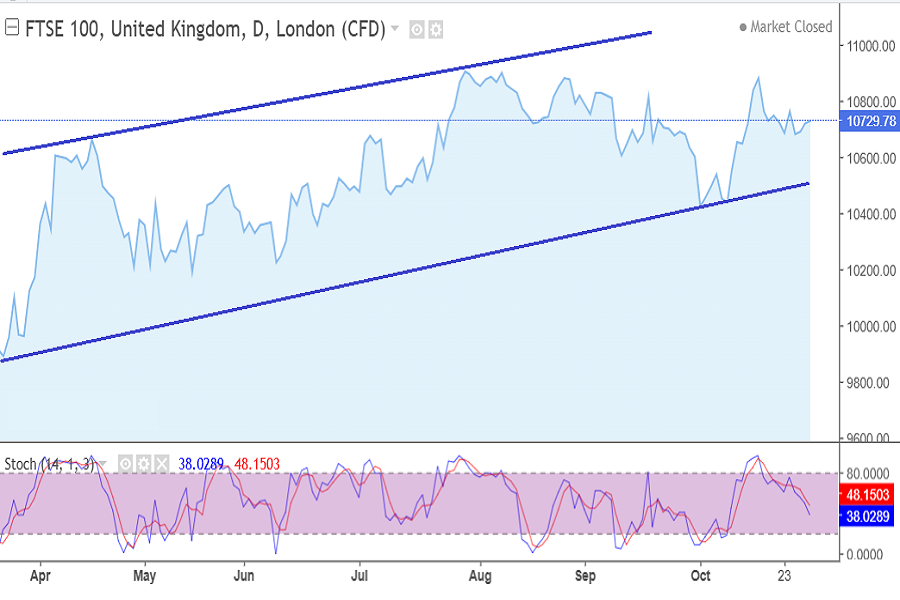
The index was the only one of the five to end the week slightly above 0, which brings us back to where we were last week and leaves a small hope for the uptrend to continue and new momentum to build in the future. Technical analysis indicators also remained in the buy category.
US stock market at the end of October 2026
The US stock market experienced an extremely volatile period as investors assessed the earnings releases of key tech companies, generating ever-increasing arguments against investing in AI. The macroeconomic backdrop was also negative, as despite the current interest rate being maintained, the likelihood of a future rate hike is increasing. Uncertainty in the stock market is also being fueled by the upcoming congressional elections and the likely escalation of the conflict with Iran after the elections, which contributed to this week's sell-off.
Rally of the week on negative unstable US market belongs to Pentair (NYSE: PNR) with +19.99% gain.
A US maker of water equipment, far from AI, pumps and filters for swimming pools, water treatment systems for homes and businesses, and other related products reported third-quarter results on Tuesday and the shares jumped about 11-12%. Adjusted earnings per share were $1.18 against expectations of $1.08, and revenue of $976 million beat the $965 million forecast. Sales fell 4% year on year, but the market saw the key signal: pool sales were down 18%, yet management said destocking by distributors was complete.
Pentair improved its full-year sales guidance to a decline of about 3%, from a previous range of 4-7%. A new acquisition added to the optimism: on 1 October, Pentair completed the purchase of Taco Group Holdings, a maker of heating and water systems for buildings, who is expected to generate $560 million in revenue in 2026, and the deal should add to earnings per share from 2027.
Even more exciting rally traditionally belongs to biotech and for this time Replimune Group (Nasdaq: REPL), whose stocks added +51.90%.
A US biotech developing oncolytic immunotherapy, genetically modified viruses that attack cancer cells and activate the immune system against them didn't skyrocket thanks to successful phase of testing their first drug, Tudriqev (RP1). Their stocks added in price thanks to successful use of their drug since it was allowed by FDA. So the first patient received the drug on 6 October, more than 15 hospitals have already prescribed it, and more than 70% of 200 priority medical centres are engaged.
This is a comeback story. The FDA rejected the drug twice before granting accelerated approval in August 2026, at the third attempt. The shares have more than doubled in recent months.
Fall of the week belongs to well-know Reddit (NYSE: RDDT). Stocks of this social network lost -36.32% just for a few trading days due to AI.
On Friday, 30 October, the shares plunged about 29%, the worst day in Reddit’s history, falling below their 52-week low. Reddit published their financial report. The quarter itself was strong: revenue rose 53% to $895 million, and earnings per share of $1.40 beat the $1.33 estimate. But the outlook spooked investors. Reddit expects fourth-quarter revenue of $1.0-1.03 billion, below the $1.045 billion consensus.
The real problem is traffic. Google’s AI features, AI Overviews and AI Mode, answer questions directly in search, so users no longer need to click through to Reddit. CEO Steve Huffman said search referrals fell by more than one million a week in October. US daily users dropped by 2.5 million in the quarter to 50.7 million, with logged-out visitors down 9%. Reddit warned that if the trend continues, daily users could fall by a “low double-digit percentage” in the fourth quarter. JPMorgan cut its price target to $150 from $185, and Goldman Sachs to $140 from $215.
The irony of the week. Google pays Reddit for content to train its AI, and the same AI is taking Reddit’s visitors away.
US indices - fast tech weekly review
S&P500
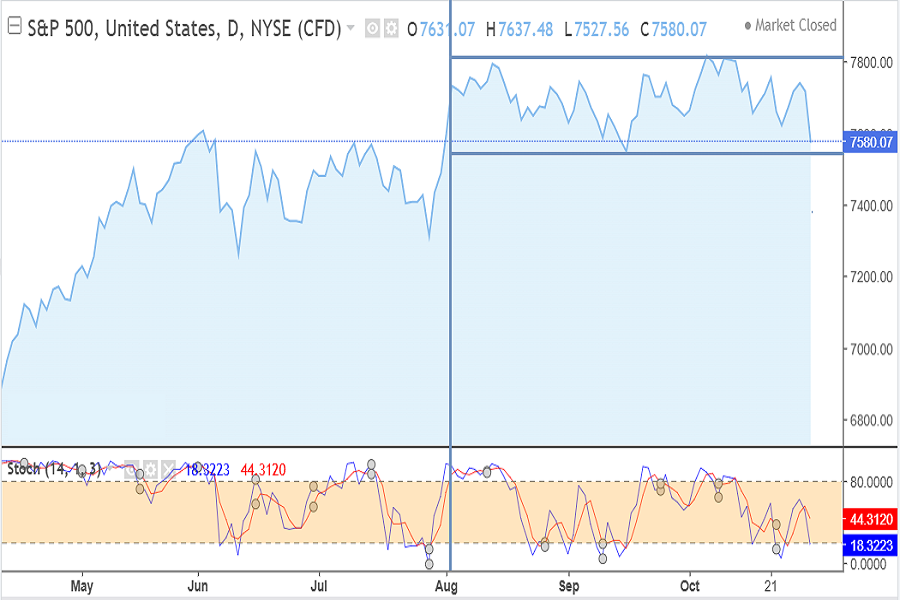
Consolidation continues, but we may soon see a test of the support line, and in a negative scenario, a trend reversal. The likelihood of a new upward rally is still highly questionable, but much also depends on the outcome of the US elections and the opportunities investors perceive as they evaluate the outcome? Anyway tech indicators show us Strong Sell signal - according to our expectations.
2. DOW Jones Industrial index (DOW30)
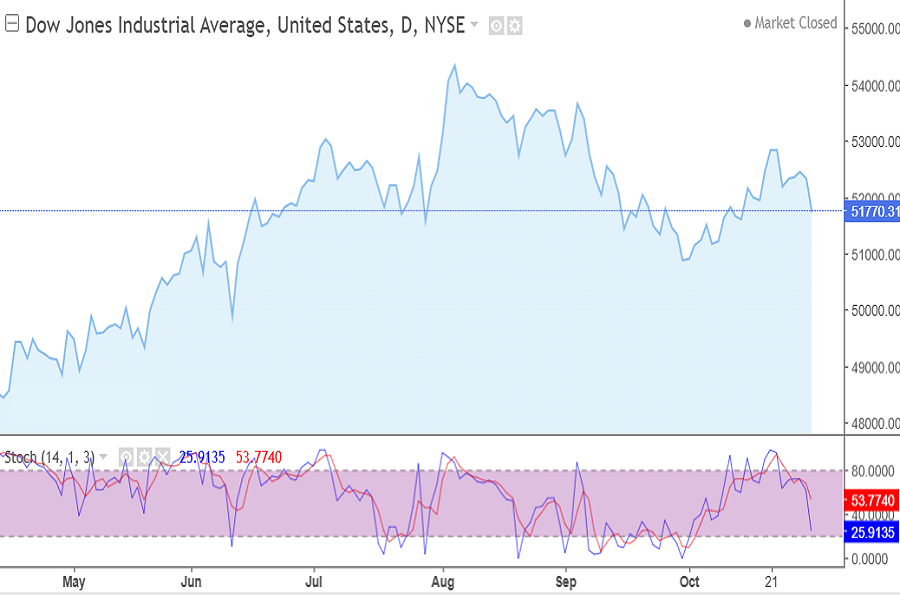
The index continued its movement, fully in line with the principles of technical analysis and our forecasts. Everything points to a continued downward movement. Technical analysis indicators have also turned downward and are no longer contradicting us.
3. Nasdaq100
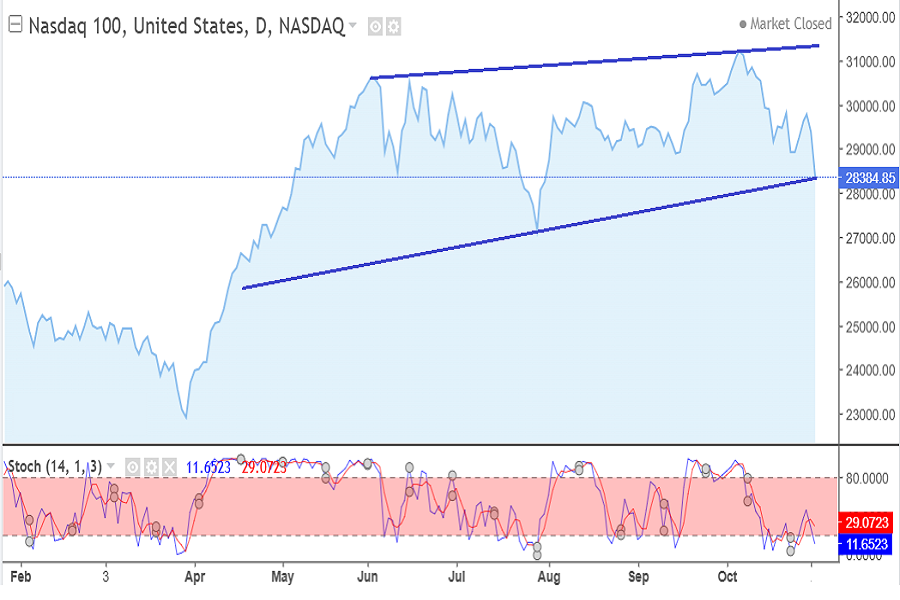
This index proved to be the most sensitive to the stock market situation and lost almost twice as much as any other index. Support was tested and shifted downward. The stochastic oscillator is stuck in oversold territory and is unable to break out. There is every reason to expect a price correction and a slight recovery after this decline. However, technical analysis indicators remain unchanged and point downward. It's too early to talk about a trend reversal, but the beginnings were made just this week.
Key currencies at the end of October 2026
EUR/USD
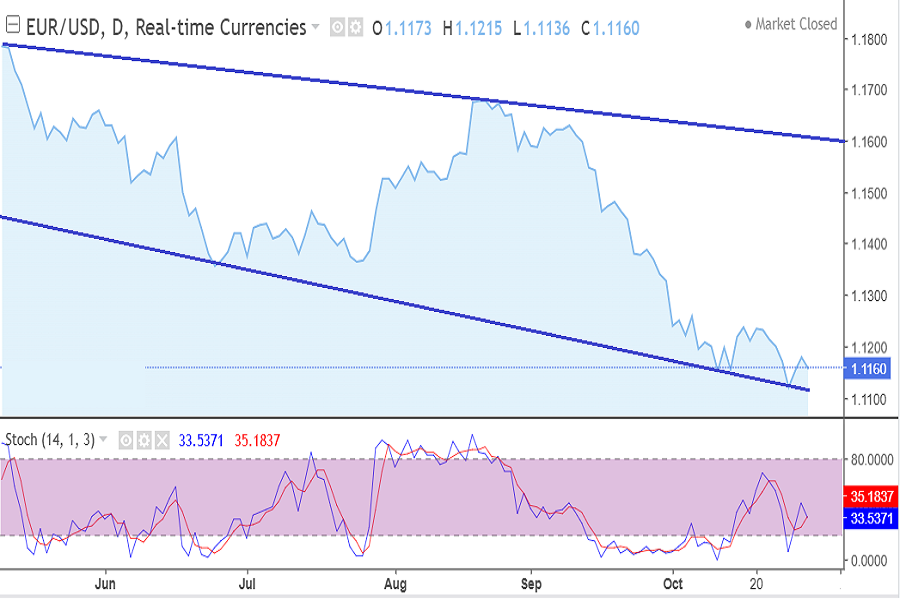
EUR/USD ended the week practically unchanged around 1.119, trading between 1.1105 and 1.1215. The European Central Bank held its deposit rate at 2.50% on Thursday but kept the door open to further hikes, warning that the energy shock is likely to push inflation up and weigh on growth. So USD was only 0.32% stronger than EUR.
Our forecast and tech indicators signal remains the same: Strong Sell. Can't see any other scenario on the chart except for a further decline.
2. USD/ZAR
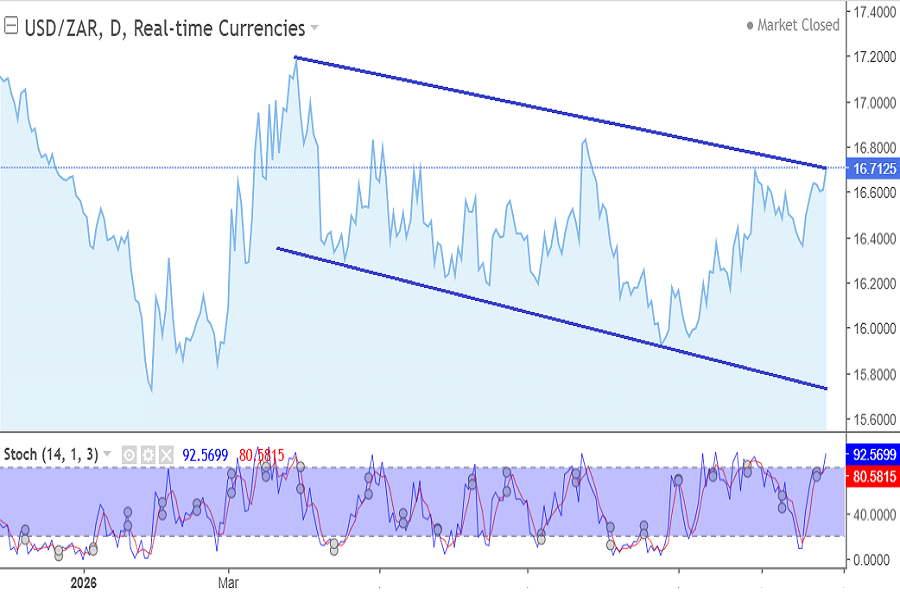
The dollar has strengthened the rand by 0.84%. The chart shows that the downward trend is about to continue. The Stochastic Oscillator is reaching the overbought zone. The resistance line is being tested and may shift if the market situation does not change. Technical analysis indicators point to the effectiveness of buying. The next few weeks will provide clarity on the current downward trend. It looks a bit outdated because current factors are against Rand. Still not enough signs of a reversal yet, but the probability increases with each new trading day.
3. GBP/USD
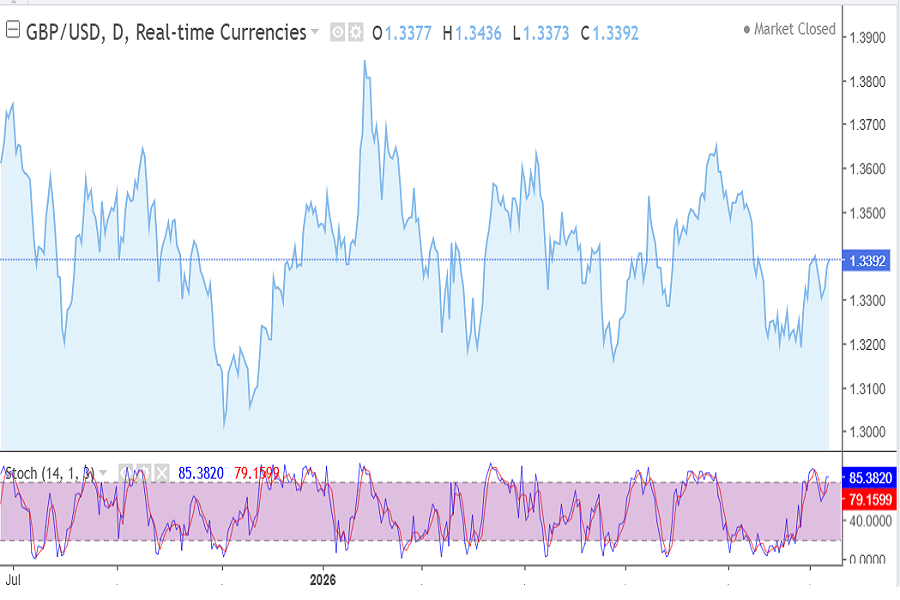
GBP/USD quotes resemble those of microcaps - high volatility and unpredictability, but unlike this time: there have been virtually no changes all week. However, in our subjective opinion, the chart favors the dollar. Technical analysis indicators are showing a buy signal, but high volatility may have confused them.
Summary
For South African investors, the verdict of the week is this: global AI doubts and US rate fears matter here too, but the rand and the JSE remain hostage to gold, oil and higher interest rates.
The next two weeks will bring three major tests. The US midterm elections on 3 November will show whether Washington’s course on Iran and energy holds, with direct consequences for oil and the rand. On 4 November, South Africa holds local elections. And on 5 November, the Bank of England is widely expected to raise rates for the first time in more than three years. On the JSE, investors will watch whether gold steadies below $4,000, and whether Northam Platinum’s sale process, with expressions of interest due by 1 December, turns into a real deal.

Stan Lytynsky
Stan Lytynsky is a well known financial expert with more than 1000 of market reviews. For the last 10 years he wrote reviews for different blogs and websites. In particular he worked for SuperForex and Zetradex forex brokers as a market analyst. Currently he is living in Canada and focused on the African market as the most promising and growing.
Comments
Loading comments…
Log in or sign up free to join the discussion.