StockTalk Special review. What's wrong with Araxi Limited?

John Nkosi

Araxi Limited (JSE: AXX) shares have been trending in the same direction in 2026: -37% over the past six months, -30% year-to-date, and -22.75% over the 12 months. There have been few rebounds, and the chart looks like a downward staircase. The stock currently trades at R1.33 with a market capitalization of approximately R1.68 billion, and its 52-week high of R2.20 was recorded on May 8, 2026.
Right now, we'll figure out why investors were disappointed with this stock, why 2026 turned out to be the most difficult period for the company on the stock market, and why investors decided that investing in this company was their worst decision?
Araxi Limited: description and perspective
Araxi's story begins with an unusual format. The company listed on the JSE Main Board in October 2015 as a SPAC (special purpose acquisition company), raising R1 billion through a private placement. Under the name Capital Appreciation, it assembled a group of fintech assets and was renamed Araxi Ltd on October 1, 2025. Headquartered in Sandton, the company has 603 employees and is led by Bradley Sachs as CEO. The business consists of two main lines: 1. Payments. Supply and maintenance of POS terminals for banks and retailers, payment acceptance software, and terminal licensing fees. At year-end, customers had 447,000 terminals, a 5.4% increase from the previous year. This line generates the majority of revenue. 2. Software. Development, consulting, and integration for banks, financial companies, retail, telecom, and healthcare. The division underwent a restructuring and had long been the group's "problem child." The key event of 2026: the acquisition of Pay@ - founded in 2007, owns South Africa's largest network of independent payment acceptance channels: over 9,000 retail locations, 150,000 mobile POS terminals, and 15 digital payment platforms. Araxi acquired 80% of the company for R1 billion. Shareholders approved the deal on May 11, and it became effective on May 28. The group also holds stakes in associated companies LayUp and AssetPool.
Although investors initially viewed the acquisition positively and the stock price rose at the time the deal closed, this subsequently worsened the company's financial performance, and the company acquired debt obligations appeared that many were not ready for.
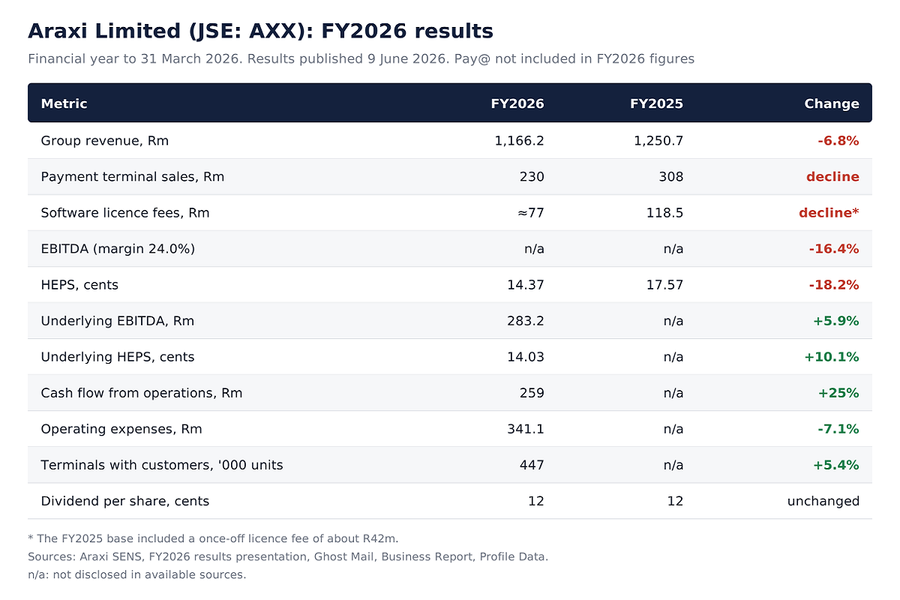
Araxi's financial year ends on March 31st. Its FY2026 report was released on June 9th, 2026, and marked the first significant impact on the stock. Two key reasons for the weak numbers: 1. Chip shortage. Due to rapid demand from the AI sector, chips became scarce and expensive, delaying the delivery of a large order, and revenue from terminal sales fell from R308 million to R230 million. 2. High licensing base. Last year, there was a one-time payment of R42 million, so licensing fees decreased from R118.5 million to approximately R77 million. Results: Group revenue decreased by 6.8%, EBITDA by 16.4%, EBITDA margin decreased by 270 basis points to 24.0%, and HEPS fell by 18.2%. The dividend was maintained at 12 cents per share.
What is wrong with Araxi stocks? 7 factors to fall down.
Araxi's decline cannot be explained by a single event. It's a confluence of several factors, and we'll separate them into confirmed facts and working hypotheses.
Factor 1. The company changed its model: from a "fortress" to a debt-based business (fact).
Until 2026, Araxi operated with a large cash cushion and no debt, which was the main argument for its reliability for the former SPAC. The Pay@ deal changed this: the acquisition was financed with R200 million of its own cash and R800 million of senior debt. After closing, the net debt to EBITDA ratio was 1.6x. Ghost Mail formulated the risk as follows: now, in a weak period, financial leverage can work against the company. 1.6x in itself is not critical, but an investor who bought Araxi as a "business with a cushion" received a completely different risk profile.
Factor 2. Weak financial results as the foundation for a major deal (fact + market valuation).
The market saw a drop in profits just as the company took on the largest debt obligation in its history. Ghost Mail noted that these were not the figures investors wanted to see as the basis for the Pay@ deal. Revenue volatility (large one-off orders, one-off licenses) makes forecasting difficult, and the market punishes uncertainty with a discount.
Factor 3. Share supply on the market (factual).
In 2026, significant block trades entered the market:
- In March, directors of subsidiary companies sold shares to pay taxes. For example, the director of Dariel Solutions sold 1 million shares at 1.81 rubles, while another director sold over 575,000 shares at 1.79 rubles.
- On June 25, Executive Chairman Michael Pimstein sold 5 million shares at 1.85 rubles, worth 9.25 million rubles, also to pay off tax liabilities.
- The following day, the CAET Economic Empowerment Trust sold a block of 40 million shares at 1.85 rubles to fully pay off its debt.
Factor 4. Founder steps down from day-to-day management (fact; price impact: hypothesis).
Effective July 31, 2026, Michael Pimstein transitioned from executive chairman to non-executive chairman, relinquishing his management responsibilities and retiring from the company. The company attributes this to corporate governance requirements (JSE Listings Requirements, King V). Hypothesis: The market could have interpreted the sale of 5 million shares in June and the departure from the executive role in July as a single story and factored this into the price.
Factor 5. Ex-dividend gap (fact, not collapse).
July 29th marked the ex-dividend date for the final dividend at 7.5 cents. With a price of around R1.80, this represents a roughly 4% price decline. This is part of the decline, but not a sign of trouble.
Factor 6. Pre-earnings silence (fact; impact: hypothesis).
The September 30th business update was cautious: the company cited the uncertain business environment in South Africa, supply and demand disruptions, rising operating costs, and deferred client investment decisions. Specific half-year figures are unavailable, and the company has had a closed period since October 1st. Hypothesis: against this backdrop, investors see no reason to buy before the report, and the price is drifting lower amid minor selling. On October 8th, the stock hit a 52-week low of R1.31, and is currently trading even lower.
Factor 7. Lack of analyst coverage (fact).
Araxi has neither analyst coverage nor a target price listed on aggregators. For a company of this size, this means there is no "anchor" for revaluation: no one can explain to the market why the decline could be excessive.
SWOT point of view. If investors focused only on weakness and treats?
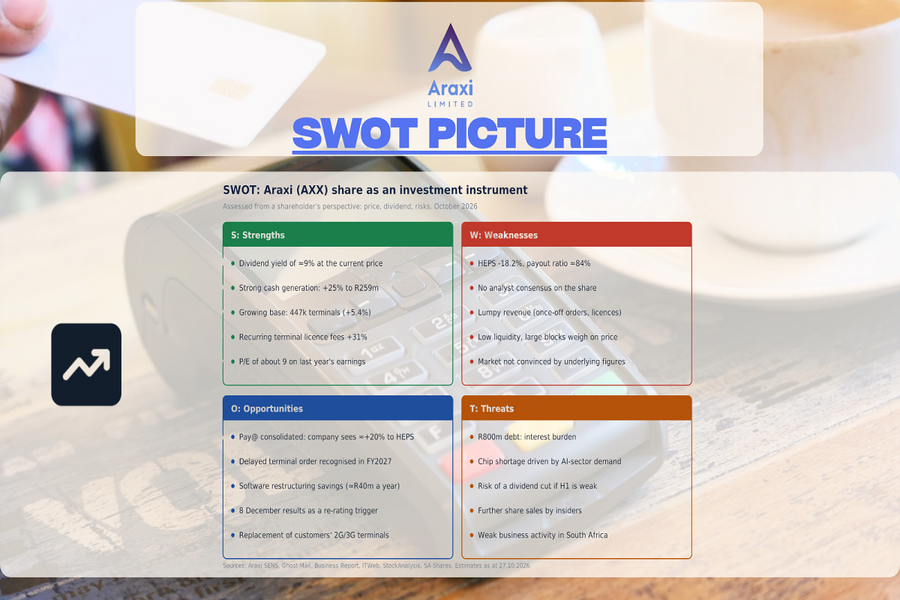
Araxi currently represents a classic "value trap or undervalued opportunity." The valuation figures (P/E around 9%, dividend yield around 9%) look attractive, but the market is deliberately wary of them because they are based on last year, before the debt accumulation and before Pay@'s consolidation. The question for investors isn't whether the stock is cheap, but whether the first half of the year with Pay@ will confirm management's thesis. Until the answer is given, all the strengths remain just promises. Bull case. The half-year report shows Pay@'s consolidation in the first months contributing significantly to profits, the postponed terminal order provides a one-time revenue boost, and Software confirms the restructuring effect. The interim dividend is retained. In this case, the market recalculates the P/E taking Pay@ into account, and the current price may be undervalued. An additional benefit: if the sale of large stakes ends, supply pressure will ease. Bear case. The chip shortage continues to slow deliveries, interest expenses are eating up a significant portion of Pay@'s capital, and South Africa's weak economy is putting pressure on customer orders. With a payout ratio of around 84%, the company could cut its dividend, which would eliminate the stock's main selling point. Further management sales are also possible after the close of business.
Forecast and tech review for Araxi Limited stocks
The December 8th report will be the turning point, one way or the other. Confirmation of Pay@'s contribution and maintaining the dividend could halt the decline, as at such multiples, sellers will have a hard time justifying a further reduction. A weak report with a dividend cut, on the other hand, could usher in the next phase of the decline, as the "dividend argument" will disappear.
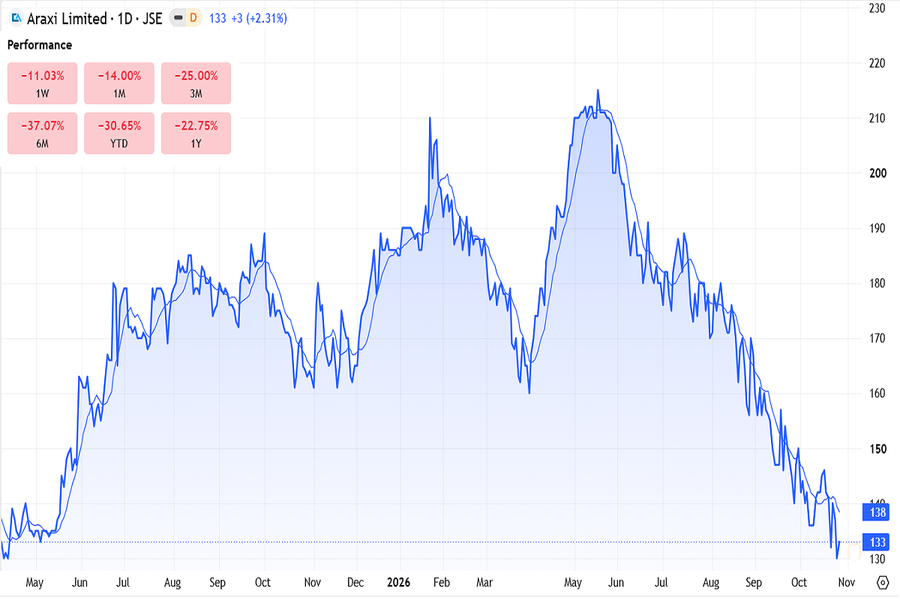
Araxi Limited stocks on JSE, October 2026
From a technical analysis perspective, everything is hopeless, with one caveat: the price correction should have occurred yesterday. Perhaps the financial report in early December will provide some respite and an upward wave. At the same time, it's hard to say the stock has bottomed out: its all-time lows were 61 cents in 2020, and at the time of listing, the stock was priced at 115 cents. This level will obviously become a psychological benchmark in a negative scenario.
Summary
So what's wrong with Araxi? The main problem isn't a single poor report, but a confluence of events in a single year. The company took on debt for the largest deal in its history, posted a decline in profits, the founder stepped down as executive and sold some of his shares, a large block from a trust shareholder entered the market, and a chip shortage hit the core product. Each event is individually explainable and even has a neutral formal cause. Together, they have destroyed Araxi's core investment thesis as a reliable and safe dividend producer. At the same time, the operating base doesn't appear to be in tatters: cash flow is growing, the terminal base is expanding, and recurring revenue is rising. The market has effectively put the company on hold until December 8th. This report will reveal whether the Pay@ acquisition was a strategic breakthrough or an expensive bet at the wrong time.

John Nkosi
John is from South Africa and know local financial market as it's own. He works directly for Stocktalk and responsible for making regular JSE market news.
Comments
Loading comments…
Log in or sign up free to join the discussion.