We Buy Cars special review. Expectations vs reality.

John Nkosi

We Buy Cars: From Hyped Newcomer to Ordinary Car Retailer
Remember April 2024? The blockbuster listing of We Buy Cars (WBC) on the Johannesburg Stock Exchange (JSE) was pitched as the arrival of a tech-driven messiah into the traditionally greasy, slow-moving world of South African automotive dealerships.
The word "platform" was thrown around much more than the word "garage." Investors weren't just buying a used car dealer; they were buying proprietary algorithms, boundless scalability, and the ultimate market disruptor. This tech-premium narrative propelled the stock to historical peaks well above R60.00.
Two years later, the corporate magic is wearing off. The latest interim consolidated financial results for the six months ended March 31, 2026, have delivered a harsh dose of reality: you cannot escape the physical laws of traditional retail.
The Anatomy of Disillusionment: Hard Numbers Don't Lie
When a company trades at a sky-high tech multiple, the market expects exponential earnings velocity. Instead, the latest financial print reveals structural stagnation:
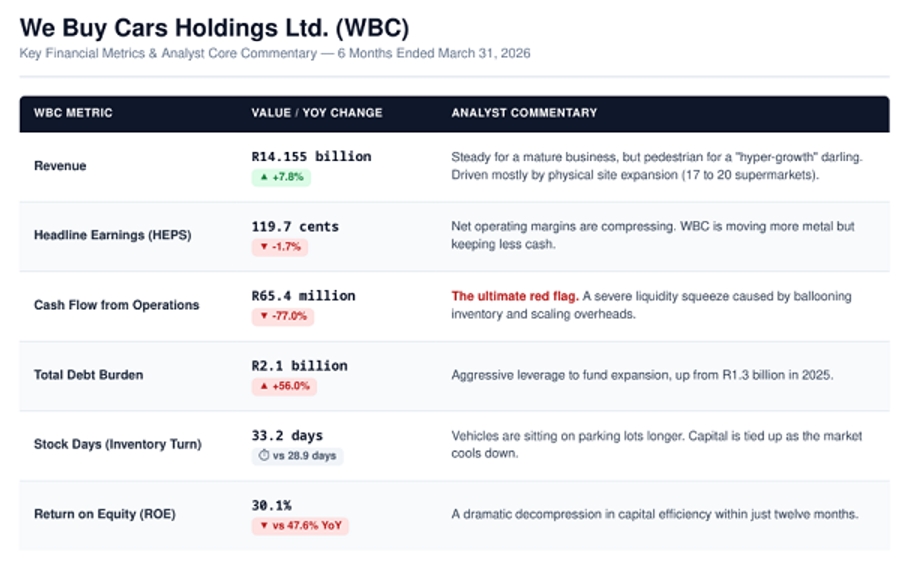
Recently published report of WeBuyCars", May 19, 2026
The "Asian Wave": Devaluation of the Used Car Thesis
The most telling admission came directly from management. We Buy Cars explicitly cited a tectonic shift in the South African automotive landscape: the aggressive expansion of affordable, tech-heavy Asian (predominantly Chinese) new vehicle brands.
When a consumer can walk into a dealership and buy a brand-new, high-spec Chinese SUV backed by a comprehensive 5-to-7-year factory warranty for nearly the same monthly payment as a 4-to-5-year-old premium German used sedan, the secondary market loses its luster.
Every extra day a vehicle depreciates on WBC's lot costs money. With stock days jumping to 33.2 days, the friction in their high-velocity model is becoming highly visible.
Welcome to the Ordinary Leagues
WBC’s operational playbook has hit the ceiling of purely organic growth. To maintain momentum, they are reverting to classic corporate consolidation—such as deploying R376.8 million to acquire a 49% stake in GoBid to tap into the salvage vehicle market.
While these are perfectly rational moves for automotive giants like Motus Holdings or Barloworld, they strip away the "magical tech multiplier." An ROE dropping from 47.6% to a grounded 30.1% confirms that WBC is playing by the exact same cyclical rules as every other retailer.
Technical Breakdown: A Massive Momentum Crack
The stock market is a voting machine in the short term but a weighing machine in the long term. Today’s brutal 7.69% capitulation to R36.00 isn't just a routine correction: it’s an institutional re-pricing of the asset's core identity.
- Trend Structural Breakdown: The high-volume sell-off cleanly severed the crucial medium-term support zone around R39.00–R39.50. Closing near session lows confirms that institutional distribution is well underway.
- The Moving Average Confluence: A bearish crossover is materializing on the daily chart as fast momentum lines slice through the slower baselines, accelerating the downward trajectory.
- The Trap Door: With MACD and RSI showing no immediate signs of divergence or exhaustion, the path of least resistance remains skewed downward. The next major historical support sits structurally deeper near the R25.00 handle.
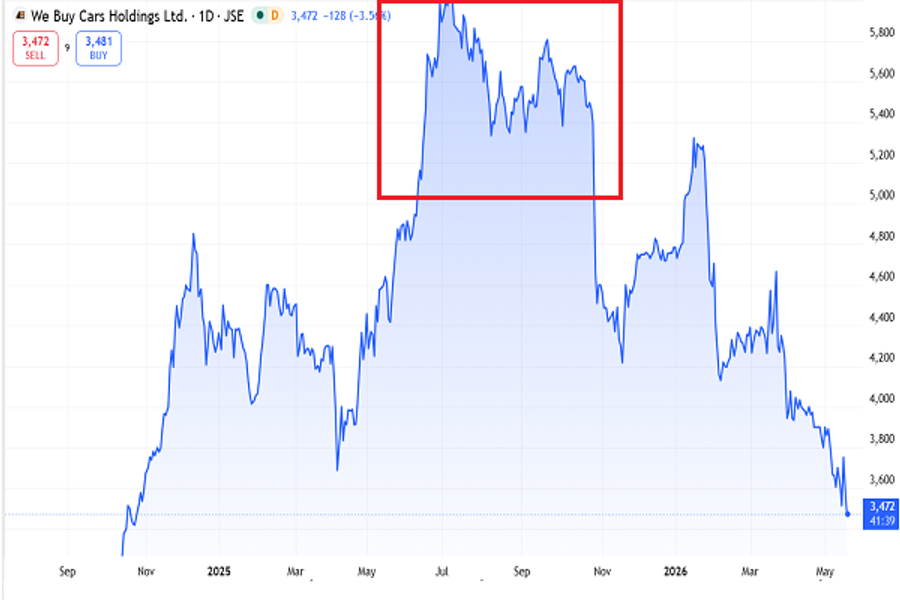
WE buy cars shares chart, May 19, 2026
On the chart we observe ups and down as a result of overhyped activity. Currently, it's a downward trend and tech indicators, both moving avarages and oscillators show us "strong sell" signal. Analytics still forwarded bullish. They believe this is the type of situation when it's cost to buy on miminums.
The Corporate Takeaway
The We Buy Cars narrative serves as a textbook lesson in market lifecycle dynamics. The honeymoon phase is officially over. The market is no longer willing to underwrite a structural premium for a digital-first story when the underlying mechanics are capital-intensive, debt-heavy, and exposed to global supply shifts.
WBC remains a formidable market leader and an operational powerhouse in South Africa—moving an impressive 17,000+ units in peak months. But it has been formally downgraded in the minds of institutional allocators: from a "Disruptive Tech Business" to a "Highly Cyclical Automotive Retailer." And in a world of high interest rates, sticky inflation, and fierce Chinese competition, ordinary retailers have to fight for every single basis point of margin. And in a world of high interest rates, sticky inflation, and fierce Chinese competition, ordinary retailers have to fight for every single basis point of margin.
If you decided to follow market analyst and buy WBC shares on minimums, it's cost to enter the market even now. If you're not sure in the company's ability to conquer the market once again, take a wait-and-see position until the upward stable momentum is detected.
What are your thoughts on WBC’s transition? Is the used car market in SA fundamentally broken, or is this just a cyclical buying opportunity? Share your opinion with StockTalk community on the website.
Not a financial advice. Do your own research. The Company isn't responsible for consequences of following or not following author's recommendations.

John Nkosi
John is from South Africa and know local financial market as it's own. He works directly for Stocktalk and responsible for making regular JSE market news.
Comments
Loading comments…
Log in or sign up free to join the discussion.