Afrimat. Special review. Strong financial report: reversal or trap?

John Nkosi
Afrimat (JSE: AFT): Strong report at trend bottom – reversal or trap?
Afrimat is a large mid-tier South African mining and commodities company specializing in open-pit mining. 2026 marks the 20th anniversary of its public listing. Since then, its shares have grown by approximately 290%, with a market capitalization estimated at approximately 4.7–5.1 billion South African rand (ZAR). Afrimat's mid-term share price peaked at over 53.99 ZAR (5,399 cents). This growth was driven by the successful launch of its bulk mining segment and iron ore exports. The company remained under pressure in 2025 and 2025 due to depletion of reserves at its key Demaneng mine, general logistical difficulties with Transnet's railways in South Africa, and power shortages and high costs, which forced the closure of ferroalloy plants.
What changed in the latest report on May 20?
The headlines are strong: revenue of R10.01 billion (+20.3%), HEPS of 95.8 cents (+32.5%), dividend of +32%, and operating cash flow of +45.4%. But beyond the annual figures, it's important to look at the segments. The profitable core is performing well: the aggregates generated revenue of +11.2% and operating profit of +24.0% with a margin of 17.7% (versus 15.8% a year earlier), while local iron ore sales rose to 1.51 million tonnes. Problem areas: cement, with revenue of +54.3%, posted an operating loss of R185.1 million due to a R271.6 million maintenance program. The key question is whether these are one-off "recovery costs" or a chronic expense (management insists on the former, noting that losses are already narrowing). Nkomati anthracite is still R160.5 million in the red due to a six-month shutdown. Ore exports continue to be hampered by problems with the railway line. There's progress on the balance sheet: R1.6 billion of short-term debt has been restructured into a five-year amortizing loan, and proceeds from the sale of non-core assets are being used to pay down debt (the increase in which is largely due to the acquisition of Lafarge). The Glenover deposit, with its rare earth and battery minerals, is a separate story; it's a real option, but it's still in the R&D and negotiation phase, not a profitable one today.
Afrimat: Technical point of view
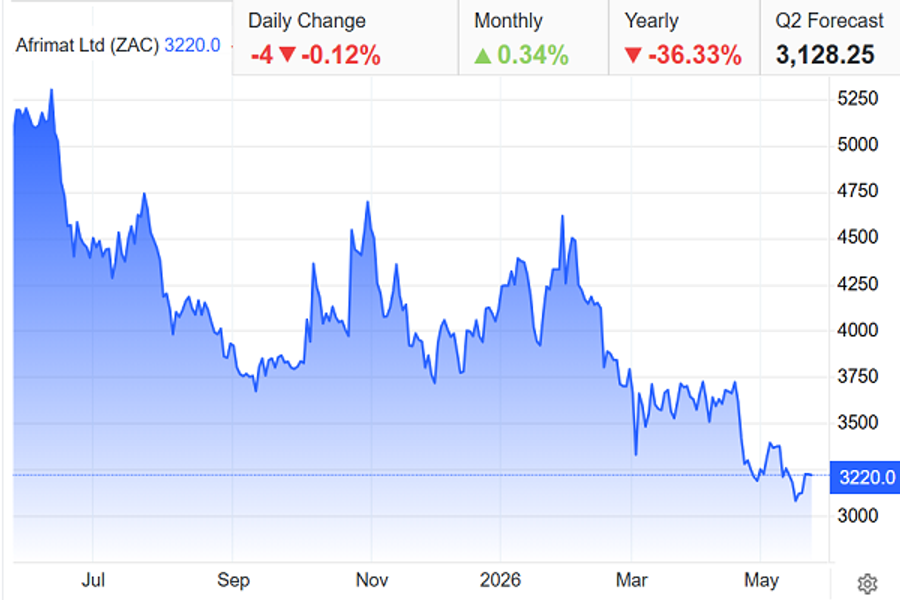
Afrimat shares price, May 2026
The AFT chart is a massive downtrend lasting 17 months. It's noteworthy that the 2026 chart is currently completely mirroring the 2025 chart's trajectory. Technical analysis indicators are signaling a sell signal. However, given the recent positive reports, it's safe to assume we're near the lows. There's no reversal yet. Moreover, the downward movement could continue in the short term.
Fundamental View and Forecast for Afrimat
Analysts are positive. Buying shares at a discount is always tempting. Afrimat is a mining company, and resources are in demand today. It's also worth remembering that Afrimat differs from other companies: they have always distinguished themselves by acquiring unprofitable, abandoned commodity assets at a reasonable price, then modernizing them and turning them into profits. What if we're currently in the unprofitable phase, and the next stage will be the profit-making phase? Perhaps investors should follow Afrimat's strategy with those who know how to do it best.
Summary
Buying Afrimat shares makes sense in the medium term, but with a caveat and the expectation of a prolonged downturn. You'll have to ride out the tough times with the company to reap the benefits, without waiting for the stock to start rising. Afrimat is a case of "possible reversal at the bottom," where fundamentals and technicals diverge. If you're still unsure, you can wait for the next earnings report and see if the market retracements. This might be the last signal you need before buying. The first buy signal has been received.

John Nkosi
John is from South Africa and know local financial market as it's own. He works directly for Stocktalk and responsible for making regular JSE market news.
Comments
Loading comments…
Log in or sign up free to join the discussion.