From Zero - to your first CFD related to JSE stocks


CFD Brokers with Access to JSE Stocks: Full Breakdown & Comparative Analysis
In the previous three articles, we discussed banks, investment funds, and brokers with real access to the stock exchange. It's time to consider a separate class of brokers that have emerged relatively recently - CFD brokers. These are typically international brokers that offer access to quotes and the opportunity to profit from them, but without actually owning the securities. Essentially, you receive a tool for profiting from the difference in the asset's value today compared to tomorrow's price, but you don't own the company's shares. Instead, you enter into a virtual Contract for Difference, tied to the opening and closing prices of a specific asset. Some might say this is a sham rather than an investment. However, the profit is quite real, and sometimes exceeds the returns of ordinary investors. Opponents of this form of stock trading will say it's a scam, not a real investment. However, the lack of ownership of the shares offers advantages: flexibility, dynamic and the elimination of the hassle of buying back shares of illiquid companies.
For both novice and experienced traders in South Africa, gaining access to companies, listed on the Johannesburg Stock Exchange (JSE) is a top priority. However, the instrument you use to access the market fundamentally changes the rules of the game.
So the primary choice lies between Direct Share Ownership and Contract for Difference (CFD) Trading.
Why do some investors and stock traders sometimes choose to trade CFDs instead of actually owning shares?
Such brokers give the client flexibility, dynamics, various bonuses for activity, cashbacks, and hold competitions. Also, such brokers provide the opportunity to make money from falling quotes. In this case, you can choose a company not only with strong financial statements, but also with bad ones. The main task is to determine the vector of movement of quotes. Since a buyer is not needed to sell an asset, orders are processed instantly. This is ideal for short-term trading. While maintaining profits, the legal status of ownership becomes secondary. In addition, you can buy or sell more shares than you have the funds for due to the presence of leverage, although the higher the leverage, the higher the risk of forced closure of the deal at an unfavorable moment, but this is only if there is a drawdown - when you have already opened the deal, but it went in the wrong direction. Ultimately, this can be avoided by simply topping up your account or using S.L/T.P levels.
Comparison - Real JSE Purchases vs. CFD Brokers?
To understand how CFD brokers operate, it is essential to compare them with traditional stockbrokers.
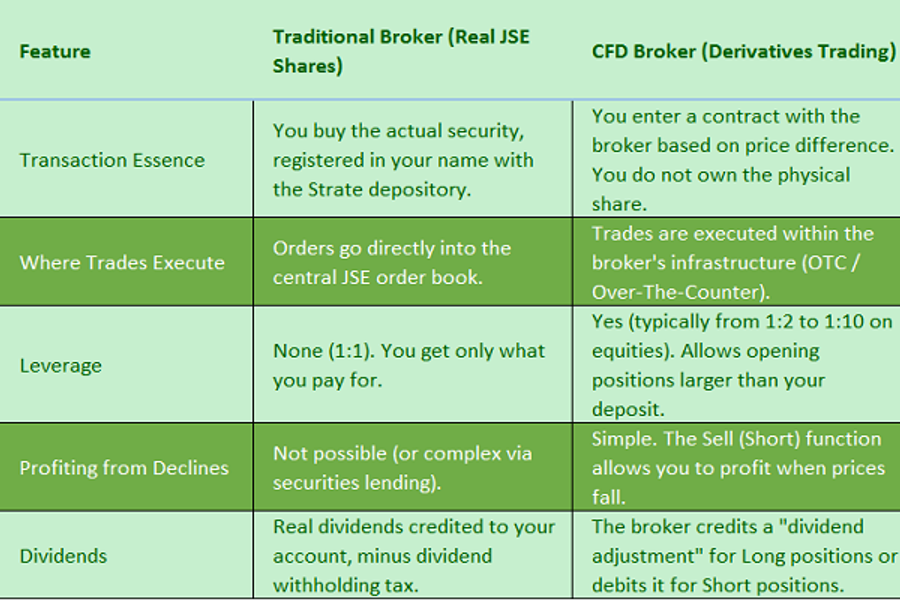
Comparison table: traditional brokers vs CFD brokers
1. Asset Ownership: Registered Shareholder vs. Contract Holder
- Real Shares: When you buy physical equities via a traditional broker (e.g., EasyEquities, Standard Bank AutoShare Exec), your ownership is recorded in South Africa’s central securities depository (Strate). You become an actual shareholder of the company.
- CFD Brokers: With a CFD, you buy a financial agreement that mimics the stock's price movement. You never own a piece of the company. If the business goes into liquidation, you have no claim on company assets.
2. Market Execution: Centralized Exchange vs. OTC (Over-the-Counter)
- Real Shares: Your order interacts directly with the public order book of the JSE. Price discovery is completely centralized, transparent, and regulated by exchange rules.
- CFD Brokers: CFDs are Over-the-Counter (OTC) derivatives. Your deal is executed directly against your broker (acting as the principal) or matched with their private liquidity pools. This is precisely why brokers in SA require an ODP (Over-the-Counter Derivative Provider) licence from the FSCA to ensure fair execution pricing.
3. Financial Leverage: Asset Protection vs. Capital Efficiency
- Real Shares: If you buy R10,000 worth of Sasol stock, you pay R10,000. Your risk is capped strictly at what you put in—the stock price cannot drop below zero.
- CFD Brokers: Leverage acts as a double-edged sword. With 1:5 leverage on equity CFDs, a R2,000 margin deposit controls a R10,000 position. A 5% increase in share price yields a 25% return on your margin, but a 5% drop results in a 25% loss. High leverage is the primary reason why retail CFD traders experience rapid capital losses.
4. Directionality: Long-Term Growth vs. Short-Term Volatility
- Real Shares: Traditional share buying is built for wealth accumulation—buying low and holding for years. Shorting physical JSE shares requires institutional scrip-lending agreements, making it practically inaccessible for retail investors.
- CFD Brokers: CFD trading shines in bear or sideways markets. You can click "Sell" (Go Short) in a fraction of a second to profit from declining JSE stock prices during economic downturns.
5. Dividends & Corporate Actions: Real Yields vs. Synthetic Adjustments
- Real Shares: You receive legitimate corporate dividends. You also retain rights to participate in rights issues, stock splits, and shareholder voting.
- CFD Brokers: CFD holders do not receive actual dividend income. Instead, brokers apply a "Cash Adjustment" (Payment in Lieu of Dividend). If you hold a Long CFD position on the ex-dividend date, the broker credits your balance; if you hold a Short CFD position, the broker debits the dividend value from your account. Furthermore, you hold no voting rights.
6. Taxation (SARS Framework in South Africa)
- Real Shares: If held for more than 3 years with long-term investment intent, profits are taxed under the favorable Capital Gains Tax (CGT) rate. Dividends are subject to a flat 15% Dividend Withholding Tax (DWT).
- CFD Brokers: Because CFDs are high-frequency speculative instruments, the South African Revenue Service (SARS) classifies all CFD profits as Income, taxing your net gains at your personal marginal tax bracket (up to 45%).
7. Cost Structure: One-Off Brokerage vs. Daily Holding Costs
- Real Shares: You pay an upfront brokerage fee, settlement fees, and STT (Securities Transfer Tax). Once paid, you can hold the shares for 10 years without paying overnight financing charges.
- CFD Brokers: Spreads and entry commissions are typically lower for CFDs, but because you are trading on borrowed capital (leverage), the broker charges an Overnight Holding Fee (Swap Rate) for every night the deal stays open. This makes long-term holding of CFDs financially unviable.
Top 5 Licensed Brokers with Access to JSE Stock CFDs
1. Vantage Markets (Vantage Forex) in South Africa - review
Vantage Markets holds a strong reputation in the online brokerage space, maintaining an aggregate rating of 4.5 out of 5 stars on Trustpilot across over 13,000 user reviews. Industry authorities like BrokerChooser rate it at 4.3 out of 5, while WikiFX gives it a high trust and compliance score of 8.70 out of 10.
The broker is widely recognized for its ultra-low non-trading fees and highly competitive Raw ECN account pricing, though user experiences regarding its customer support can vary.
Regulation: FSCA, ASIC, FCA
.JSE Access: Offers CFDs on top South African companies and major indices (JSE Top 40).
Platforms: MT4, MT5, Vantage App, TradingView.
Key Highlights: Very tight spreads and competitive stock commissions. Ideal for trading both Forex pairs and JSE equity CFDs.
Core Pros and Cons
Pros:
- Top-Tier Platforms: Seamless integration with MT4, MT5, TradingView, and ProTrader.
- .Low Barriers to Entry: Casual traders can start with zero-commission gold/stock CFDs.
- FSCA Compliance: Traders appreciate that they are dealing with a locally licensed entity, offering peace of mind regarding fund safety and local legal recourse.
- High Leverage Availability: Active South African day traders heavily favor the 1:500 leverage option to maximize capital efficiency on smaller deposit balances.
- ZAR Transfer Options: Reviews frequently highlight the speed of local fund routing, with credit/debit card and major e-wallet transfers clearing efficiently.
Cons:
- No ZAR Base Accounts: Vantage does not natively offer ZAR as a base account currency. South African traders must convert their funds into USD, EUR, or GBP, which can expose them to currency conversion fees during deposits and withdrawals.
- Customer Support Delays: Similar to global complaints, South African users report slow live-chat responses during high-volume market hours
- Withdrawal Hurdles: Some users have experienced delays or blocks on transactions when failing to meet strict compliance profiles or internal company policies.
2. IG Markets South Africa - review
IG Group holds an industry-leading reputation as one of the world's most trusted brokers, carrying an exceptional 96 out of 99 Trust Score and an overall expert rating of 4.7 out of 5 stars from regional evaluation authorities like FxScouts. [1, 2]A critical structural shift occurred when IG Group officially closed its domestic South African operations and ZAR-denominated trading accounts. While South African clients can still seamlessly trade with IG, new applications are now routed through IG International (offshore). Local traders retain full protection, as the broker remains heavily monitored by top-tier authorities including the UK Financial Conduct Authority (FCA) and Australia's ASIC.
Regulation: FSCA (FSP 42151 / ODP authorized).
JSE Access: One of the most extensive catalogs available — over 1,000 local JSE stocks, including mid-cap and small-cap companies.
Platforms: IG Web Platform, L2 Dealer, MT4.
Key Highlights: An industry veteran offering Direct Market Access (DMA) on CFDs for maximum price transparency.
IG's Core Pros and Cons for South Africans
Pros:
- Unrivaled Market Access: Trade over 17,000 global instruments spanning Forex, indices, shares, and options.
- Premium Platform Suite: Full access to a proprietary web app, MetaTrader 4, ProRealTime, and L2 Dealer.
- Exceptional Execution: Near-zero slippage via direct institutional liquidity channels.
Cons
- No Native ZAR Accounts: All domestic ZAR accounts have been phased out; trades incur currency conversion fees.
- Restrictive Retail Leverage: Leveraged trading caps are tied to strict international standards (typically 1:20 to 1:30 max).
- High Stock CFD Costs: Trading costs for individual share CFDs skew higher than the industry baseline.
3. AvaTrade (Ava Capital Markets) in South Africa. Review
AvaTrade operates as a major player in South Africa under the local entity Ava Capital Markets Pty Ltd, boasting a strong trust profile and holding an aggregate rating of 4.8 out of 5 stars on Trustpilot. Regional financial platforms like SA Shares award the broker an overall score of 97%, largely due to its absolute regulatory compliance, multi-platform setup, and unique localization features tailored specifically for South African traders.
Unlike IG Markets—which phased out its local operations—AvaTrade is fully anchored in South Africa, maintaining physical offices in Sandton, Johannesburg, and operating under Financial Sector Conduct Authority (FSCA) License No. 45984.
AVA's Core Pros and Cons for South Africans
Pros:
Local FSCA Protection: Segregated local client accounts backed by a physical corporate office in Johannesburg.
Native ZAR Accounts: Fund, trade, and withdraw in Rand without incurring currency conversion losses.
Built-In Risk Controls: Access to AvaProtect, a proprietary insurance tool allowing traders to safeguard trades against losses.
Cons:
- Aggressive Inactivity Fees: Penalties start after just 3 months of account dormancy.
- No Raw ECN Accounts: Traders seeking ultra-low raw spreads + commissions will not find a true ECN match here.
- Support Availability: Local clients occasionally mention that telephone and chat customer support lines run on a strict 24/5 schedule, leaving a gap for cryptocurrency or weekend adjustments.
4. Plus500 review
Plus500 maintains an exceptional safety and compliance record for South African traders, carrying a maximum 99 out of 100 Trust Score from top brokerage monitoring portals. The broker is fully operational in South Africa and regulated locally by the Financial Sector Conduct Authority (FSCA) under the corporate entity Plus500 South Africa Pty Ltd (FSP License No. 47546).
The provider stands out for its proprietary, beginner-friendly trading technology. However, its rigid restriction to a spread-only fee model and its lack of support for popular third-party tools like MetaTrader make it less ideal for high-volume, algorithmic scalpers.
JSE Access: Broad selection of JSE assets, including major single stocks and the headline SA index.
Platforms: Proprietary Plus500 platform (MT4/MT5 are not supported).
Key Highlights: Highly intuitive user interface suitable for beginners, featuring an excellent mobile application and transparent spread-based pricing.
Plus500' Core Pros and Cons for South Africans
Pros:
- Highly Secure Oversight: Fully regulated by the local FSCA and publicly listed on the London Stock Exchange (LSE: PLUS).
- Flawless Mobile Architecture: The web and mobile apps rank among the highest-rated platforms globally for usability.
- Guaranteed Stop Losses: Built-in specialized risk tools prevent accounts from sliding into a negative balance.
Cons:
- No MetaTrader Support: The broker does not allow integrations with MT4 or MT5 platforms.
- High Overnight Fees: Keeping trades open past market close incurs steep financing rollover rates.
- Lacks Deep Research: The platform features minimalist charting and very basic fundamental news feeds. So if you decide to trade with Plus500 don't forget to keep StockTalkSA turned on.
5. iFX Brokers review
iFX Brokers is a prominent, domestic South African broker founded in 2018, maintaining a high trust footprint with an overall score of 93 out of 100 on regional review aggregators. It is fully regulated by South Africa’s Financial Sector Conduct Authority (FSCA) under license number 48021, and holds an official Over-the-Counter Derivatives Provider (ODP) authorization.
The broker is highly regarded locally for providing a native, zero-conversion environment for South African Rand (ZAR) accounts alongside aggressive promotional bonuses. However, it faces notable public criticism concerning strict rules surrounding its promotional terms.
JSE Access: A popular South African broker providing access to JSE instruments via derivative contracts.
Platforms: MT4, MT5.
Key Highlights: Locally based in South Africa. Offers convenient local deposit and withdrawal methods (ZAR Instant EFT) without currency conversion fees.
iFX brokers Core Pros and Cons
Pros:
- Strict ODP Regulation: One of the few domestic South African brokers fully authorized as an ODP under FSCA oversight.
- Ultra-Low Entry Barrier: A tiny $10 minimum deposit paired with localized ZAR bank funding channels.
- Pure MetaTrader Focus: Flawless deployment of MT4, MT5, and dedicated micro-lot Cent accounts.
- Same-Day Withdrawals: Local South African traders consistently note that standard bank wire payouts typically clear into local accounts within 24 hours.
Cons:
- No Stock Trading: Primarily restricted to Forex, Gold, and basic CFDs; no access to international share equities.
- Strict Bonus Clauses: Promotional credit comes with heavy terms that can result in profit cancellation if breached.
- No Proprietary Platform: Does not offer a standalone, custom-branded web or mobile app dashboard.
- Profit Cancellations: Multiple active traders have flagged that if the broker determines you have misused their 100% deposit bonus framework (e.g., via specific hedging structures or rapid news scalping), they will strictly audit the account, cancel generated profits, and return only the seed deposit. So it's better not use bonuses with iFX brokers
FSCA regulated CFD Brokers Comparison table
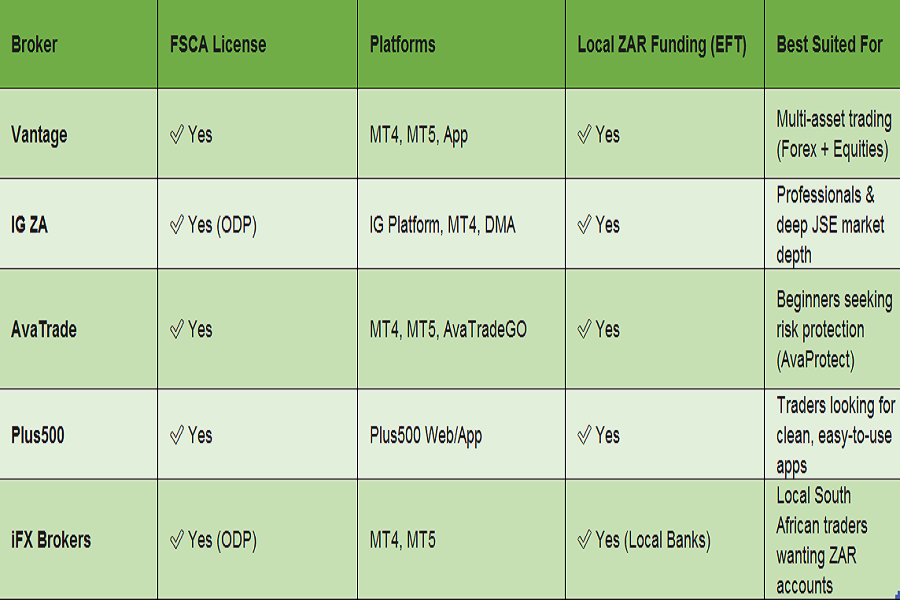
FSCA regulated brokers comparison table
Summary: Which One Should You Choose?
- If you plan to invest long-term, collect dividends, and avoid leverage risk, opt for a traditional stockbroker (e.g., EasyEquities, Standard Bank AutoShare Exec, or Nedbank Private Wealth).
- If you want to trade actively, means to be dedicated to trading every day, 24/5, use leverage, short JSE stocks, and execute trades quickly via mobile apps, choose a reliable broker with an FSCA / ODP license from the list above (such as Vantage, IG, or AvaTrade).
Final words regarding way from zero - to active investing or trading
We've covered all the investment options in South Africa. We're not saying any one is good or bad. We've covered a variety of scenarios: from passive income - to active trading every day and every hour. You'll undoubtedly find the right fit for your budget and time frame among all the options we've discussed, but one thing is certain: our website will be useful for staying up-to-date on market developments and learning what other investors are saying about trading today.

Stan Lytynsky
Stan Lytynsky is a well known financial expert with more than 1000 of market reviews. For the last 10 years he wrote reviews for different blogs and websites. In particular he worked for SuperForex and Zetradex forex brokers as a market analyst. Currently he is living in Canada and focused on the African market as the most promising and growing.
Comments
Loading comments…
Log in or sign up free to join the discussion.