Offshore Brokers: A Chance to Earn or a Risk for Your Wallet?

John Nkosi

Searching for a broker, you will inevitably run into a limited choice: there aren't that many brokers licensed in South Africa, and the terms they offer aren't exactly attractive. Add to that a strict AML/KYC verification process, and the picture gets even more discouraging. Meanwhile, you open the first ratings site you find and discover a huge selection of brokers offering far better terms: smaller minimum deposits, interesting account types including multi-currency and cent accounts, bonuses and cashback, leverage of up to 1:2000, and simple verification. So you ask yourself: why limit yourself to brokers licensed in South Africa at all?
Offshore Brokers Without an FSCA License: Outright Scam or New Opportunities?
Comparing local and foreign brokers, you'll also find a wider range of trading instruments and possibly better service and reviews. So why does everyone insist you should only invest with FSCA-licensed brokers, despite all their drawbacks? Let's figure out who offshore brokers actually are.
We can't automatically treat all such brokers as fraudulent schemes: one-armed bandits that, absent tight oversight from regulators, can do whatever they like with client money.
Generally, "offshore brokers" refers to brokerage services without a local South African license, but with a license from their place of registration predominantly offshore jurisdictions like Belize, Mauritius, and sometimes Cyprus. However, the best-known brokers often hold several licenses to operate in different markets. That means these companies do carry certain obligations - around anti-money-laundering measures, operating conditions, and the financial commitments required to obtain a license. That said, every such license has its price and the more prestigious the license, the more expensive it is.
As Many Licenses as There Are Countries in the World?
Imagine opening your own brokerage with the intention of building an honest business, with no intent to harm clients or steal their money. You haven't earned a single cent in commissions yet, but you already owe everyone, carry obligations to clients, and must deposit a substantial sum in the bank to prove your solvency.
How did it used to work? Getting a license in your place of registration gave you the right to operate worldwide, letting you attract clients online and profit from volume without a problem.
How does it work now? Every country wanted to earn money from issuing licenses, and the cost of those licenses is set not by business costs or profits, but by the appetite of officials, following a simple rule: the more expensive the license, the wealthier the company that comes to market and can afford it and the fewer brokers there are to oversee.
What does this mean for fintech companies? Want to operate worldwide? Pay all 150 countries and staff an entire accounting department that spends its days producing and submitting reports and going through monitoring ahead of each of 150 regulators. Only a handful of companies can afford that luxury, and the profitability of a presence in each country is questionable, simply because, whereas people around the world used to find brokers themselves on ratings sites, now you have to spend not just on local licenses but also on advertising, plus regulatory compliance that can sometimes make a business completely uncompetitive. For example, if the cost of a single trade is $1, and the regulator caps the commission at 0.5 cents.
So we can't say definitively whether an offshore broker is a scam or simply an honest foreign company that just can't afford a South African license because it isn't cost-effective.
The Less Spent on Licensing - the More Accessible the Services?
Coming back to the difficult choice of broker: a hypothetical Belize-based broker offers you cent accounts, a convenient deposit/withdrawal system, no tax withheld at source, a demo account for practice, a deposit bonus, and a bunch of other perks. It spends less on licensing, has fewer conditions and restrictions - no leverage caps or other protective mechanisms. Does that mean it's a scam? No. It just means lighter offshore regulation.
Whether an offshore broker is reliable or not, you can only really find out at the trading and withdrawal stage. You can't fully rely on reviews either: an unusually high rating can mean the platform is moderated - meaning negative comments get quietly removed on some services.
As an investor, what matters to you is not the fact of being "offshore" itself, but the specific jurisdiction and what actually stands behind the license.
Not All Offshores Are Equal
The word "offshore" blurs real differences in regulatory rigor. Mauritius (FSC) requires real capital, a physical office, a compliance function, and holds a solid banking reputation. Seychelles (FSA) and Vanuatu (VFSC) are faster and cheaper, but banks treat them with more caution. St. Vincent and the Grenadines is a special case: the local regulator doesn't actually issue forex licenses at all. It only registers companies, something the regulator itself has repeatedly confirmed. The phrase "regulated by FSA SVG" in a website footer effectively means "registered," not "under supervision."
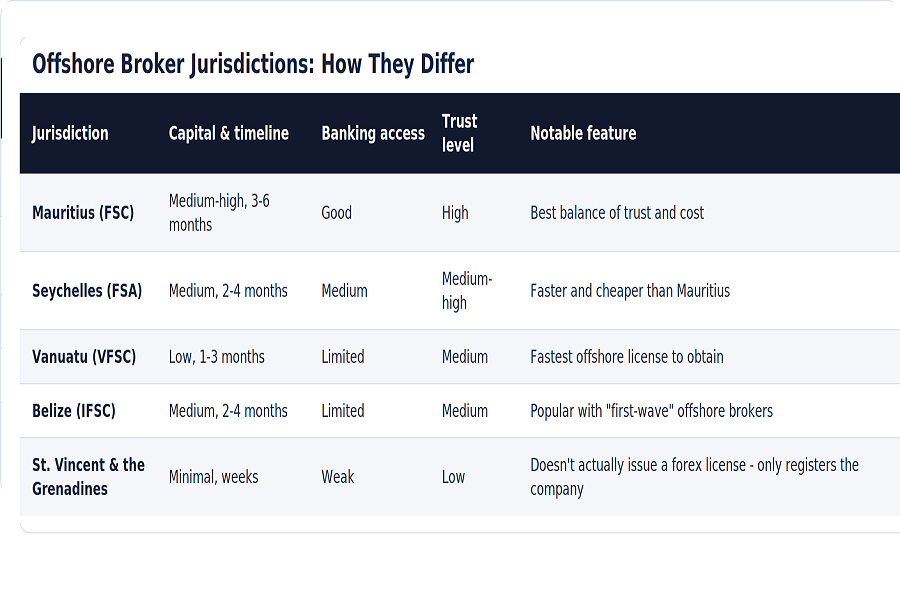
Offshore brokers jurisdictions comparison
What About an FSCA (South African) License?
This is where the "offshore or South Africa" dilemma needs a correction and it's worth actually seeing how hard it is to get an FSCA license, and why not every broker is willing to go through it.
For forex and CFD brokers, the FSCA offers two main routes:
- Category I FSP under the STP model (an agency model where the broker only routes orders to liquidity providers and takes no counterparty risk). There's no fixed statutory minimum capital here: the regulator assesses solvency on a case-by-case basis but the review process typically takes around 4–6 months.
- ODP status (Over-the-Counter Derivative Provider) - mandatory if the broker acts as a market maker and is itself the counterparty to the trade (i.e., the model most offshore platforms actually run on). This requires capital equal to roughly six months of the company's operating expenses, and the process itself typically stretches to 12–24 months.
Beyond capital, an applicant also needs to:
- register a South African legal entity;
- appoint at least one Key Individual, usually a South African resident, who must pass "fit and proper" vetting: a relevant qualification (a degree or diploma in finance, economics, or commerce), no history of fraud or regulatory sanctions, personal financial soundness (they can't be under debt review or sequestration), and pass the required regulatory exams;
- build a compliance function, an AML/FICA program, and hold professional indemnity insurance;
- submit audited financial statements annually and maintain the required capital level on an ongoing basis, not just at the point of licensing — alongside mandatory client fund segregation.
This isn't a one-off formality. It's an ongoing supervisory regime, and combined with legal, audit, and compliance overhead, the total cost of entry for a broker ends up well above the symbolic "price of a license." As one indicator: even a ready-made (already-existing) Category I FSP license currently trades on the secondary market for roughly $80,000–140,000 before accounting for the cost of maintaining it.
Worth flagging separately: in 2026, South Africa's parliament is expected to consider the COFI Bill (Conduct of Financial Institutions Bill), which would replace the current FAIS Act and shift regulation to an activity-based licensing model, with a roughly three-year transition period for existing FSPs. This isn't yet enacted law. It's an anticipated reform but it could raise the barrier to entry for new players even further.
Risks of Trading with Offshore Brokers Without an FSCA License
By using any foreign platform, you become subject to foreign rules and laws whatever they may be. Trading with 1:2000 leverage on large sums, you're agreeing to a risk of losses that can multiply many times over your deposit. The FSCA wouldn't allow such trading conditions, but a company registered under offshore soft license, effectively tells both you and the broker: As soon as you agreed to the risk of financial loss, you are ready for any losses - in principle, there can be no claims. Local police or complaints to local authorities won't help either: since your activity took place abroad, you'd have to file a complaint in the company's place of registration - Vanuatu, in this hypothetical.
- No access to the FSCA or the FAIS Ombud. If an offshore broker has no parallel FSCA license, you can't file a complaint with the South African regulator or use the free FAIS Ombud arbitration.
- Weak legal protection and an unreachable company. Suing a company registered in Belize, Vanuatu, or St. Vincent is practically unfeasible for a retail investor in South Africa, both in cost and in time.
- Market-maker conflict of interest. Offshore brokers aren't permitted to connect directly to the JSE. So they operate through CFDs, simulating trading and acting as the counterparty to the trade, meaning they have a direct interest in your losses.
- Extreme leverage. The FSCA caps retail leverage at around 1:30; offshore platforms offer 1:500–1:2000. The higher the leverage, the faster ordinary market volatility can wipe out a deposit especially without correct stop losses levels settled.
- No guaranteed protection against negative balances, and unsegregated funds. Promises of "segregated accounts" and "no negative balance" offshore are often not backed by independent audits.
- Inconvenient, costly deposits and withdrawals. Access to local payment systems is often restricted for companies not registered in South Africa, and many offshore brokers rely on crypto and e-wallets instead of cards/EFT with markedly weaker protection in a disputed transaction.
- Risk of the platform disappearing. An offshore shell company can shut down or rebrand with minimal consequences for its owners, while client funds aren't protected by any compensation fund.
- SARB exchange controls. Transferring money abroad for trading must fall within South African Reserve Bank limits (the annual Single Discretionary Allowance and Foreign Investment Allowance, the latter requiring tax clearance) and go through an authorized dealer, bypassing these channels creates personal compliance risk for the trader.
- Tax obligations to SARS. Profit from an offshore platform isn't automatically declared: the responsibility to report it to the tax authority rests entirely with the trader.
Advantages
- A wider choice of brokers
- Better trading conditions, including minimum deposit
- A wider choice of trading instruments - all markets, all currency pairs
- Account types including cent and multi-currency accounts, demo accounts for practice
- No tax withheld at source, though this is not tax exemption: the trader is still required to declare profit to SARS (see the risks section above)
How to Vet an Offshore Broker Before Committing Money
- Find the license number and verify it directly on the regulator's register (Mauritius FSC, Seychelles FSA, etc.) - not on a screenshot from the broker's own website.
- Check which legal entity the contract is actually with. This is stated in the client agreement and doesn't always match the "main" brand on the website.
- Check whether the broker states client fund segregation and negative-balance protection and whether that's in the contract, not just in the marketing.
- Look for reviews specifically about withdrawals, not just an overall rating.
- Holding licenses in several jurisdictions at once (including FSCA) is generally a good sign.
Red Flags
"Risk-free" profit guarantees, a "personal manager" pressuring you to add to your deposit, bonuses with terms that effectively block withdrawals, unwillingness to clearly state the license and jurisdiction, and withdrawals only via crypto or private wallets that bypass banking channels.
Conclusions
Offshore brokers can open up new opportunities, especially for beginners, thanks to flexible conditions and demo and cent accounts where you can test both a strategy and the broker itself with minimal losses.
At the same time, as trading volumes scale up, the risks grow: a broker might let you withdraw small amounts, but the higher your turnover, the greater the temptation for that broker to engineer a financial loss for you. The only question is what counts as a "large" sum for that particular broker.
When working with any offshore broker, it's worth treating your profit as truly yours only once it lands in your bank account — not before.
And it's worth keeping in mind: you don't actually own the shares: you only earn from the change in their price via a CFD, and shares of South African companies are most likely not directly accessible to you this way. We've covered the pros and cons of CFD trading in more detail in our article listing FSCA-licensed CFD brokers.
There's no single answer to "chance or risk." An offshore license is neither a verdict nor a guarantee of a scam. It's a cheaper, faster regulatory model that can back either an honest business or an empty shell. The difference is that with an FSCA-licensed broker, you have an external arbiter - the regulator and the FAIS Ombud. With an offshore broker, that function largely falls on you: you are your own regulator, and your only real protection is the due diligence you did before opening the account - not after your first withdrawal problem.

John Nkosi
John is from South Africa and know local financial market as it's own. He works directly for Stocktalk and responsible for making regular JSE market news.
Comments
Loading comments…
Log in or sign up free to join the discussion.