Prop Trading and Prop Firms: Check-up of your skills, Waste of Time, a Chance to Win?

John Nkosi

What Is Prop Trading?
Proprietary trading (prop trading) is a model in which a trader works with a firm's capital rather than their own, splitting the profit with the firm. It used to be the domain of closed institutional desks at banks and hedge funds. Today the term, in retail usage, is tied to the "challenge"-based prop firm industry (FTMO, Apex, Topstep, The5ers, and dozens of others): a trader pays a fixed fee for an attempt to pass an evaluation on a simulated account, and if successful, gets access to a "funded" account with a profit split.
This has grown into its own industry. According to independent market analysts, interest in proprietary trading has risen more than 600% over the past four years, with the industry now estimated at roughly $20 billion across over 2,000 active firms. For context, between December 2015 and April 2024 the prop trading industry grew 1,264%, far outpacing traditional investing's 240% growth over the same period.
Why Traders Get Hooked on These Challenges?
The logic is simple: most retail traders lack access to capital comparable to an institution's. A regular account is capped by one's own deposit, but many want to trade larger size. A prop challenge becomes a way to "rent" leverage on someone else's capital for a fixed, known price. Risk is limited to the cost of the attempt rather than the full potential drawdown of a larger account.
There's a second, more psychological driver too. For an experienced trader who has already built a consistent system but is capped by their own deposit, the challenge is a way to monetize skill without years of saving capital or raising investors. For those less confident in their edge, the format works as gamification: a clear goal, a timer, rules, leaderboards, a competitive feel that a solo account on one's own capital doesn't offer. That mix of motives - genuine capital constraints for some, the pull of a competitive format for others, explains much of the industry's growth described above.
What Winners Actually Get?
A trader who clears the evaluation gets access to a "funded" account and a share of the profit - industry-wide, this is typically a 70-90% profit split in the trader's favor, with the firm keeping the remainder. Some firms run scaling plans: as of late 2025/early 2026, published terms show FTMO scaling accounts up to $400,000 with the split improving from 80% to 90%, The5ers scaling from $100,000 up to $4 million with the split rising from 50% to 100%, and Apex paying 100% of profit on the first $25,000 and 90% after that. These are specific program terms, not guaranteed outcomes. Conditions differ by firm and change over time.
It's worth being realistic about the odds. A large-scale analysis found that a review of over 300,000 accounts across 10 firms showed only 14% of participants passed the evaluation, just 7% of all traders ever reached a payout, and the average payout was roughly 4% of the funded account size. Firm-by-firm estimates vary: FTMO's combined pass rate (challenge plus verification) is estimated at 10-12%, Apex at 15-20% on a first attempt, Topstep at 15-20%, and the industry average at 5-10%. In other words, "winner" is by definition a minority outcome, worth stating plainly rather than burying in the fine print.
How to Choose a Reliable Prop Firm
There's no single regulator licensing and vetting all prop firms to one common standard, so most of the due diligence burden falls on the trader. Things worth checking before paying:
- Rule transparency. A credible firm clearly discloses how drawdown is calculated (trailing vs. static), profit targets, and disqualification conditions rather than burying them in fine print. Vague language here is a warning sign.
- No guaranteed-outcome claims. Any claim of "guaranteed profits" or specific promised returns is a clear marketing red flag rather than an honest risk disclosure.
- Independent reviews, not just the firm's own site. A trustworthy firm is transparent about rules, payouts, and fees, and its reputation is backed by independent reviews rather than only its own case studies. It's worth noting that even specialized review-verification platforms reject as many as 94% of firms that apply to be listed in their database — meaning a large share of the market fails even a basic integrity check.
- Jurisdiction and licensing. Some firms deliberately register in minimal-oversight jurisdictions. As of 2026, legitimate forex prop firms increasingly choose Cyprus (CySEC) licensing for EU/UK trader acquisition, or South Africa's FSCA which has a lower capital threshold than CySEC while jurisdictions like Anjouan, SVG, or Mauritius are chosen specifically for minimal regulatory burden. For a trader, this is a direct signal: the less transparent the jurisdiction, the higher the risk in a payout dispute.
- Payout track record and time in business. A firm with no public record of real payouts over at least a year or two can't yet be judged objectively on reliability.
Risks and Advantages
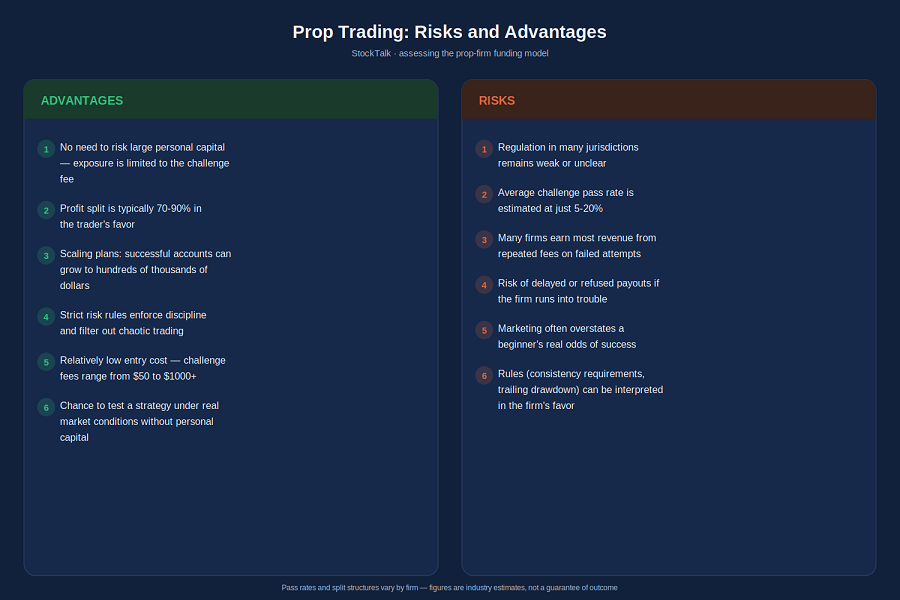
Advantafes ans risks when using Prop firms services
So, what do you actually get?
- For a relatively small fee, you gain access to a large amount of virtual capital. While these funds do not belong to you personally, you are free to use them at your own discretion for trading, opening any type of position or investing over either a limited or unlimited timeframe.
- During the challenge itself, you generally cannot withdraw any profits you generate, though this depends on the specific rules of the challenge. Typically, only those who successfully complete all rounds qualify for an account with withdrawable profits, often provided that your initial fee is also credited to the account balance.
- Admittedly, the process is time-consuming, involving multiple rounds and a host of conditions to meet; however, it allows traders with limited capital to generate higher profits by trading larger volumes. Crucially, they do not risk any more money than the amount they originally paid for the account.
- It is more than just a demo account, though it bears some resemblance. The problem with a standard demo account is that it offers you absolutely nothing of substance unlike the setup provided by a proprietary (prop) trading firm. Here, you operate in a real-world environment rather than a simulation, risking actual capital (even if only a portion belongs to you). It is an excellent opportunity to test your strategy and your ability to turn a profit while trading large volumes.
- However, there are downsides. Such firms are typically subject to minimal regulation. Obligations to the client are often ill-defined, the risk of financial loss remains high, and only about 20% of clients actually succeed. Participating in a challenge means competing against other traders in every round; you might not come out on top even if you end up profitable - because the profits are virtual.
- Then again, this mirrors real life: when applying for a job, you are competing for a position, and not everyone gets an offer, no matter how talented they are.
So, is it worth undertaking these challenges? Yes, if you want to compete and win, and if quiet, passive investing is no longer enough for you. Yes, if you feel capable of more but lack the hundreds of thousands of dollars in capital needed for exchange trading, and you have no desire to raise outside investment or be accountable to specific individuals. In such cases, prop trading firms are willing to share the risk of significant losses while limiting your personal liability.
Weak Regulation - the Core Systemic Risk
This deserves a closer look, since it's where the model is most exposed. Most prop firms don't formally manage real client deposits in the live market (evaluation-stage accounts are typically simulated), which for years let them sit in a regulatory gray zone outside classic broker oversight.
The clearest case study is MyForexFunds (MFF), at the time the world's largest forex prop firm. In August 2023 the US Commodity Futures Trading Commission (CFTC) froze MyForexFunds' assets, alleging fraud: the firm was accused of misrepresenting simulated trading as live trading, manipulating server-side execution, and concealing roughly $310 million in client funds, at a point when the firm had more than 135,000 customers.
But the story doesn't end there, and it's important not to present an outdated version of events as current: in May 2025 a US federal court dismissed the CFTC's case against MyForexFunds with prejudice, sanctioned the regulator, and awarded the company its attorney's fees, after which an Ontario court approved the return of the company's assets, and MyForexFunds announced plans to resume operations, and by April 2026 the firm had begun sending traders their outstanding unpaid balances.
This case isn't simply "the firm turned out to be a scam": it's an illustration of how unsettled the regulatory framework in this industry still is: the allegations were serious, but the regulator's own conduct was later found legally deficient. The practical takeaway for traders is that even a "the regulator already dealt with it" status doesn't guarantee lasting clarity in this space.
That uncertainty is actively being addressed right now, in 2026. Several regulators have moved in parallel over the past few months: in August 2026 the SEC filed enforcement actions against two prop firms for misrepresenting simulated trading as live; in late August the NFA issued marketing standards for affiliate programs at futures prop firms, effective December 1, 2026; in September 2026 the UK's FCA updated its requirements on prop firm marketing claims, ESMA issued a joint statement on challenge fees potentially falling under MiFID II, and Australia's ASIC issued its first formal guidance on the status of simulated challenges. Pressure has also been building at the national level for a while: Italy's Consob, Belgium's FSMA, and Spain's CNMV issued warnings about prop firm risks as early as 2024, and an estimated 80 to 100 prop firms closed between 2023 and 2024 amid tightening rules.
The takeaway for traders is simple: regulation here isn't "absent". It's actively being built right now, which means the rules for any given firm can change at short notice, up to and including a regulator halting the firm's operations entirely, as has already happened.
Verdict: Entertainment, a Waste of Time, or an Opportunity?
The honest answer is all three, depending on who's entering and why.
For an experienced trader with a tested system and a clear-eyed view that most participants won't pass, a prop challenge is a rational way to access leverage on someone else's capital, with a real, capped downside equal to the cost of the attempt.
For a beginner treating it like a lottery ticket: no tested strategy, no real risk management. It's primarily a way for the firm to monetize recurring challenge fees rather than a shortcut to fast income. The pass-rate data (5-20%, and lower still by some aggregate measures) says as much directly.
As pure entertainment, it can work too but then it deserves the same treatment as any product with a high built-in probability of loss: don't put in money whose loss would actually hurt, and don't mistake competitive excitement for an investment strategy.

John Nkosi
John is from South Africa and know local financial market as it's own. He works directly for Stocktalk and responsible for making regular JSE market news.
Comments
Loading comments…
Log in or sign up free to join the discussion.