Investment Fund or Pyramid Scheme? How to Tell a Licensed Unit Trust From a Scam?

John Nkosi
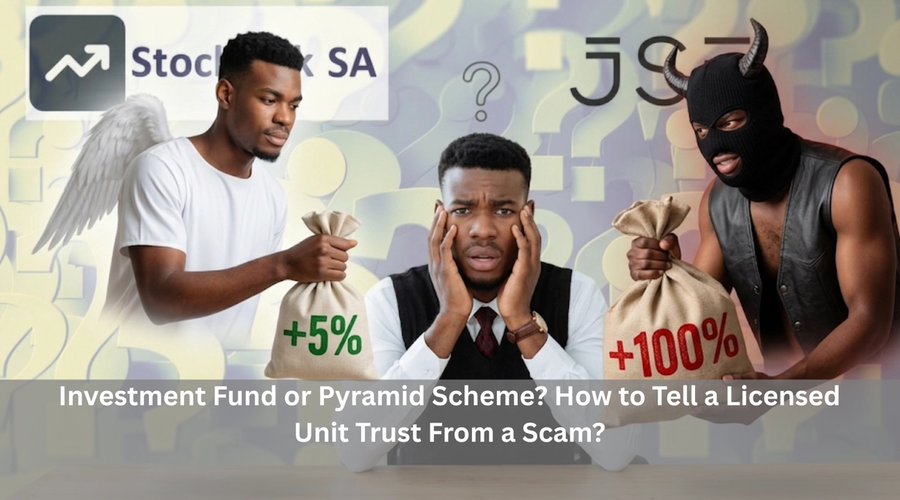
At first glance, the pitches look identical: put your money in, earn a percentage of the returns. But behind that common phrasing sit two completely different worlds and the cost of confusing them can be severe.
How to Spot a Pyramid Scheme or Scam
The clearest red flag is a return that simply cannot be sustainable. Pyramid schemes and scams promise 25–100% a month, sometimes with payouts within a few days of investing. No legitimate capital market generates returns like that consistently — if it were possible, fund managers would have outperformed Warren Buffett many times over by now.
The second red flag is behaviour. Scammers are relentlessly persistent: they call you, message you, push urgency, and insist on a "guaranteed return." Guaranteed returns don't exist in real markets - the phrase itself is a red flag, regardless of the amount involved.
A telling local example is South Africa's Mirror Trading International (MTI) scheme. The company promised investors monthly returns of around 10% and claimed to use an automated bot to trade Bitcoin on their behalf, with membership accelerating sharply during the 2020 lockdown. The Western Cape High Court later ruled MTI a Ponzi/pyramid scheme and voided all agreements with roughly 200,000 members. Founder Johann Steynberg fled to Brazil, was arrested there on charges of using forged identity documents, and died in April 2024 before ever facing trial in South Africa. Liquidators managed to recover only around R1.1 billion of the stolen funds - meaning the vast majority of investors never saw their money again. Estimates of the total scale of the losses vary significantly across sources (from the hundreds of millions to tens of billions of rand), so any specific figure should be treated with that uncertainty in mind.
How to Recognise a Licensed Investment Fund
Here, everything runs in reverse. Licensed funds in South Africa, primarily unit trusts regulated under CISCA and overseen by the FSCA - will offer noticeably more modest percentages and will always warn you about risk. That's not a formality; it's a direct regulatory requirement.
The key difference is who initiates contact: a licensed fund won't chase you down or talk you into making a deposit. In most cases, you'll be the one reaching out to them. And even then, your account won't go live instantly: you'll need to go through a serious KYC/AML verification process first. This follows directly from regulation: investor assets must be held by an independent trustee, kept separate from the management company and responsible for safeguarding the funds, and the scheme itself is required to regularly publish performance reports and disclose its liquidity terms.
What's more, licensed funds tend to be passive about attracting clients: sometimes frustratingly so for people used to being "sold to." But that's the flip side of reliability: companies operating under the FAIS Act and CISCA simply can't behave like aggressive salespeople, because doing so would put their licence at regulatory risk.
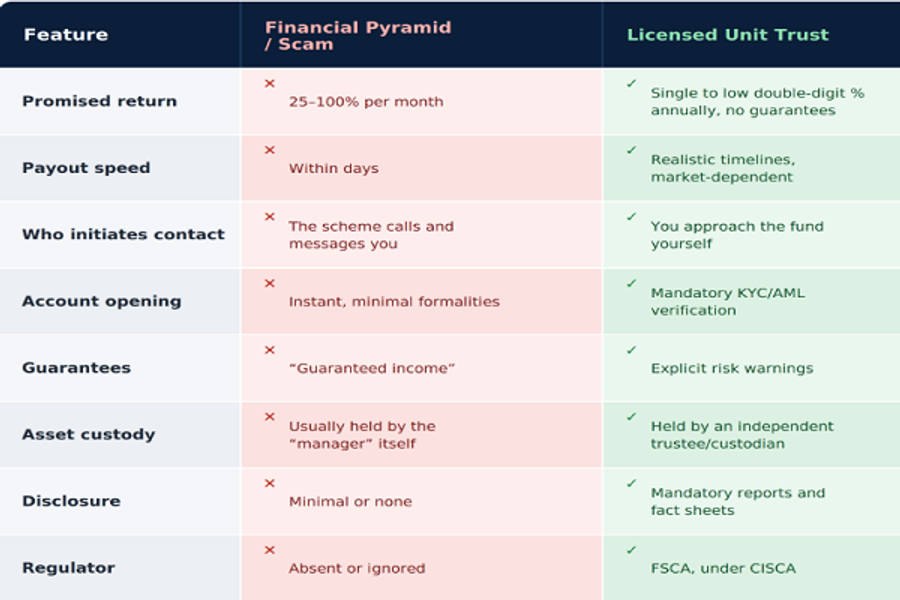
Comparison Scam vs Licensed investment fund
Step-by-Step: How to Choose the Most Reliable Fund
Step 1. Check the fund's registration with the FSCA. Go to the regulator's official site (fsca.co.za) and look up the management company via the FSP (Financial Services Provider) search in the authorised-providers database, or via the separate Entity-Persons-Search for companies and individuals. If the status isn't "Authorised" - i.e. it shows "Suspended" or "Cancelled" or the company doesn't appear in the database at all, don't transfer any money.
Step 2. Cross-check the FSCA's public warning list. The regulator's website publishes a list of individuals and entities it says are conducting unauthorised financial services business without the required licence. It's a fast way to screen out already-flagged schemes before you invest time in a deeper check.
Step 3. Confirm the fund is registered specifically as a Collective Investment Scheme (unit trust) under CISCA. This is a separate registration from a standard FSP licence. It confirms the fund is subject to trustee requirements, disclosure rules, and asset-diversification rules, rather than merely being licensed to "advise" on investments.
Step 4. Find out who holds the assets (the trustee/custodian). Ask directly, or find the name of the independent trustee in the fund's documentation. It should be a separate entity (typically a bank) — not affiliated with the management company itself, or the whole point of separating control is lost.
Step 5. Request and read the Minimum Disclosure Document (fact sheet). A legitimate unit trust is required to regularly publish performance reports, disclose its liquidity terms, and outline its portfolio structure. In the fact sheet, look at: fees (TER/TIC), 1/3/5-year return history, portfolio composition, and assets under management (AUM) - a very small, young fund carries more risk than one with a long, publicly documented track record.
Step 6. Check for ASISA membership. The Association for Savings and Investments South Africa brings together reputable asset managers. Membership isn't a legal requirement, but it's an additional marker of transparency and adherence to industry reporting standards.
Step 7. Notice who makes first contact. If the initiative always comes from the "fund" - calls, messages, persuasion, that's a behavioural red flag in its own right, regardless of what the paperwork check turns up.
Step 8. Match the fund to your own risk profile and time horizon. Even a fully legitimate, reliable fund may not be right for you. An aggressive equity fund isn't a good fit for a conservative investor with a one-year horizon, for example. Structural reliability and product suitability are two separate questions, and both matter.
Bottom Line
The difference between a unit trust and a pyramid scheme isn't visible in the marketing pitch. It's in the details: who holds the money, who makes first contact, how easy it is to open an account, and what's actually being promised. If any of that looks "too convenient" - returns without risk, money without verification, a manager who calls first, that's the signal to stop and check the fund's FSCA registration before transferring anything.

John Nkosi
John is from South Africa and know local financial market as it's own. He works directly for Stocktalk and responsible for making regular JSE market news.
Comments
Loading comments…
Log in or sign up free to join the discussion.