From zero to your first JSE share in your hands. A Guide for South African Investors

John Nkosi
How to Buy Shares on JSE Through South African Banks?
For many South Africans, the easiest entry point into the stock market isn't a specialist brokerage — it's the bank they already use. FNB, Standard Bank, Absa, and Nedbank all offer share-trading platforms that plug directly into your existing banking profile, making it possible to buy into companies like Shoprite or mining giants like Anglo American without opening an account elsewhere.
This guide walks through what each bank offers, what you need before you start, and how the actual process of buying a share works.
The Basics: What a Share-Trading Account Actually Is
When you buy a share through your bank, you're not buying it "from the bank". The bank's stockbroking division (FNB Securities, SBG Securities for Standard Bank, Absa Stockbrokers and Portfolio Management, or Nedgroup Private Wealth Stockbrokers for Nedbank) executes the trade on your behalf on the Johannesburg Stock Exchange (JSE). Your bank account funds the trade; the brokerage division handles the mechanics of buying and holding the shares in your name.
Before you can trade with any of the four banks, you'll typically need to:
- Complete FICA/KYC verification — ID document and proof of address, standard for any South African financial account.
- Link or open a transactional account with that bank, since most share-trading accounts are tied to your existing banking profile.
- Fund the account via EFT or internal transfer before placing your first order.
Once that's done, buying a share is the same basic action regardless of which company you're after - search the JSE code, place a buy order, and the trade settles a few working days later.
Comparing the Four Bank Platforms
FNB — Share Investing
FNB's Share Investor account gives access to the full range of JSE-listed shares, ETFs, ETNs, and Krugerrands, accessed by logging into FNB Online Banking or the FNB App. There's a lower-cost Share Builder tier aimed at smaller, more automated monthly investing, and a Tax-Free Shares Account that lets investors put money into the JSE Top 100 each month without paying tax on the returns.
Standard Bank — AutoShare Invest and Online Share Trading
Standard Bank splits its local offering in two: AutoShare Invest, opened via internet banking or the mobile app, is built for newer investors and requires an existing rand account with the bank; Online Share Trading (OST) is the more established platform with derivatives access, free educational courses, and a built-in tax-free investment account. Both connect to JSE-listed shares and ETFs directly.
Absa — Stockbrokers and Portfolio Management
Absa's self-managed accounts cover local and offshore markets, shares, and ETFs, with Premium and Private Banking clients getting reduced fees and brokerage rates. Its Smart Account also includes a free World Trader Account for those wanting international diversification alongside JSE holdings.
Nedbank - Online Share Trading
Nedbank requires a Nedbank ID to open a live trading account, and offers a 30-day trial account for new users to learn the platform before committing real money. It also runs a Young Investor account aimed specifically at 18–25 year-olds, giving that age group access to the full JSE and select ETFs with no minimum investment requirement.
exact fee structures (brokerage percentages, monthly account fees, minimums) differ across all four banks and change periodically. Clarify relevant rates.
Worked Example: Buying Shoprite
Shoprite Holdings trades on the JSE under the code SHP. The process is identical across all four platforms:
- Log in to your share-trading account.
- Search "Shoprite" or enter the code SHP.
- Choose a market order (executes at the current price) or a limit order (executes only at a price you set).
- Confirm the number of shares and the estimated cost, including brokerage and statutory fees.
- Submit the order. It settles a few working days after the trade date.
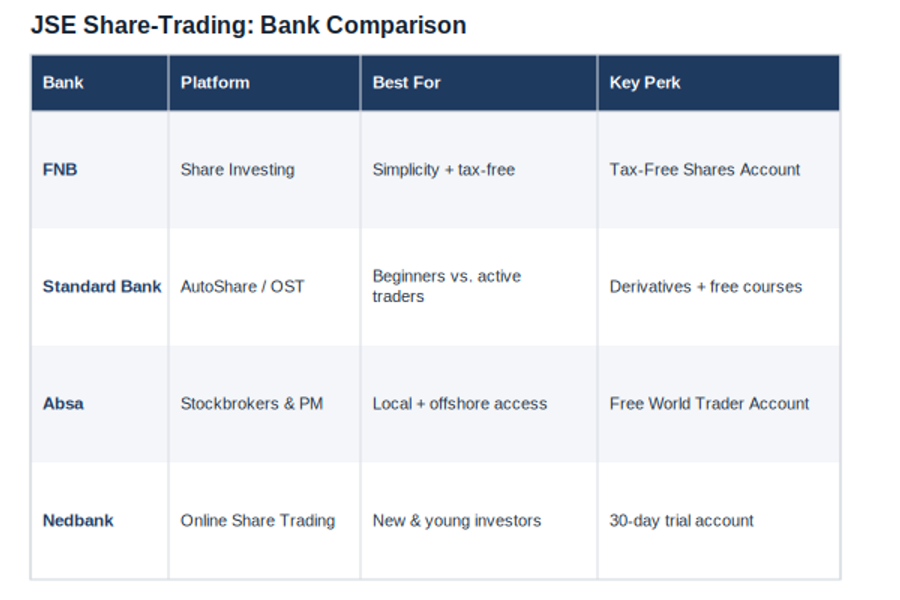
Entering JSE via banks: comparison table
Buying Into Mining Companies
The JSE's mining sector is one of the most actively traded parts of the exchange, and the same process applies whether you're after a diversified major or a single-commodity producer. Common examples investors search for include:
- Anglo American (AGL) - diversified major
- Sibanye-Stillwater (SSW) - precious metals (PGMs, gold)
- Harmony Gold (HAR) - gold
- Kumba Iron Ore (KIO) - iron ore
- Exxaro Resources (EXX) - coal and diversified minerals
No separate account or process is needed to buy mining shares versus retail or banking shares. They're all just line items on the same JSE order book, searchable by code on any of the four platforms above.
Before You Place Your First Trade on JSE
A few things worth flagging for readers considering this route:
- Share prices fluctuate and past performance doesn't guarantee future returns — standard risk language, but worth stating plainly for anyone new to direct share investing.
- Fees compound over many small trades. Comparing brokerage percentages and monthly account fees across banks matters more for frequent traders than for buy-and-hold investors.
- This is general information, not financial advice. Anyone acting on it should check current rates directly with the bank and consider speaking to a licensed financial advisor for guidance specific to their situation.
SUMMARY
You've learned all the ways to buy shares through banks as a reliable investment method. Banks with the appropriate licenses can be trusted beyond all doubt. They will provide real access to stock quotes - not an imitation of the rates. Fees for maintenance, account opening, and purchases may seem high, but you should understand that since these institutions are subject to the most stringent requirements and obtain expensive licenses, it can't be cheap and it can't be for free. There's likely no bonuses, giveaways and other rewards for newcomers: they're not interested to refer random people but real investors who register to invest. At the same time, you can be confident that banks won't manipulate prices and quotes because they earn enough from commissions. If you're still looking for cheaper alternatives, they do exist, but the risks may be higher. We'll discuss other ways to buy shares next time. You can check all the methods and choose the one that's most convenient for you.

John Nkosi
John is from South Africa and know local financial market as it's own. He works directly for Stocktalk and responsible for making regular JSE market news.
Comments
Loading comments…
Log in or sign up free to join the discussion.