How to Trade, How to Invest, and How Much? A Step-by-Step Guide

John Nkosi
"How do I start, and how much money do I need?" This is the very first question every newcomer asks. Entering the financial market can feel overwhelming, and it's completely normal to feel a bit hesitant. The truth is, the market offers multiple paths and countless strategies.
Which one is right for you? You decide. Let’s break down the two primary ways to participate in the market, look at their pros and cons, and figure out how much you should actually risk.
The Two Main Paths: Direct Investing vs. CFD Trading
1. Direct Share Investing (Traditional Buying)
When you buy shares directly through a licensed JSE (Johannesburg Stock Exchange) broker, you become a part-owner of that company. Your ownership is registered electronically (via Strate in South Africa), making you an official shareholder.
- The Goal: You profit when the company grows and its share price goes up over time.
- Dividends: This is the best part. Companies often distribute a portion of their net profit to shareholders as dividends. Think of it as a loyalty reward for trusting them with your capital.
- The StockTalk Advantage: Using StockTalk, you can easily track your physical portfolio, monitor your dividend calendar, and optimize your holdings as the macroeconomic landscape changes.
Keep in mind: Direct investing usually requires a higher entry threshold due to minimum broker fees, and you can only profit when the markets are rising.
2. CFD Trading (Trading on Price Movements)
CFD stands for Contract for Difference. This method allows you to speculate on the price movements of shares without ever owning the underlying asset.
- Absolute Flexibility: You can profit from both rising and falling markets. If you think a stock’s price will drop, you can "go short" (open a sell deal).
- Instant Execution: Everything happens via specialized trading apps. There is no need to wait for clearing houses; you can enter and exit trades within seconds.
- The Catch: Since you don’t own the actual shares, you do not receive voting rights or corporate dividends.
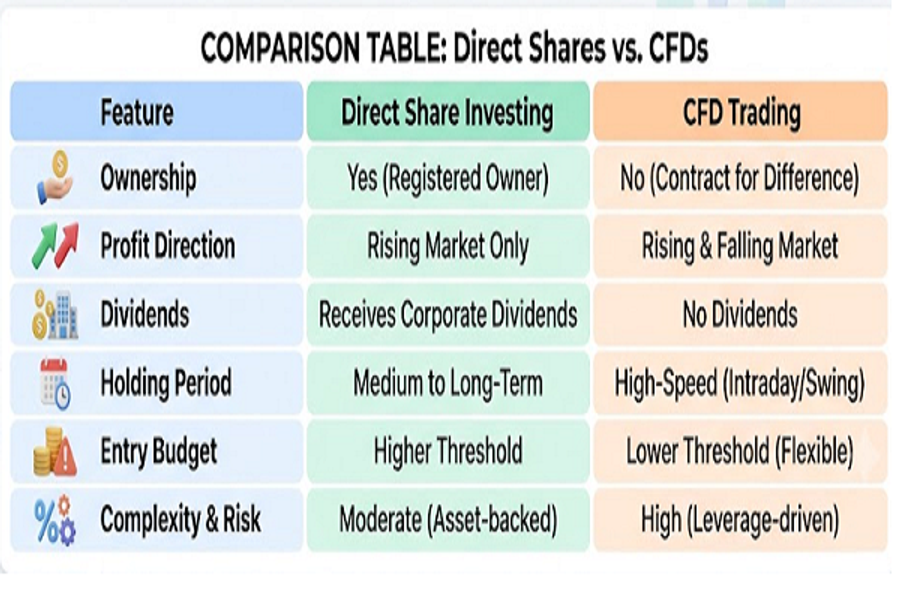
Comparison table direct investing vs CFD trading
Some investors dismiss CFDs as "pure gambling." In reality, it is simply a different financial instrument. In fact, many successful market participants play both games simultaneously: holding steady stocks for the long term while using a small portion of their budget for short-term CFD trading.
How Much Should You Invest?
There is no single "magic number." Your starting budget depends on your financial situation, your chosen path, and your risk tolerance. However, every beginner must follow these four golden rules:
Rule 1: Only risk what you can afford to lose
Investing and trading involve real risk. Never use money meant for rent, bills, or your emergency fund.
Rule 2: Start with "Paper Trading" (Demo Accounts)
If you are completely new, open a Demo account first. It allows you to buy and sell shares using virtual funds under real market conditions. It is the perfect way to test your strategies without risking a single cent. Note: Don't stay on Demo for too long, or you might miss great market entry points that rarely repeat.
Rule 3: Keep your leverage low
CFD brokers offer "leverage" (borrowed funds to amplify your trade size). While it can boost your profits, it can wipe out your account just as fast if the market moves against you. While some platforms offer high ratios like 1:100, beginners should keep leverage strictly under 1:5 or 1:10 to stay safe.
Rule 4: If your budget is limited, look at ETFs
If you only have a few hundred Rands, do not buy high-risk "penny stocks" (micro-caps) that can easily go bankrupt. Instead, look at ETFs (Exchange-Traded Funds). They allow you to buy a tiny fraction of the top 40 JSE companies at a very low cost, giving you instant diversification.
Summary
The financial market isn't a one-size-fits-all environment. Whether you choose the patience of traditional investing or the agility of CFD trading, the best strategy is the one that aligns with your financial reality. At the same time it's cost to test all kinds of investing and choose the most suitable personally for you, starting from limited budget and then gradually increasing.
This article is for educational and informational purposes only and does not constitute financial advice or a recommendation to buy, sell or hold any security. Always do your own research.

John Nkosi
John is from South Africa and know local financial market as it's own. He works directly for Stocktalk and responsible for making regular JSE market news.
Comments
Loading comments…
Log in or sign up free to join the discussion.