From zero - to your first JSE share. Part 3. A Classic of investing #2.

John Nkosi
A classic of investing 2.0: investment funds/managers
Unlike a broker, a licensed investment fund manager doesn't give you direct ownership of a specific JSE share. You buy a unit in a pooled fund, and the manager decides which shares the fund holds. It's just as old and legitimate a route into the market - the first modern mutual fund (Massachusetts Investors Trust) dates to 1924 in the US - but it's a fundamentally different mechanism from picking your own stock through a broker.
Mutual funds eliminate the main problem - choosing the best companies for investment, as well as the time spent searching for them. You also don't need any experience or skills - just a wish to invest profitably. This is how wealthy individuals in the US have been doing things for over 100 years. There is still a risk of financial loss: funds aren't magicians. However, if you choose a reputable and licensed fund, the risks are likely lower than when trading independently. However, the entry threshold is significantly higher, and the rules remain the same - invest only what you're willing to lose in a worst-case scenario. However, a reputable fund will offer guarantees of protection. The key is to distinguish a licensed fund from over-hyped experts with phony reviews, no licenses, and no accountability to clients, but promising 200% daily returns.
Meet the licensed fund managers, operated on JSE
Time to review investment funds, work for a years. So they desrved they-re not a one-time project but a well successful financial company.
Allan Gray - South Africa’s largest privately owned investment manager
Allan Gray investment fund was founded in 1973 by Allan W.B. Gray. Began listing flagship Allan Gray-Orbis funds as AMETFs on the JSE in late 2025, tradable like ordinary shares.
Allan Gray holds elite, top-tier professional fund ratings from institutional bodies like PlexCrown and Morningstar for its stable, long-term returns, though it maintains a low 2.2 to 3.1 rating on public consumer complaint boards due to administrative friction. As South Africa’s largest privately owned investment manager, it is widely praised by financial professionals for its contrarian, value-driven investment philosophy, but faces consumer criticism regarding high fee transparency and rigid operational paperwork.
Fund Ratings & Performance OverviewAllan Gray’s reputation is deeply split between its highly-rated fund metrics and consumer support scores:
- PlexCrown & Morningstar Fund Ratings: 4.3 to 5 / 5 Stars. Flagship funds like the Allan Gray Balanced Fund and the Allan Gray-Orbis Global Balanced Feeder Fund regularly claim top PlexCrown honors for superior risk-adjusted returns.
- Hellopeter: 2.2 / 5 stars (Driven primarily by complaints over strict paperwork, compliance checks, and slow payouts).
- Trustpilot: 3.1 / 5 stars (Reflective of mixed consumer experiences with call center responsiveness).
Core Performance Metrics (As of Mid-2026)The long-term annualized track records across their primary investment vehicles remain consistently robust:
- Allan Gray Balanced Fund: The go-to fund for retirement annuities (RA). It averages roughly 11.5% to 12% annualized return since inception, outperforming its long-term composite benchmark.
- Allan Gray Stable Fund: Designed for capital preservation. It boasts an annualized return of roughly 11.3% since inception, steadily outpacing its benchmark (cash + 2%) with incredibly low volatility.
- Allan Gray-Orbis Global Balanced Feeder Fund: A standout offshore performer, posting over 24% growth on a 1-year basis trailing into 2026, easily crushing its international benchmark.
Key Pros and Cons from User ReviewsWhat Investors Love (The Pros)
- Elite Wealth Management: A bulletproof institutional track record spanning decades; highly trusted for large-scale capital, trusts, and retirement portfolios.
- The "Contrarian" Edge: Their strategy focuses on buying undervalued companies that other managers ignore, leading to massive defensive outperformance during market downturns.
- Strong Digital Portal: The self-service investor dashboard is universally praised for clean tracking, statement generating, and fund switching.
- No Mandatory Advisor Fees: Users can bypass expensive financial planner fees by investing directly through the Allan Gray platform at no extra surcharge.
Major User Complaints (The Cons)
- High Fee Structures: If you use an external broker, total fees (Platform + Fund Manager + Advisor) can easily exceed 1.5% to 2% annually, which aggressively eats into compounding growth compared to passive index funds.
- Complex Performance Fees: Certain funds (like the Orbis offshore vehicles) use a sliding-scale performance fee model. In years of extreme outperformance, the Total Expense Ratio (TER) can spike noticeably.
- Heavy Administrative Burden: Clients note that altering debit orders, editing beneficiaries, or updating FICA compliance involves tedious, multi-page paper trails.
2. Coronation Fund Managers review (JSE: CML)
Founded Cape Town, 1993 and being listed on JSE June 2003 this fund is the only SA asset manager, directly listed on the JSE. For the six months ended 31 March 2026 (reported May 2026): revenue R2.1bn (+3%), profit attributable to equity holders R770m (+6%), but HEPS dipped 5% to 195.1 cents (partly reflecting a SARS tax matter). AUM R746bn (-2% on market movements), average AUM +15% to R776bn.
Coronation Fund Managers commands elite institutional ratings, carrying a Bronze Morningstar Medalist Rating and top-tier industry rankings for long-term wealth building, but it receives a low 1.5 to 2.5 rating on public consumer complaint boards. Much like its primary rival Allan Gray, Coronation is an active, valuation-driven asset manager managing over R600 billion. It is highly regarded by financial advisors for retirement planning, though retail investors sometimes voice frustration over rigid compliance protocols and administrative bottlenecks.
CML's Fund Ratings & Industry Standing
Coronation's reputation is evaluated through institutional investment benchmarks rather than typical retail app store metrics:
- Morningstar Medalist Rating: Bronze (Indicating a highly repeatable process, a robust management team, and strong potential for future outperformance).
- PlexCrown Fund Ratings: 4 to 5 / 5 Stars across its flagship portfolios for long-term, risk-adjusted performance.
- Hellopeter / Trustpilot: ~1.5 to 2.5 / 5 stars (A low public score driven almost entirely by retail client gripes over identity verification (FICA), death benefit payouts, and communication response delays).
Key Pros and Cons from User Reviews
What Investors Praise (The Pros)
- Decades of Outperformance: Renowned for an active, long-term valuation philosophy that shelters capital during market declines and exploits mispriced equities.
- No Upfront Investment Fees: When investing directly via Coronation's online portal, investors pay 0% initial transaction fees.
- Seamless Portal Tools: The digital investor platform is praised for clean execution on fund switching, viewing balance sheets, and managing debit orders.
- Transparent Distribution: A dependable track record for semi-annual dividend payouts across its income-yielding unit trusts.
Major User Complaints (The Cons)
- Layered Fee Surcharges: While direct investing is clean, onboarding through an external broker introduces layered platform and advisor fees, pushing the Total Expense Ratio (TER) above 1.3% to 1.6% annually.
- Rigid Compliance Friction: Users frequently note that updating bank accounts or processing withdrawals triggers intensive administrative scrutiny and FICA paperwork delays.
- Active vs. Passive Drag: During heavy bull markets, active management fees can cause the fund to briefly trail low-cost passive index trackers (like the Satrix Top 40 or Sygnia indices).
3. Ninety One fund review (JSE: NY1 / LSE: N91)
Ninety One has been Established in 1991 as Investec Asset Management; demerged and dual-listed March 2020. For FY2026 (year ended 31 March 2026, reported June 2026): adjusted EPS +12% to 17.4p, profit after tax £153.5m (+2%), AUM +31% to £171.8bn - though £18.3bn of that came from the one-off Sanlam asset take-on (organic AUM growth was 17.4%). Full-year dividend raised 10% to 13.4p. As of the most recent quarterly update (30 June 2026), AUM has grown further to £184.0bn.
Ninety One (formerly Investec Asset Management) holds top-tier institutional quality ratings, commanding an global "A" to "Bronze" Morningstar ranking, but features a lower 1.8 to 2.8 rating on public customer feedback sites due to strict onboarding paperwork. Dual-listed on the JSE (ticker: NY1) and LSE (ticker: N91), it operates as a massive global asset powerhouse handling over £184 billion (R4+ trillion) in assets. It is highly regarded by financial advisors for its active multi-asset portfolios, though self-directed retail users note administrative and compliance friction.
Corporate & Fund Ratings Overview
The firm’s dual corporate and retail identity results in a clear divergence between institutional performance metrics and public customer review channels:
- Morningstar Fund Quality Scale: Bronze / Silver Medalist Ratings across flagship funds.
- PlexCrown Fund Rankings: 4.2 / 5 Stars on risk-adjusted consistency over rolling 3- and 5-year periods.
- LSE / JSE Stock Outlook: Strong Buy / Stable from financial analysts, highlighting zero balance-sheet risk.
- Hellopeter / Trustpilot: ~1.8 / 5 stars (A standard trend among premium asset firms, driven by retail complaints over complex inheritance, FICA compliance, and withdrawal timelines).
Key Pros and Cons from User Reviews
What Investors Value (The Pros)
- Massive Global Scale: Bolstered by its recent structural integration with Sanlam’s active asset businesses, providing deep institutional liquidity security.
- Sophisticated Risk Mitigation: Highly praised for downside protection in multi-asset buckets during global equity recessions.
- Direct Investor Platform: The "Ninety One Investment Platform" offers a clean, user-friendly digital interface to view unit trust assets, modify debit orders, and perform tax switches.
- Strong Corporate Dividend Profile: For those buying the public stock (JSE: NY1), it presents a highly resilient 6.4% historical dividend yield track.
Major User Complaints (The Cons)
- Retail Investment Minimums: Opening a direct portfolio demands a steep baseline entry requirement—typically R10,000 lump sum or R500 monthly recurring via debit order.
- Administrative Friction: International regulatory status implies rigid KYC/FICA loops. Users note that transferring or liquidating money requires intensive paperwork verification.
- Active Fee Drag: Flagship actively-managed equity portfolios feature Total Expense Ratios (TER) hovering around 1.16%, drawing criticism from investors favoring ultra-cheap index trackers
4. Old Mutual Investment Group review (JSE: OMU)
Old mutial fund traces to 1845; demutualised/listed 1999; re-listed on JSE post-2018 "managed separation." FY2025 (year ended 31 December 2025, reported March 2026): adjusted headline earnings +24% to R8.3bn (adjusted HEPS +26% to 189.8 cents), results from operations +13% to R9.8bn, full-year dividend raised 8% to 93 cents.
Old Mutual Investment Group (OMIG) holds an institutional-grade reputation with stable, quantitatively derived "Neutral" Morningstar Medalist Ratings, but it experiences a low 1.5 to 2.2 rating on public retail consumer complaint platforms. As one of South Africa's oldest and largest legacy financial institutions, it manages over R1 trillion in assets. While highly trusted by corporate pension funds and institutional investors, its retail arm draws severe public criticism over excessive bureaucratic red tape and payout delays.
Old mutual's Fund Ratings & Institutional Standing
Because Old Mutual operates at a massive corporate scale, its evaluation is split between financial matrix stability and standard public grievance hubs:
- Morningstar Medalist Rating: Neutral across flagship funds (e.g., Old Mutual Balanced Fund). This means the portfolios are mathematically stable, highly reliable, and securely designed to track market cycles without erratic downside risks, though they rarely beat the highest active alpha managers.
- PlexCrown Fund Rankings: 3 to 4 / 5 Stars for consistent, long-term asset allocation.
- Hellopeter / Trustpilot: 1.5 to 2.2 / 5 stars. Note that these poor consumer scores are heavily skewed by Old Mutual’s generalized insurance and funeral policy claim disputes, rather than specific investment execution
Key Pros and Cons from User Reviews
What Investors Value (The Pros)
- Absolute Institutional Safety: Backed by centuries of capital infrastructure; there is zero risk of platform insolvency or default.
- Shariah & ESG Leadership: Universally praised for having some of South Africa's most robust socially responsible and Islamic investment frameworks. [1]
- Diverse Product Wrapper: Seamless integration between discretionary Unit Trusts, Tax-Free Savings Accounts (TFSA), and corporate group retirement solutions.
- Extensive Physical Footprint: Unlike "digital-only" apps, investors who prefer face-to-face interaction can access physical Greenlight branches and advisors across Southern Africa.
Major User Complaints (The Cons)
- Severe Onboarding Friction: Retail users frequently complain about "archaic" administrative protocols. Processing transfers, moving retirement annuity (RA) funds, or updating FICA documents involves long paper trails.
- Layered Fee Drag: Retail Total Expense Ratios (TER) hover around 1.18% to 1.58%. If paired with a tied Old Mutual financial advisor, total fees can become highly expensive compared to modern passive alternatives.
- Clunky Digital App: The "Old Mutual Invest" mobile interface receives poor marks compared to modern fintech apps, with users citing limited customization and sluggish response times.
5. Satrix review (wholly owned by Sanlam)
Founded November 2000, launching the first ETF in SA, this fund can bs called the youngest. Wholly Sanlam-owned since 2012; not separately listed, though its ETFs trade on the JSE. No standalone profit figures published; holds roughly 38% of SA's ETF market by industry estimates.
Satrix commands excellent institutional ratings, holding a Bronze Morningstar Medalist Rating for its flagship index tracking, but its retail-facing investment platform (SatrixNOW) scores lower on public boards, averaging 1.5 to 2.3 stars due to administrative support bottlenecks. Owned by Sanlam, Satrix is South Africa’s pioneer in index-tracking investment products. It is widely celebrated by industry professionals for offering ultra-low-cost Exchange Traded Funds (ETFs) and index unit trusts, though retail platform users frequently cite delays in manual service channels.
Satrix's Platform Ratings & Industry Standing
The reputational profile for Satrix shifts dramatically depending on whether you evaluate the performance of its index funds or the utility of its retail online portal:
- Morningstar Fund Quality Rating: Bronze Medalist Rating. Flagship products like the Satrix 40 ETF score high marks for perfect index replication and operational stability.
- SALBA / Krutham (Intellidex) Awards: Regularly sweeps "People's Choice" and "Best Total Return" awards for South African ETFs.
- Hellopeter (SatrixNOW Portal): 1.5 / 5 stars. The consumer score is heavily weighed down by DIY retail complaints regarding administrative waiting times and withdrawal rules.
- Trustpilot: ~2.1 / 5 stars. Mirroring its parent group, Sanlam, public feedback highlights friction when dealing with centralized call center inquiries.
Key Pros and Cons from User Reviews
What Investors Love (The Pros)
- Pioneering Low Fees: Recognized as one of the cheapest ways to build passive wealth. Flagship ETFs carry incredibly low Total Expense Ratios (TER), with the Satrix 40 ETF managing an ultra-efficient fee structure (~0.10% to 0.30%).
- No Minimum Barriers: Through the SatrixNOW platform, retail investors can start purchasing top global and local index funds with no strict minimum lump-sum requirements.
- Diverse Passive Selection: Provides vast market exposure spanning the JSE Top 40, property indices, resource indices, and major offshore buckets like the Satrix Nasdaq 100 or S&P 500.
- Tax Efficiency: Offers excellent Tax-Free Savings Account (TFSA) and Regulation 28-compliant retirement options that carry zero performance fees.
Major User Complaints (The Cons)
- Support & Ticket Backlogs: Investors note that trying to reach customer consultants for portal issues often results in generic, "copy-and-paste" responses with long resolution windows.
- SARS Document Integration: Users frequently report bugs when trying to pull or automatically synchronize tax data and IT3b/IT3c certificates for annual tax returns.
- Slow Settlement/Payout Cycles: Processing fund switches or full banking withdrawals triggers strict compliance holding periods, which beginner users find confusing or frustrating.
- Platform Scam Clones: Because Satrix is a household name in South Africa, users warn about malicious social media and WhatsApp groups mimicking the brand to solicit fake deposit returns. (Always use the official official website or verified SatrixNOW app directly).
Satrix Products vs. Satrix Platforms
It is important to remember that you do not have to use the SatrixNOW platform to buy Satrix products. If you dislike their direct customer service, you can purchase their exact same award-winning ETFs (like STX40 or STXNDQ) through any third-party online stockbroker we reviewed earlier (such as EasyEquities or PSG Wealth).
6. PSG Asset Management review
PSG Asset Management holds exceptional institutional and fund performance ratings, including multiple News24 FundHub Industry Performance Awards and strong Morningstar Medalist placements, but shares the generalized 1.5 out of 5-star consumer score of its parent group, PSG Financial Services, on retail review platforms. Functioning as the dedicated fund-management arm of the group, it manages over R83.7 billion in assets. It is highly revered by industry professionals for its strict "3M" contrarian investment philosophy, though it faces common retail complaints concerning administrative and withdrawal turnarounds.
Fund Ratings & Industry Standing
Because PSG Asset Management operates as a wholesale factory for unit trusts rather than a retail trading app, its ratings are driven by rigorous quantitative evaluation:
- Industry Recognition: Top Honors Winner at the News24 FundHub Industry Performance Awards, recognizing elite risk-adjusted performance over rolling five-year cycles.
- Morningstar Medalist Rating: Silver / Bronze Ratings across its prominent underlying funds and Fund of Funds (FoF) allocations, signaling structurally high potential for long-term alpha.
- Parent Group Credit Rating: AA-(ZA) with a Stable Outlook from Global Credit Ratings (GCR), reflecting immense institutional liquidity and safety
- Hellopeter / Trustpilot (Group Hub): 1.5 / 5 stars. This low consumer score tracks the entire financial services operation, largely driven by administrative onboarding delays, rather than the core performance of the funds themselves
PSG's Core Performance & Strategy Rates
PSG Asset Management utilizes a distinct 3M Investment Framework (evaluating Moat/Competitive Advantage, Management Quality, and Margin of Safety). Their flagship unit trusts include:
- PSG Balanced Fund: A flagship multi-asset vehicle optimized for retirement compliance (Regulation 28). It is favored for its defensive equity stance during volatile global cycles.
- PSG Equity Fund: A high-conviction local stock portfolio targeting deeply undervalued JSE equities. Favorable market turnarounds drove its asset pool up by 37.7% recently.
- PSG Diversified Treasury / Income Portfolios: Consistently secure top positions for cash-clearing and capital preservation, pulling significant cash inflows via corporate networks.
Key Pros and Cons from User & Industry Reviews
What Fund Analysts Praise (The Pros)
- True Contrarian Management: They excel at buying unloved, cheap assets that passive trackers miss, yielding significant outperformance when market cycles flip.
- Massive Institutional Backing: Total group assets under management exceed R564.6 billion, rendering insolvency or liquidity events non-existent.
- Consistent Distribution Surcharges: Fixed-income portfolios are highly regarded by retirement planners for delivering stable, predictable yields.
Major Individual Complaints (The Cons)
- Performance Fee Spikes: Because their contrarian picks can surge rapidly, performance-linked fees can temporarily elevate the fund's Total Expense Ratio (TER) in banner years.
- Advisor-Centric Architecture: The onboarding ecosystem favors investors coming through an independent or tied financial advisor, making pure direct-to-consumer DIY account opening feel cumbersome.
- Administrative Processing Lag: Much like its platform counterpart PSG Wealth, users mention strict compliance loops (FICA/KYC verification) that lengthen withdrawal timelines
Bottom line
Investing through funds has its advantages and disadvantages. Among the advantages are extensive investment experience and commitment to clients. None of the funds reviewed were unprofitable. Disadvantages include bureaucracy, high fees, weak control over the use of your funds, and a high entry fee. This investment method is suitable for you if you have a sufficient amount according to the terms and conditions, if you're investing for many years but lack the time and experience, and don't want this to hinder your passive income. As with brokers, we don't recommend delving into negative reviews on rating sites, as satisfied clients rarely write reviews. However, you shouldn't completely ignore them either – just be prepared for bureaucracy, slow withdrawals, and high fees.
To summarize, we've put together a comparison table of the funds we reviewed today, and we hope this helps you see the full picture.
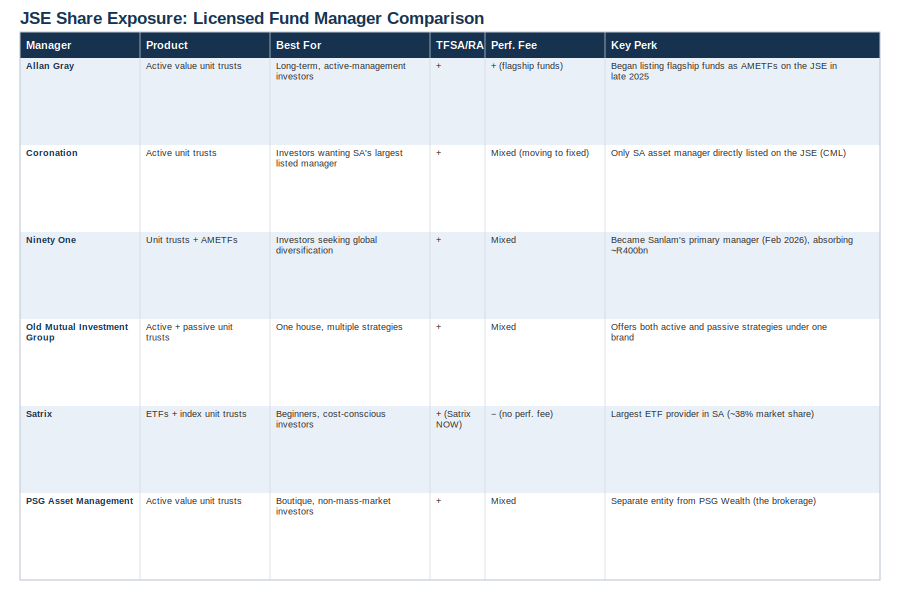
Comparison table of investment funds in South Africa, July 2026
Take a look also to our review of licensed brokers in South Africa and review of banks as the way for investing in South Africa.

John Nkosi
John is from South Africa and know local financial market as it's own. He works directly for Stocktalk and responsible for making regular JSE market news.
Comments
Loading comments…
Log in or sign up free to join the discussion.