From Zero to your first share in your hands. Part 2: A Classic of Investing #1

John Nkosi
From zero to your first share in your hands. A Classic of Investing: Independent Brokers
In this review, we'll examine the most traditional, classic, and time-tested methods of stock trading: independent licensed brokers and investment funds. Yes, this is practically the same method of buying and selling shares as described in American films.
You might be thinking about banks as the most traditional method, but it is only recently, with the popularization of investing, banks have begun to provide services of stock investing to their clients, since banks, when receiving banking licenses, already meet the strictest requirements of regulators, so it is not a problem for them to also obtain permission to access the stock exchange.
When we talk about brokers, we're referring to those who offer actual, legally binding stock purchase deals.
Why brokers are needed
Retail investors cannot trade on the JSE directly. Every buy or sell order has to pass through a licensed intermediary who is authorised to place it on the exchange. Without a broker, there is simply no way for an individual to turn an intention to buy or sell a share into an actual transaction on the market.
Independent brokers are licensed financial services providers, authorised by South Africa's regulator (the FSCA) and admitted as members of the JSE. This membership places them on the exchange's official register and makes them part of the mechanism through which the market operates: it is the combined flow of orders that brokers place on behalf of their clients that continuously sets share prices through supply and demand.
Independent, but not all equally independent
"Independent" here mostly means "not a bank" and every broker in this piece qualifies. But there's a second sense of "independent" worth distinguishing: a small, standalone business versus a brokerage arm inside a large multi-line financial group.
Sharenet Securities, Anchor Stockbrokers, Otto1890
: PSG Wealth (part of PSG Financial Services), Sanlam iTrade (part of Sanlam).
List of the most known Independent Brokers in South Africa
1. EasyEquities review (operated by First World Trader, part of Purple Group Ltd, JSE: PPE).
and now can be called the most known broker in South Africa. While users praise its low fees, accessibility for beginners, and fractional share investing, Trustpilot reviews indicate a generally poorer sentiment, hovering around EasyEquities itself launched in 2014 due to rising complaints about slow customer support, withdrawal delays, and platform fees. But let's be honest: all brokers usually have slow withdrawals and fees. You can consider it as a disadvantage vs banks with their own money transfers inside.
For the six months ended 28 February 2026 (reported April 2026): group revenue R258.5m (+8.8%), profit before tax R78.7m (+33.3%), profit attributable to owners R40.7m (+21.2%), HEPS 2.86 cents (+21.0%) — an accelerating, profitable business.
2.2 to 2.5 out of 5 stars
A synthesis of user feedback highlights a stark divide between platform utility and operational performance:What Users Love (The Pros)
- Accessibility: No minimum account size or investment limits, allowing anyone to start investing.
- Fractional Shares: Investors can purchase tiny fractions (up to 1/10,000th) of high-priced shares.
- Low Cost: Very competitive commission structures (~0.25% brokerage fees) with no hidden monthly account fees.
- Diverse Markets: Easy access to South African (JSE), US, UK, European, and Australian stock markets in one dashboard.
Major User Complaints (The Cons)
- Support Delays: Customer service is ticket-only and notoriously slow, often taking weeks to resolve urgent queries.
- Withdrawal Deadlines: Processing payouts often feels sluggish, stretching beyond standard settlement timelines.
- Administrative Errors: Tax-free and retirement account users report delays in receiving vital tax certificates or SARS document submissions.
- Cluttered Updates: Users complain that recent app updates look crowded, push auxiliary products like "EasyProperties," and feature delayed, 15-minute delayed market quotes.
2. PSG Wealth (division of PSG Financial Services Ltd, formerly PSG Konsult, JSE: KST)
The Company Founded 1998 by Willem Theron and Wallie Krumm, with PSG Group (Jannie Mouton's holding company, founded 1995) taking a 50% stake. Renamed PSG Financial Services in August 2023. FY2026 (year ended 28 February 2026): group recurring headline earnings R1.68bn (+32%), with the Wealth division contributing R950m (+25%).
PSG Wealth holds a mixed online reputation, securing high marks for safety and its network of face-to-face financial advisors, but averaging lower scores (around 1.5 to 3.2 stars) on public consumer complaint boards. Unlike tech-first platforms, PSG Wealth operates on a traditional, advisor-led model, meaning individual user experiences heavily depend on the specific wealth manager assigned to their account.
PSG's Key Pros and Cons from User Reviews
- Top-Tier Regulation: Highly trusted, institutional-grade security for large investment portfolios.
- Expert Personal Guidance: Access to highly qualified financial advisors for complex estate planning and wealth management.
- Comprehensive Suite: Robust options spanning multi-asset funds, offshore investments, share portfolios, and local trusts.
- Strong Performance Records: Institutional funds (like their FoF ranges) generally meet steady, risk-managed benchmarks.
Major User Complaints (The Cons)
- Higher Costs: Fees are structured around advisor commissions and platform management, making it significantly more expensive than self-service platforms like EasyEquities.
- Slow Onboarding: Digital onboarding and compliance paperwork (FICA/KYC) are frequently criticized as slow and archaic.
- Communication Lapses: Some clients note a lack of proactive communication from central customer support once an account is established.
- Higher Entry Barriers: High minimum investment thresholds make it restrictive for casual or beginner retail investors
3. Sharenet Securities review
Sharenet was founded in 1988 by Anthony Walker as a JSE data provider; the Sharenet Securities brokerage entity was separately incorporated in 2005. Private company, not JSE-listed; no public standalone profit figures.
This broker maintains an exceptionally low public profile with sparse footprint on major review aggregators, leaving it without a formalized star rating on channels like Trustpilot or Hellopeter. Because
rather than a mass-market retail app, public feedback is primarily limited to positive independent industry safety assessments and internal client testimonials.
Platform Safety & Regulatory Standing
While public consumer ratings are functionally absent, institutional review entities view the broker favorably regarding security:
- BrokerChooser Safety Assessment: Highly Safe / Legit. It is heavily regulated under South Africa's Financial Sector Conduct Authority (FSCA) and features standard investor protection compliance.
- Industry Longevity: Operating for decades as a primary source of JSE market data and technical charting tools, the platform carries high institutional trust.
Key Pros and Cons from User & Platform Data
Because Sharenet Securities targets active, high-net-worth investors rather than passive retail beginners, its structure heavily shapes user sentiment.
- Advanced Analytics: Highly praised for integration with Sharenet Analytics and Powerstocks research, providing top-tier charting tools and market depth data.
- Personalized Trade Desk: Unlike modern "no-reply" apps, clients have phone-in execution capabilities and direct access to an active dealing desk.
- Robust Data Subscriptions: Offers exceptionally accurate real-time price feeds, stock scanners, and broker consensus forecasts.
The Cons
- High Cost Barrier: The "Classic Trader" account carries a steep 0.5% brokerage fee (with a R100 minimum per trade) and a flat R96 monthly account fee.
- Restrictive Minimums: The platform requires a hefty minimum account size of R200,000, completely locking out casual or introductory retail investors.
- No Native App Dominance: It relies on robust web-based technical terminals rather than a streamlined, gamified mobile app, making it intimidating for newer investors
4. Sanlam iTrade review (platform of Sanlam Private Wealth, part of Sanlam Limited, JSE: SLM)
Sanlam was founded 8 June 1918 in Cape Town, demutualised and listed on the JSE 30 November 1998. FY2025 (year ended 31 December 2025, reported March 2026): normalised net result from financial services R15.94bn (+20% normalised, +3% reported). Headline earnings per share actually fell 18% to 792 cents. Management attributes this to a high 2024 comparison base that included a one-off R1.4bn payout from the terminated Capitec partnership. Final dividend raised 9% to 485 cents per share. Group-wide figures, since iTrade is a platform, not a separately reported unit.
Sanlam iTrade generally receives high institutional ratings and positive feedback for its advanced JSE data tools, but its parent group (Sanlam) maintains a low 2.0 to 3.3 rating on consumer review sites due to centralized administrative friction. Operating as the online stockbroking arm of Sanlam Private Wealth, it functions as a premium platform geared toward serious traders who value deep fundamental research and market tools over mass-market retail app simplicity.
Sanlam itrade's Key Pros and Cons from User Reviews
- Institutional-Grade Tools: Highly praised for its comprehensive charting capabilities, consensus broker forecasts, and fundamental data inputs.
- Direct Market Access (DMA): Serious day traders appreciate direct, unaltered execution access straight to the Johannesburg Stock Exchange (JSE).
- Free Live Price Depth: The "Standard" account includes real-time price feeds showing the top 5 bids and offers.
- Strong Educational Resources: Beginners benefit from robust demo environments, extensive webinars, and introduction-to-trading tutorials. [1, 2, 3]
Major User Complaints (The Cons)
- Outdated App Interface: Users note that the mobile execution app (powered via Iress integrations) feels clunky, glitchy, and strictly utilitarian compared to modern retail investment platforms.
- Steep Trading Costs: Standard broking fees start at a fixed R75 basic charge + 0.5% per trade. This is highly expensive for smaller, fractional trade structures.
- Monthly Maintenance Fees: Accounts incur a R50 + VAT monthly fee (waived only if you generate over R300 in brokerage fees during that month).
- High Entry Capital: Unlike zero-minimum retail apps, opening an iTrade Standard account requires a baseline deposit threshold of R5,000.
5. Anchor Stockbrokers review
Anchor Capital was founded in 2009; the wider Anchor Group was formed in January 2012 by Peter Armitage; the Anchor Stockbrokers entity was separately established in 2016. Important correction: Anchor Group Limited delisted from the JSE in 2021, following a December 2020 shareholder vote to buy out minority holders at R4.25/share. It is now a private company, owned across three shareholder groups - Masimong Group Holdings and Capricorn Capital Partners. No public profitability figures are available post-delisting.
Anchor Stockbrokers holds virtually no retail-facing star ratings on standard consumer boards like Hellopeter or Trustpilot, but it commands elite, top-tier professional ratings within South African institutional investment circles. Functioning as the institutional dealing and stockbroking arm of the prominent wealth manager Anchor Capital, the firm caters strictly to high-net-worth individuals, asset managers, and corporate entities rather than casual retail app users.
Because Anchor Stockbrokers bypasses the mass retail market, its performance is measured by financial industry benchmarks rather than public app store scores:
- Financial Mail (FM) "Ranking the Analysts" Survey: 1st Place Winner in multiple categories (including the #1 ranked Black Economic Empowerment firm out of 12 qualifying brokers).
- Sector Analyst Rankings: Regularly takes #1 and #2 spots for its quantitative analysis and real estate sector equity research.
- Morningstar Institutional Rating: Rates parent group Anchor Capital with an "Above Average Parent" rating, highlighting strong risk-adjusted fund performance and stable asset management metrics.
- Security & Regulation: Fully institutional-grade security. It operates under strict FSCA (Financial Sector Conduct Authority) compliance in South Africa via Anchor Capital (Pty) Ltd.
Key Pros and Cons from Professional Feedback
What the Industry Loves (The Pros)
- Award-Winning Research: Celebrated for highly accurate equity forecasts, macro strategy documents (The Navigator), and deep-dive property sector insights.
- Bespoke Corporate Access: Provides direct execution, dealing desk support, and capital market structuring for institutions and corporate accounts.
- Active Management Synergy: Integrates seamlessly with Anchor Capital’s broader global wealth, private client, and asset management platforms.
- Elite Execution: Delivers efficient Direct Market Access (DMA) for high-volume transactions with minimal slippage.
The Strategic Drawbacks (The Cons)
- No Self-Service Retail App: It does not offer a gamified, cheap mobile app for retail day traders (unlike EasyEquities or Sanlam iTrade).
- Exclusionary Cost Barriers: Transaction costs are structured for high-value portfolios, making it cost-prohibitive for small or introductory trade sizes.
- Inaccessible to Beginners: No fractional share investing or zero-minimum accounts; it requires institutional scales of capital to onboard.
- Security Note: Because of their prominent reputation, the brand name is frequently targeted by fraudulent WhatsApp and social media clone syndicates (always ensure you deal directly with their official Sandton/Bryanston office).
6. Otto1890 review (formerly Sasfin Securities/Sasfin Wealth)
Traces back to 1890, when Otto Pollak became one of the first JSE members and founded a brokerage; operated for decades as Frankel Pollak Securities before Sasfin acquired it in 1999. Parent Sasfin Holdings delisted from the JSE at end-December 2024 after 37 years, and exited banking entirely in 2026 (SARB cancelled the licence effective 30 June 2026). Rebranded Otto1890 in March 2026. Now private and unlisted — no public standalone profitability.
Otto1890 holds virtually zero consumer-facing star ratings on retail aggregators like Trustpilot or Hellopeter because it operates as an institutional wealth manager and boutique stockbroker, though its institutional fund ratings sit at a highly favorable "AA-(ZA)" stable outlook. Formally known as Sasfin Wealth before a massive corporate separation and rebrand, Otto1890 handles over R100 billion in assets under management. Its performance is tracked via professional multi-manager surveys and fund analysis models rather than public review spaces.
Platform Ratings & Institutional Standing
Because the firm focuses on private clients, asset management, and stockbroking execution desks, its rating profile relies on professional financial metrics:
- GCR Ratings (Global Credit Ratings): AA-(ZA)(f) with a Stable Outlook for its underlying asset structures (e.g., Otto1890 BCI Core Income Fund).
- Alexforbes Multi-Manager Survey: Top-Tier Ranking in its respective risk bands, with its Horizon Low Equity portfolio heavily praised for delivering a 19.43% one-year return, soundly beating the ASISA benchmark.
- Morningstar Medalist Rating: Neutral (Quantitative), indicating that the fund models are mathematically stable and track market cycles reliably, without erratic spikes or performance pitfalls.
- Regulation & Safety: Highly secure. It operates as an independent FSCA-regulated entity completely separated from the legacy Sasfin banking unit.
Otto's Key Pros and Cons from Industry Feedback
What the Market Praises (The Pros)
- Deep Institutional Heritage: Named after founder Otto Pollak (dating back to his 1890 ties with the JSE), the firm is led by highly respected JSE stalwarts like market commentator David Shapiro.
- Strong Fixed Income Performance: Widely favored by institutional advisors for its specialized fixed income, flexible income, and core cash-alternative portfolios.
- Comprehensive Financial Engineering: Combines active stockbroking execution desks with robust global fiduciary services, estate planning, and corporate health consulting.
- Clean Structural Break: The corporate transition away from Sasfin Bank insulates client wealth from legacy banking regulatory fines or discontinued forex issues.
What Clients Need to Consider (The Cons)
- No "App Store" Self-Service Ecosystem: You will not find an easy, instant-onboarding mobile application aimed at micro-investors or low-value day trading.
- High Wealth Thresholds: Tailored strictly for high-net-worth families, institutional corporate pools, and advisory consulting networks.
- Higher Advisor Fees: Wealth management portfolios carry personalized advisory fees that do not align with the zero-fee, DIY structure of retail platforms.
Bottom line
Independent brokers, especially fintech-native ones (EasyEquities) are the cheapest entry point compared to banks or investment funds. Low or zero minimum deposit, commission only on the trade itself, often no monthly fee. You pay only when you actually transact. It's enough similar to CFD brokers and some of mentioned brokers actually suggest trading on CFD instead of real purchases - as an additional option with some benefits (will be reviewed in details in the final article within a series).
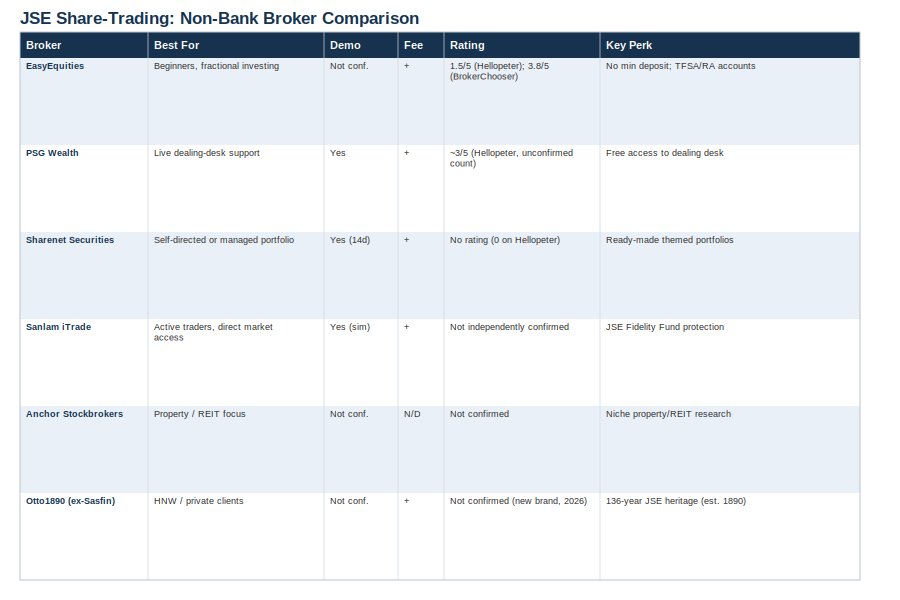
Comparison table of brokers in South Africa. July 2026
Provided table and detailed review of 6 brokers remind us that rating leaves investors with a difficult choice: low-rated brokers or unrated brokers who are simply not registered on rating sites.
What we really don't recommend for beginners is reading and delving into all the negative reviews. Highly rated brokers simply don't exist, as they are based solely on reviews from dissatisfied investors. Successful investors don't have time to write reviews - they simply count their profits and invest. Also, some good reviews may be blocked by rating sites, as their algorithms are set up according to the rule:
In this situation, we recommend sticking to a well-known strategy:
investments can carry a high risk of loss. When making a trade, conduct your own research based on your skills, testing and the data you can see on StockTalkSA.
Also, check out our bank reviews: you might find this method more convenient and reliable.

John Nkosi
John is from South Africa and know local financial market as it's own. He works directly for Stocktalk and responsible for making regular JSE market news.
Comments
Loading comments…
Log in or sign up free to join the discussion.