StockTalk Retrospective. Stefanutti stocks: a tough story with hopeful chapter.

John Nkosi

Stefanutti Stocks: a near-death story with a hopeful turn
South African construction group Stefanutti Stocks Holdings Limited (JSE: SSK) is one of the most striking examples in South African corporate history of a major business that went from undisputed leadership through a deep crisis and the threat of liquidation to a full-fledged financial recovery.
The story of this company is more reminiscent of an ordinary person's life than the development of a major business, its struggle for survival, its resistance to serious illnesses, and its ability to survive despite debt and tax obligations. History and Golden Age.
The company's origins date back to 1971, when Gino Stefanutti founded the construction firm, Stefanutti Bressan. The company grew rapidly, specializing in complex engineering structures, concrete work, and industrial construction. In 2008, a key merger occurred with major contractor Stocks Building, resulting in the creation of the Stefanutti Stocks brand. That same year, the combined group was listed on the Johannesburg Stock Exchange (JSE). The company has grown into a giant with multibillion-dollar contracts, operating not only in South Africa but also in Mozambique, Namibia, Botswana, and Mauritius.
Stefanutti Stocks and the 2008 Global Crisis.
In 2008, amid the global financial crisis that devastated numerous construction companies worldwide, Stefanutti Stocks escaped unscathed. It was at this time that the lucrative merger mentioned above took place. Furthermore, since South Africa hosted the 2010 FIFA World Cup, the company received lucrative contracts to build infrastructure for the tournament. The government spared no expense in financing. South Africa became an island of stability for the construction business, and for Stefanutti Stocks, this was one of its best periods.
The company chose an opportune time to list on the Johannesburg Stock Exchange (JSE). The merger and listing allowed it to attract a huge amount of cash from investors. With excess liquidity and minimal debt, the company was fully protected from the credit crunch that was then engulfing developers in the US and Europe. This promised the company great prospects: entry into new markets that became free after the crisis.
Stefanutti stocks 10 years ago.
The company was growing larger, more bureaucratic, and demanding greater liquidity. At the same time, government contracts were cut compared to what the company could have secured during the country's preparations for the World Cup. This had already bankrupted many competitors. Eskom's new contract for the construction of a Kucile combined heat and power plant seemed like the long-awaited ticket to the future. Shares rose again on news of a new, lucrative contract. In reality, this contract turned out to be a trap and nearly destroyed the company, which had successfully operated for almost 50 years. Due to constant project changes by the client, delays, and management chaos, Stefanutti Stocks incurred enormous uncompensated expenses. Huge commercial claims accumulated, which Eskom refused to pay.
In July 2020, Stefanutti Stocks found itself in a severe working capital crisis. Trading of the company's shares on the JSE was temporarily suspended. A traditional liquidation was avoided by the launch of a large-scale restructuring plan, agreed upon with a group of creditors led by Standard Bank.
Compared to a living person, the company was effectively in intensive care after a turbulent youth and long, hard work. The company faced multiple surgeries with dubious chances of recovery.
Litigation, restructuring, and recovery lasting approximately five years.
The business rescue measures lasted approximately five years and included:
- Asset sales (disposals): The Group systematically divested foreign and non-core divisions. For example, at the end of 2025, the sale of a profitable but heavily collateralized stake in Al-Tayer Stocks (UAE) was completed, and operations in Mozambique (SS-Construções) and Mauritius were closed. The goal was to focus on marginal projects within South Africa.
- Settlement agreement with Eskom (November 2025): A historic breakthrough. The company signed a final agreement for the Kusile Thermal Power Plant, securing a payment of R580 million (ZAR). This resulted in a net profit after tax of R492 million (ZAR) and concluded years of legal proceedings.
- New loan agreement: On October 31, 2025, the old, stifling agreements with creditors were cancelled. The company entered into a new 5-year loan agreement with Standard Bank for R850 million at a market-based 3-month JIBAR + 3.5%. By January 2026, thanks to the influx of funds from Eskom and the sale of assets, this debt was quickly reduced to R250 million, cutting interest expenses by 70%.Stefanutti stocks today.
Stefanutti's financial recovery with explosive growth.
As of May 27, 2026, the shares traded in the range of 6.90 - 7.12 ZAR. Over the past year, the stock has gained more than 66.83%, and since the beginning of 2026 (YTD), it has grown by 55.68%, entering the top 5 best-performing stocks on the JSE by year-to-date growth. By comparison, just a year ago in May, the shares were worth around 3.05 ZAR, and during the worst of the crisis, they were worth cents. Thus, Stefanutti shares turned out to be a kind of cryptocurrency that no one believed in anymore, but their value has skyrocketed tenfold. The market capitalization is approximately R1.34 billion. According to the annual report for the financial year ending February 28, 2026, published yesterday (May 26, 2026), the group's financial health has improved dramatically: ⦁ Operating profit increased by 107% ⦁ Net profit for the year increased by 202% ⦁ Total order book increased by 100%
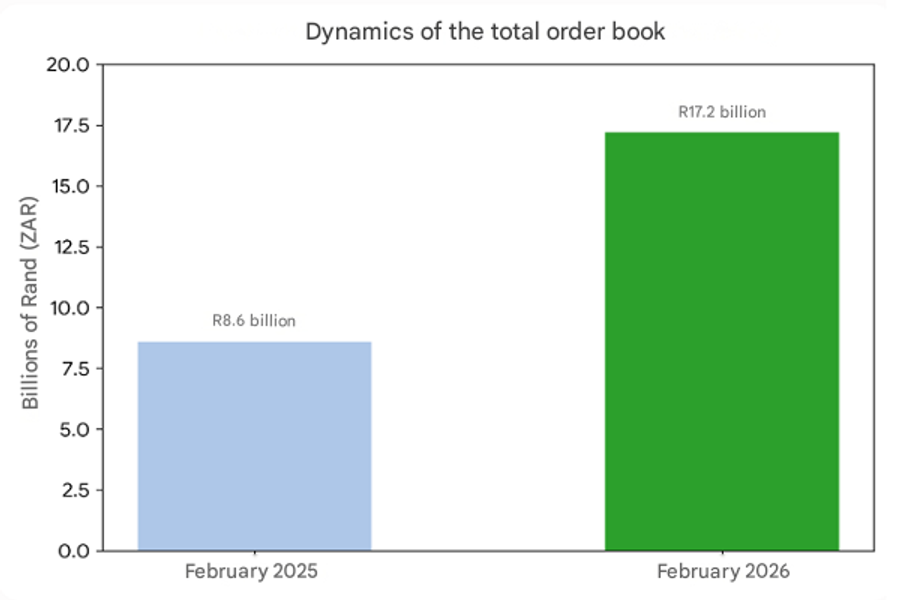
Stefanutti stocks, order book 2025 vs 2026
The 2026 portfolio structure shows that Stefanutti Stocks is shifting away from potentially risky megaprojects (like the Kusile Thermal Power Plant) toward more flexible and diversified sectors—road construction, mining services, data center construction, and alternative energy facilities. Half of the entire portfolio (R8.5 billion) is long-term, with contracts maturing beyond 2027.
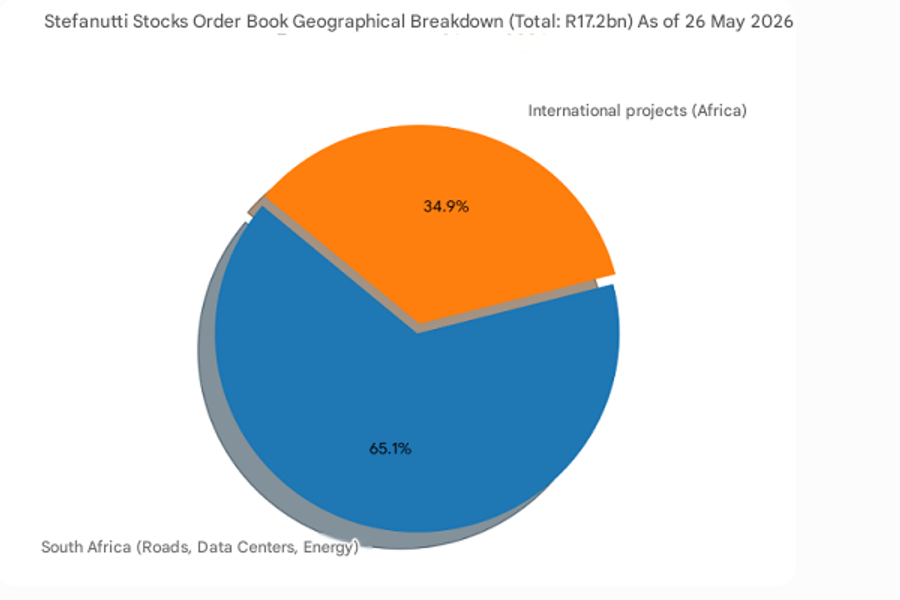
Stefanutti stocks geographical breakdown, May 2026
Technical and fundamental overview.
It sounds strange and even amusing, but the restructuring, disputes, and all the accompanying positive processes have become a powerful driver of the company's stock, lifting it from the bottom to the stars.
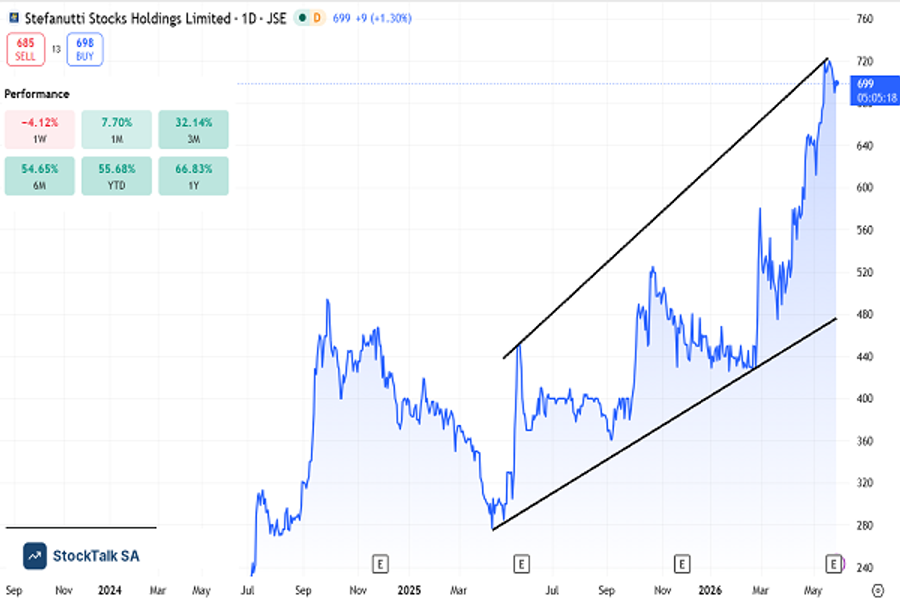
Stefanutti stocks (JSE: SSK) price chart, D1, May 2026
The chart shows a rapidly developing uptrend. The resistance line shifted significantly upward in May on news of the actual completion of the recovery process and a strong financial report. Oscillators and moving averages are signaling a buy signal.
From a fundamental analysis perspective, things aren't so clear-cut. The company's specialization in large infrastructure projects leaves Stefanutti stocks dependent on government contracts and orders from large corporations. This presents both risks and opportunities, as Africa as a whole is a territory in need of construction across all fronts, from roads to factories and plants. However, it was precisely this large-scale project that nearly destroyed the company.On the other hand, having survived all the vicissitudes of hell, the company has acquired a certain immunity, which could help Stefanutti stocks better navigate future challenges. Furthermore, the company demonstrates that it is well-positioned for new large projects lasting several years. Therefore, investors are optimistic, and the stock's growth indicates demand.
Summary
Stefanutti Stocks is a company with a checkered and troubled history. Many investors are wary of holding such assets in their portfolios and view the company with distrust. The lack of dividends, small market cap, and low net margins reduce its appeal. The company has just moved from the category of "highly speculative, toxic asset on the verge of closure" to the category of "healthy business with a clear strategy." This may make the shares undervalued today, and this status can be considered a buy signal.
Disclaimer: This material is for informational purposes only. All investments involve risk, and past performance is no guarantee of future results. Upon investing do your own research. Author isn't responsible of consequences of following or not following recommendations, if found in the article.

John Nkosi
John is from South Africa and know local financial market as it's own. He works directly for Stocktalk and responsible for making regular JSE market news.
Comments
Loading comments…
Log in or sign up free to join the discussion.