StockTalk Retrospective. Texton: A Story That Could End Like a Good Movie

John Nkosi

A Quiet Beginning (2005–2011)
Every good story starts small, and this one starts in an office park in Sandton. The fund's roots trace back to 2006, but it didn't reach the Johannesburg Stock Exchange until 2011. Back then it wasn't even called Texton: it listed as the Vunani Property Investment Fund, a name still echoed in the company's registered address at Block D, Vunani Office Park.
The ambition was the standard one for the genre: become a leader in capital allocation across property classes, diversifying by sector and geography to smooth out returns. For a while, it worked at scale. By 30 June 2017, the portfolio held 43 properties in South Africa worth R3.4 billion and eleven in the United Kingdom worth R2.1 billion - roughly R5.4 billion of assets spanning office, retail, and industrial across two countries.
On paper, this was a serious diversified REIT. In fact it was dependent on office property value which fall in 2020 upon Covid period. The problem was hiding in the mix.
Texton's Years When Everything Went Wrong
What makes the ending dramatic is how long the middle dragged. Texton had a hard time, and the trouble started before the pandemic: much of it rooted in the UK side of the portfolio. Then came the global reckoning for office space. And office was exactly where Texton was most exposed: by gross lettable area, the portfolio is about 87.5% offices, the single asset class that suffered most after 2020.
The numbers tell the decline without mercy. From R5.4 billion of assets in 2017, the fund shrank to a direct property portfolio of R1.9 billion by 30 June 2025 (down from R2.1 billion the year before). On the exchange it was brutal: by mid-2025 the share was down roughly 18.75% over one year, 31.58% over three years, and 63.89% since its IPO. Translated out of market-speak: anyone who believed in this story from the listing had lost almost two-thirds of their money. Analysts were blunt about it: the stock traded thinly, and there were better property plays on the JSE.
But under the hood, something important was happening. Management was repairing the balance sheet: selling assets, paying down debt. The loan-to-value ratio fell to 14.7% on the back of debt repayments from asset sales, and the interest cover ratio improved to 2.1x. The fund was getting smaller, but cleaner and sturdier. That quiet repair job is exactly what turned it into a target.
The Hero Arrives
Every good story needs some hero, who sees what everyone else has missed. Here it's Heriot REIT and its founder, Steven Herring, known as a shrewd dealmaker with strong property DNA and a knack for spotting undervalued assets with turnaround potential. While the market was writing Texton off, Herring was quietly accumulating: over about two years, Heriot built a stake of roughly 25%.
Then the ultimatum arrived. In November, the consortium proceeded with a mandatory offer to all shareholders at R1.20 per share in cash, and continued the mandatory-offer process into January. The discount to net asset value that the market had ignored for years had finally found a buyer willing to pay for it.
Texton's Turn: A Share Price That Doubled, and Why?
Here's the part that looks like a paradox. A stock that had fallen for years suddenly surged. As of early June 2026, TEX traded around 450c, up about 72% in a single day from a previous close of 262c. The analytics aggregators flipped their tone to "Strong Buy" with a price target near 680c.
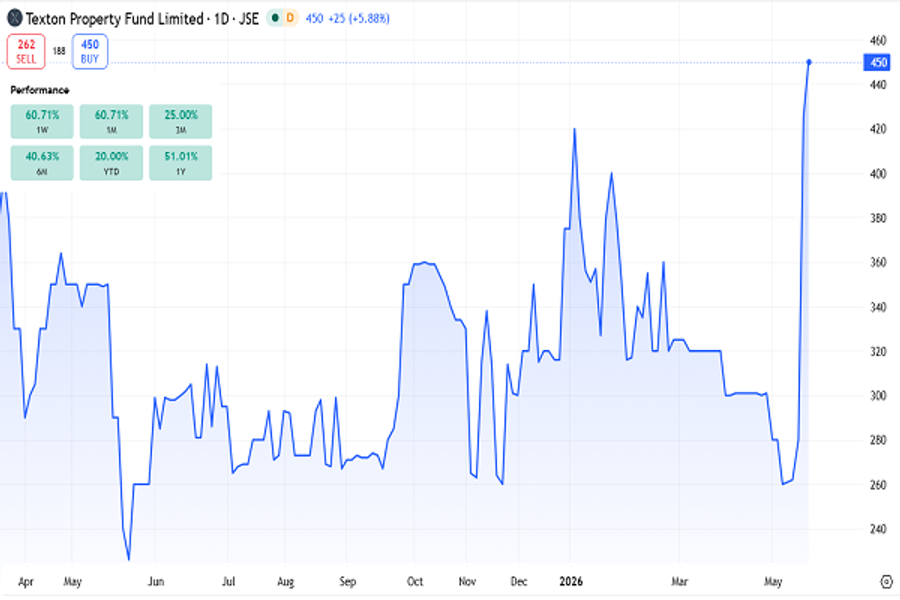
Texton (JSE: TEX) price chart, June 2026
Why Texton shares climb if a delisting could follow?
Because a takeover delisting and a bankruptcy delisting are two completely different events and confusing them is the most common mistake retail investors make.
A bankruptcy wipeout is when a company collapses, assets fail to cover debts, shares are cancelled, and holders get nothing. Texton is nowhere near that: with an LTV of just 14.7% and an ICR of 2.1x, this is a low-debt fund sitting on real property. It isn't going broke, it's being bought.
A takeover delisting is the opposite: a buyout, usually at a premium. The price rises precisely because a buyer, the Heriot consortium is paying cash to take the shares off the market. For years the stock traded at a deep discount to the value of its underlying property. A strategic buyer showed up and said, in effect, "I'll pay for that." The market instantly re-rated the share from "price of a tired office REIT" to "price someone is actually willing to pay." The rally is the discount closing.
For a shareholder, then, a delisting here doesn't mean zero - it means a forced sale for cash. The question isn't "will I lose everything," it's "will I be paid a fair price, and could I get stuck along the way." And that's where the real risk lives, in three forms:
- The buyout price is below fair value. The buyer wants to pay as little as possible; the minority wants as much as possible. Mandatory-offer rules exist to protect minorities and require a premium for control — but "a premium" is not the same as "full NAV."
- Getting trapped in limbo (the worst case). If the consortium reaches, say, 70–85% but stops short of the ~90% threshold that triggers compulsory acquisition of minorities at the offer price, the company can be delisted or left with a tiny free float. You'd be holding shares almost nobody will buy at a sensible price — not zero, but illiquid and stranded.
- The deal collapses entirely. Then the premium evaporates and the share falls back toward its dreary pre-bid level. Anyone who bought the spike books a loss.
The Ending That Hasn't Been Written
This is why it's "a story that could end like a good movie" — the ending depends on which scene gets filmed next.
The good ending: the consortium clears the threshold, buys everyone out at a fair, premium price, a long-suffering holder finally recovers part of what was lost, and the curtain falls.
The bitter ending: the free float collapses, minorities are left holding illiquid paper, and the delisting goes through at a price that disappoints.
For readers, the honest takeaways are simple. This is not a buy-and-hold growth story. The upside is capped at whatever the consortium pays, and the share structurally can't go higher than that. Buying after a one-day surge of ~72% isn't investing; it's betting on the outcome of an arbitrage.
Editorial note: As of this writing, no public confirmation of a delisting had appeared in open sources - the deal's status remained open.
This article is part of the StockTalk Retrospective series. It is for information and educational purposes only and is not financial advice. Always do your own research and consider seeking advice from a licensed professional.

John Nkosi
John is from South Africa and know local financial market as it's own. He works directly for Stocktalk and responsible for making regular JSE market news.
Comments
Loading comments…
Log in or sign up free to join the discussion.