Trading Robots, EA and AI: Can You Trust them Your Money?

Automated trading existed long before everyone started talking about artificial intelligence. In forex and CFD markets, Expert Advisors (EAs) have been in use since the mid-2000s, when the MetaTrader 4 platform became the standard for retail brokers.
The principle is simple. A programmer takes a trading strategy, such as a moving-average crossover, a level breakout or a set of technical indicators, and turns it into code. The EA then opens and closes trades on its own according to those rules, with no human involved. These programs were and still are sold to people who lack the skills or time to trade themselves but have the desire and the funds.
It sounds tempting: buy a robot, switch it on, and it trades for you around the clock, free of emotion and fatigue. In this review we look at whether an EA is the key to success, whether it helps you avoid mistakes, and whether it can trade as effectively as the most experienced traders.
What an Expert Advisor is and why it is risky?
An EA is a program built into the trading terminal. In MetaTrader, EAs are written in MQL4 and MQL5, and ready-made ones can be bought or rented on the official MQL5 Market, on third-party sites or directly from developers. The tool is well known and in demand: it removes routine work, never gets tired, and never breaks its own rules out of fear or greed.
But automation has a downside.
- Wrong settings. An EA does exactly what it is told. A mistake in lot size, a missing stop-loss or the wrong instrument can turn even a decent strategy into a source of losses.
- Ineffective and questionable algorithms. Many EAs are built on aggressive schemes such as martingale (doubling the position after every loss) or grid trading without risk limits. Such systems can show steady growth for months, then wipe out the entire deposit in minutes during a sharp market move.
- Fraudulent bots. This is probably the biggest risk. Pyramid schemes are often sold as “a robot that makes money by itself”. A telling example for South African investors is Mirror Trading International (MTI). The company claimed its automated trading bots generated consistent profits of an average of 10% per month, yet it was not licensed for that business, and the FSCA advised clients to withdraw their funds as soon as possible. MTI’s former broker, FX Choice, refuted the claims about AI and bot trading, saying MTI executed only a few trades, and those were done manually. The US regulator CFTC later described MTI as a $1.7 billion Ponzi scheme in which little actual trading took place, and its CEO Cornelius Johannes Steynberg was ordered to pay over $3.4 billion. According to the CFTC, Steynberg also created fake customer accounts and balances using MetaTrader demo accounts.
- Risk of being banned by the broker. Aggressive EAs can open hundreds of trades a minute and overload the broker’s server. In addition, many brokers’ terms prohibit certain strategies, such as latency arbitrage or tick scalping. Breaking the rules can lead to cancelled profits or a closed account. Before running any EA, read your broker’s client agreement.
Finally, keep the bigger picture in mind: CFD trading is high-risk in itself. Analysis by EU national regulators shows that 74-89% of retail accounts typically lose money on CFDs, with average losses per client ranging from €1,600 to €29,000. An EA does not change these numbers; it only automates the decisions.
What changed with AI?
Artificial intelligence has mainly lowered the barrier to entry. Building an EA used to require knowing MQL or hiring a programmer. Today, language models can write working code from a plain-text description of a strategy, explain errors and help refine the algorithm. A trader can build their own EA that takes more conditions into account, manages positions more carefully and adapts more flexibly to changing markets.
There are, however, several important caveats.
- AI makes mistakes. Code written by a model can contain logic errors that are invisible at a glance: a wrong position-size calculation, a missing exit condition, poor handling of price gaps. On a live account, such an error costs money.
- Markets remain unpredictable. No algorithm knows the future. The US regulator says so directly: the CFTC advisory reminds investors that AI technology cannot predict the future. News, central bank decisions, geopolitics and unexpected events break any historical pattern.
- Risk of overfitting. AI makes it easy to “optimise” a strategy so that it looks perfect on past data. But a strategy tailored perfectly to the past often fails in the future.
- “AI” has become a marketing lure. Fraudsters picked up the new theme quickly. As the CFTC observes, with the growth of AI in everyday life, scammers claim it can generate huge returns using bots, trade signal algorithms and crypto-asset arbitrage algorithms. In South Africa the regulator sees the same trend: the FSCA warned about a deepfake video on WhatsApp falsely showing FSCA Commissioner Unathi Kamlana endorsing a fraudulent AI trading tool.
The bottom line: AI makes building EAs more accessible and potentially smarter, but it does not turn them into a guarantee of profit.
How to use an EA: a strategy
If you still decide to try automated trading, treat an EA as a tool, not a source of passive income. Here are the basic rules.
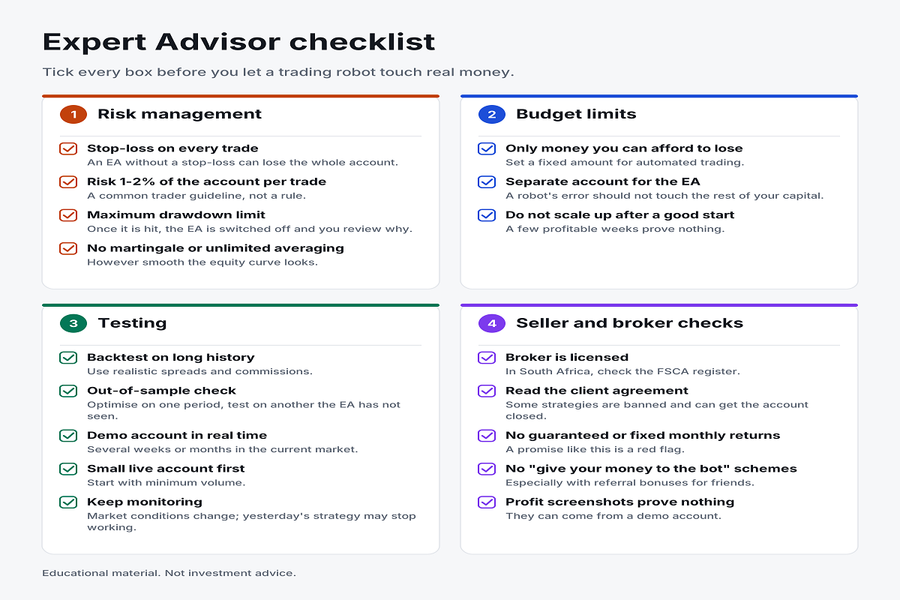
1. Risk management
- Every trade needs a stop-loss. An EA without a stop-loss puts the whole account at risk.
- A common rule among traders is to risk no more than 1-2% of the account on a single trade. It is a guideline, not a law, but it helps you survive a losing streak.
- Set a maximum drawdown limit; once it is reached, the EA is switched off and you investigate the cause.
- Avoid martingale systems and unlimited averaging, however attractive their equity curves look.
2. Budget limits
- Set aside a fixed amount for automated trading that you can afford to lose.
- A separate account is best, so that a robot’s error does not affect the rest of your capital.
- Do not increase your stake after the first few good weeks: a short profitable run proves nothing.
3. Testing
- Backtesting. MetaTrader has a built-in strategy tester. Test the EA over a long stretch of history with realistic spreads and commissions.
- Out-of-sample check. Optimise the parameters on one period and test on another the EA has never “seen”. If results drop sharply, the strategy is most likely overfitted.
- Demo account. A few weeks or months of real-time demo trading will show how the EA behaves in the current market.
- Small live account. Only then move to real money, starting with minimum volume.
- Ongoing monitoring. Even a tested EA needs supervision. Market conditions change, and a strategy that worked a year ago may stop working.
4. Checking the seller and the broker
- Check that the broker is licensed by a regulator. For South African investors this means an FSCA licence, which can be verified on the regulator’s website.
- Be wary of promises of fixed monthly returns or guaranteed profit, requests to transfer money “to the bot”, and bonuses for bringing in friends.
- Profit screenshots prove nothing: as the MTI case showed, they can be produced from a demo account.
Conclusions
An Expert Advisor is not a key to success and will not turn a beginner into an experienced trader. It is an automation tool: it executes its built-in strategy precisely and without emotion. If the strategy is weak, the EA will simply lead to losses faster and with more discipline.
Artificial intelligence has made building EAs more accessible and the algorithms potentially more flexible. But AI does not remove the main risks: coding errors, overfitting, market unpredictability and fraudsters who use the fashionable word “AI” as bait.
Anyone who wants to try automated trading should start by understanding the strategy, applying strict risk management, limiting the budget and testing for a long time. Any promise of “a robot that makes money by itself” should be treated as a reason to investigate, not a reason to invest.
This material is for educational purposes only and does not constitute investment advice.

Thandiwe Mbeki
Graduated from the University of Cape Town (UCT) with a degree in Financial Mathematics and Economics, after which she earned the CFA (Chartered Financial Analyst) designation. Rose through the ranks from an equity trader to an institutional investment portfolio manager. For the past 7 years, Thandiwe has been teaching investment with use of her own researched programs.
Comments
Loading comments…
Log in or sign up free to join the discussion.