USD/ZAR: fundamental review & forecast

John Nkosi
USD/ZAR Forecast 2026: Key Features and Trading Dynamics Nowadays
The USD/ZAR currency pair remains one of the most compelling instruments in the forex market, capturing the attention of international investors, swing traders, and tourists alike. But what makes South African Rand trading so attractive to the global financial community? The answer lies in its characteristic high volatility, deep liquidity, and a unique blend of predictable macroeconomic cycles paired with emerging market risks.
Below, we break down the historical performance of the USD/ZAR exchange rate, its recent price correction, and the fundamental drivers shaping the market in June 2026.
The Broader Trend: How ZAR Gained the Upper Hand
Since April 2025, the USD/ZAR currency pair has been locked in a definitive, long-term downward trend, heavily favoring the South African Rand (ZAR). This macro shift can be attributed to a combination of external global pressures and shifting domestic fundamentals:
- Global US Dollar Softness: Global sentiment shifted as market participants adjusted to shifting political and economic landscapes in the United States, including expectations surrounding trade and loose monetary policy paths.
- South Africa’s Structural Rebound: On the domestic front, the South African economy began flashing strong macroeconomic recovery signs. A major turning point was the stabilization of the country's power grid, with state utility Eskom achieving a historic milestone of over 300 consecutive days without rolling blackouts (load shedding). This eliminated a multi-year structural bottleneck, boosting productivity and investor confidence.
- Commodity Boom: As a premium commodity-linked currency, the ZAR found immense support in rallying global resource prices. Surging demand and higher prices for precious metals, gold, and platinum-group metals (PGMs) significantly improved South Africa’s terms of trade, ensuring a steady influx of hard currency.
Market Dynamics: The 2026 Price Correction
Q1 2026: The USD Fights Back
The first quarter of 2026 triggered a healthy and much-needed price correction for the pair. After a prolonged downtrend, the market hit a temporary exhaustion point near the psychological 15.80–16.00 zone.
Traders aggressively rotated back into the USD as a string of resilient economic data emerged from the United States. Concurrently, initial market expectations for immediate and aggressive policy rate cuts by the Federal Reserve failed to materialize. This prompted a global reassessment of the greenback, sparking a corrective rally that pushed the USD/ZAR chart back up toward the 17.20 level.
Q2 2026: The Rand Regains Momentum
The dollar's dominance proved short-lived. By the second quarter of 2026, the South African Rand reclaimed its bearish momentum on the pair.
Global rating agencies, including Fitch and S&P, highlighted positive structural developments within the South African economy, noting the pragmatic fiscal discipline enforced by the Government of National Unity (GNU). Furthermore, renewed domestic inflation concerns forced the South African Reserve Bank (SARB) to adopt a more hawkish stance, ultimately raising the repo rate to 7.00%. The prospect of high real yields reignited lucrative carry trade flows, sending USD/ZAR back down.
Fundamental Disconnect: ZAR Resilience Today
Today, we are witnessing a fascinating divergence in the forex markets. The US Dollar is flexing its muscles globally, supported by robust safe-haven demand and a strong US Manufacturing and Services PMI—which hovers roughly 4 points higher than South Africa’s equivalent indices. Under normal market conditions, this macro yield gap would trigger a sharp sell-off in emerging market currencies.
Yet, the ZAR exchange rate today is defying the odds. Despite the widening business activity gap, the Rand continues to hold its ground stubbornly. The primary anchor preventing a ZAR sell-off is the ongoing rally in spot gold prices. As geopolitical tensions simmer globally, gold acts as a sovereign shield for South Africa's trade balance, absorbing the broader dollar strength.
Technical Analysis & USD/ZAR Forecast
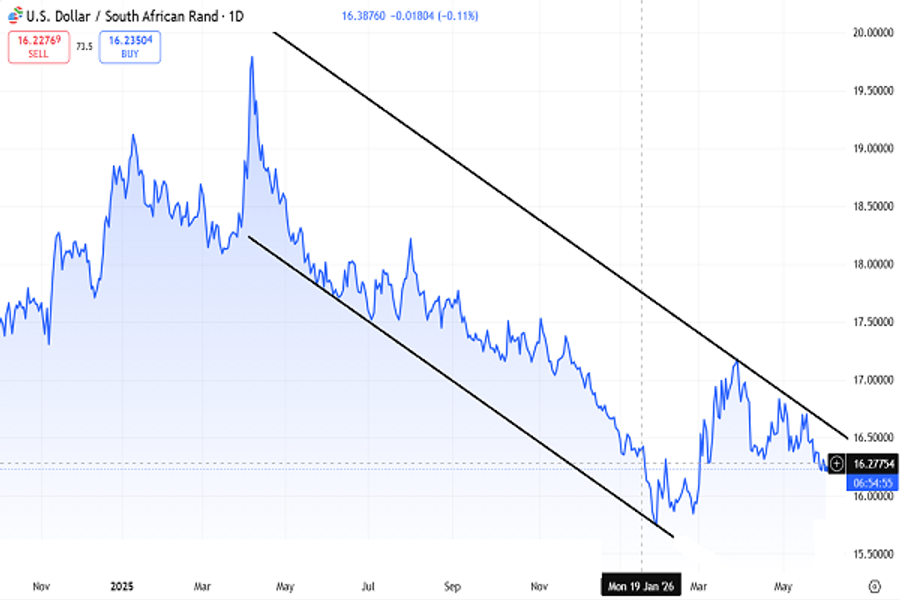
USD/ZAR chart, D1, June 2026
From a technical perspective, daily and weekly indicators are flashing a unanimous
signal for the pair. Entering June 2026, USD/ZAR is retesting key technical support shelves not seen since late 2022, when the dollar hovered around the 15.00–15.50 ZAR threshold. If current macro tailwinds persist, a retest of these cyclical multi-year lows remains highly probable.
Key Economic Events to Watch:
- South African Q1 GDP Data: Crucial for confirming whether the lack of load shedding has successfully translated into hard macroeconomic growth.
- US CPI Inflation & Unemployment Numbers: Key metrics that will dictate the Fed’s next move regarding interest rates and drive the DXY index.
- Geopolitical Risk (Strait of Hormuz): Escalating tensions in international shipping lanes present a double-edged sword. While it drives safe-haven flows to the dollar, it also accelerates the commodity and oil price shock, which directly impacts inflation differentials between the US and South Africa.
Trading Verdict: As long as South Africa’s structural reforms hold steady and commodity prices remain elevated, shorting the bounces on USD/ZAR remains the dominant institutional play.

John Nkosi
John is from South Africa and know local financial market as it's own. He works directly for Stocktalk and responsible for making regular JSE market news.
Comments
Loading comments…
Log in or sign up free to join the discussion.